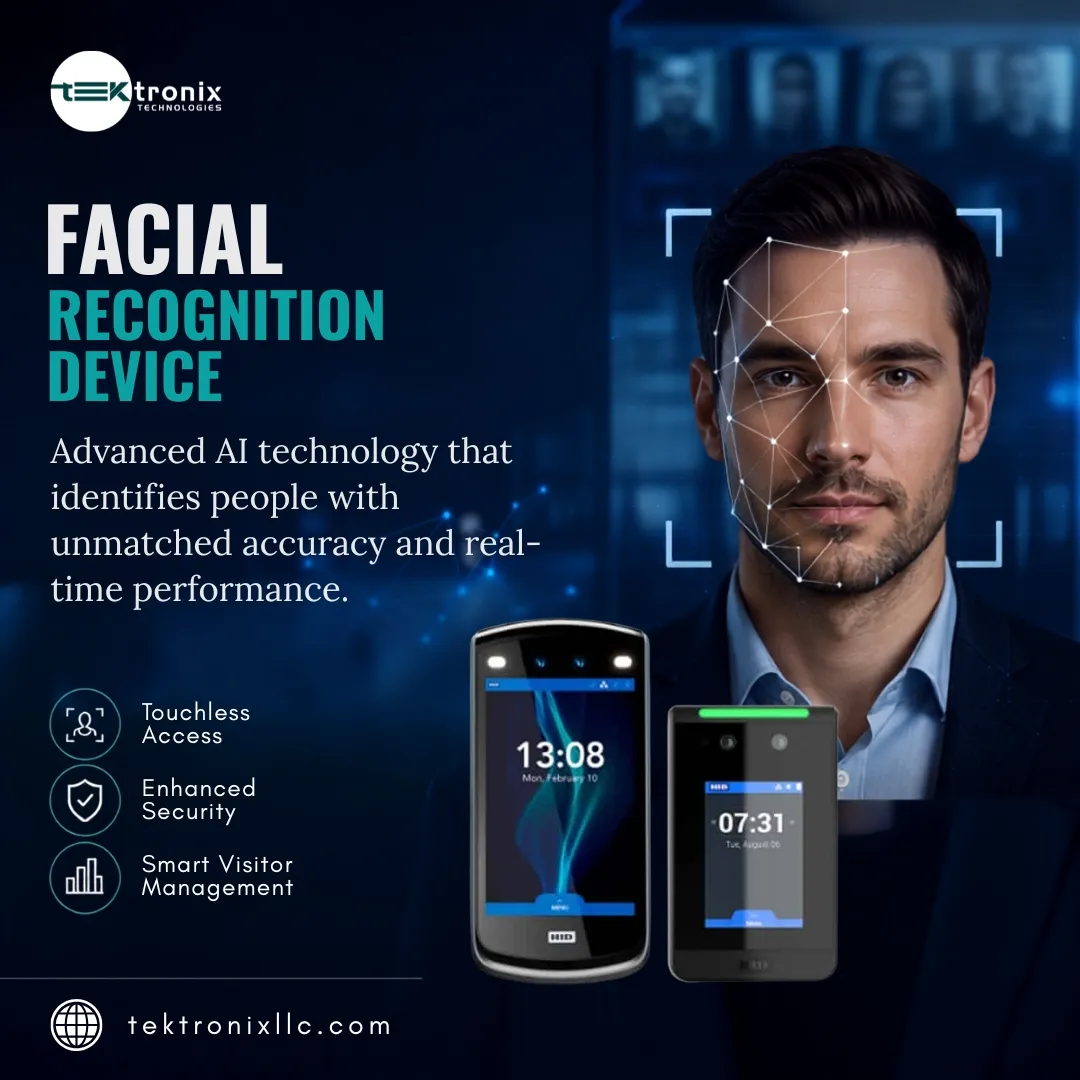

The corporate security landscape across Oman and the broader Gulf region is undergoing a fundamental shift, and the Facial Recognition System is at the centre of that transformation. Modern workplaces — from Muscat’s financial district towers and energy sector campuses to Riyadh’s NEOM-adjacent business hubs, Dubai’s DIFC, and Doha’s Lusail City commercial precincts — are replacing legacy card-based access infrastructure with intelligent biometric systems that verify identity in milliseconds, generate forensic-quality audit trails, and eliminate the credential management burden that plagues traditional physical security programmes. For organisations ready to make the transition, enterprise facial recognition access control solutions purpose-built for the GCC’s regulatory environment and operational demands represent the most significant advancement in corporate security technology of the past decade.
Why GCC Corporate Workplaces Are Prioritising Biometric Security Now
The convergence of three regional trends is accelerating biometric adoption across the GCC’s corporate sector. First, national digital transformation agendas — Oman Vision 2040, Saudi Vision 2030, UAE Centennial 2071, and Qatar National Vision 2030 — are driving governments and the state-linked enterprises that dominate each economy to adopt technology standards consistent with their smart nation ambitions. Physical security infrastructure is explicitly included in these modernisation mandates, with biometric identity verification at workplace entry points forming part of the broader national identity and credentialing ecosystem.
Second, the GCC’s role as a hub for multinational corporate regional headquarters means that global enterprise security standards — set by parent organisations in the United States, Europe, and Asia — are being applied to Gulf facilities. ISO 27001 information security management requirements, SOC 2 Type II compliance obligations for technology companies, and PCI DSS physical security controls for financial services all increasingly specify biometric or multi-factor physical access control as minimum standards for sensitive facility zones. Third, the regional cyber-physical security threat environment is intensifying, with insider threat incidents, credential-based breaches, and social engineering attacks targeting corporate access control systems at a frequency that makes legacy card-based systems an unacceptable risk for any organisation managing valuable people, data, or assets.
Facial Recognition Access Control: The Architecture of Intelligent Identity Verification
Facial Recognition Access Control replaces the two-part credential verification process of traditional access control — presenting a card or PIN, then the system checking it against a database — with a single, unified biometric verification step that simultaneously captures identity evidence and makes the access decision. The individual approaches the access point; the system identifies them; the door, turnstile, or barrier opens. No card to present, no PIN to remember, no interaction required.
The architecture supporting this interaction has three distinct layers. The hardware layer — the camera, processor, and physical access mechanism — captures the biometric data and executes the physical access decision. The identity layer — the biometric matching engine and enrolled template database — performs the comparison and generates the match result. The policy layer — the access control management platform — applies the organisation’s access rules to the match result to determine whether the identified individual is authorised to access the requested zone at the current time. This three-layer architecture separates the concerns of identity, access policy, and hardware execution in a way that makes the system both more secure and more operationally flexible than any credential-based alternative.
Face Detection: How the System Finds and Frames Every Face
Face Detection is the foundational first step in the biometric verification pipeline — the process by which the system’s camera and image processing algorithms identify the presence and location of a human face within the camera’s field of view. Before any identity comparison can occur, the system must accurately locate the face, assess its quality (sufficient resolution, adequate lighting, acceptable angle), and extract a standardised facial region image for submission to the matching engine.
Modern face detection algorithms based on deep convolutional neural networks achieve detection speeds under 50 milliseconds and maintain reliable performance across a wide range of challenging real-world conditions: partial occlusion by glasses, scarves, or face coverings; significant variation in ambient lighting including the harsh direct sunlight common in GCC building approaches; faces presented at angles up to 45 degrees from perpendicular to the camera; and simultaneous detection of multiple faces within a wide-angle camera frame. For corporate access control deployments in Oman and across the GCC, where camera placement options may be constrained by lobby architecture, detection robustness across varied presentation angles is a particularly important performance criterion to verify during system evaluation.
Facial Identification: Matching Identity Across Thousands of Enrolled Records
Facial Identification is the one-to-many biometric search process that compares a newly captured facial image against an entire enrolled database to determine who the individual is, without any prior claim of identity from the subject. In a corporate access control context, facial identification is used at primary building entry points where the system must determine — from the full enrolled population of thousands of employees, contractors, and registered visitors — who is approaching the barrier.
The computational challenge of performing a one-to-many search across a database of tens or hundreds of thousands of enrolled templates in under 500 milliseconds has been solved through a combination of hardware acceleration (dedicated neural processing units on modern edge computing devices), algorithmic efficiency (approximate nearest-neighbour search methods that dramatically reduce the comparison space without sacrificing accuracy), and intelligent gallery management (pre-filtering the search population based on access point location, time of day, and expected presence). For GCC corporate campuses with large enrolled populations — a major oil company campus with 5,000 registered personnel, for example — these optimisations ensure that identification speed remains within acceptable bounds as the enrolled population scales over time.
Facial Authentication: One-to-One Verification for High-Security Zone Access
Facial Authentication is the one-to-one biometric verification process that confirms whether a specific individual — who has declared their identity through a prior action such as presenting an employee ID or entering a PIN — is actually who they claim to be. Rather than searching across the entire enrolled database, the system retrieves the single enrolled template corresponding to the claimed identity and compares it against the newly captured facial image.
Facial authentication is the appropriate verification method for high-security corporate zone access where the additional layer of declared identity provides a second factor of assurance beyond the biometric match alone. A financial institution’s treasury department, a pharmaceutical company’s-controlled substance storage room, or a technology company’s data centre server floor may each require employees to both present a credential (a smart card or mobile token that declares their identity) and pass a biometric facial authentication check before the door releases. This two-factor approach — something you have plus something you are — achieves the highest identity assurance level available in physical access control and is increasingly required by the international security standards that GCC enterprises are aligning with.
Facial Recognition Device: Hardware Engineering for Gulf Operating Conditions
Selecting the right Facial Recognition Device for a GCC corporate deployment requires evaluating hardware specifications against the specific environmental and operational challenges of the region. A device that performs flawlessly in a Northern European office building may deliver significantly degraded performance in a Muscat lobby where direct sunlight creates extreme contrast ratios, or in a Riyadh outdoor security checkpoint where summer air temperatures exceed 50°C.
Purpose-built GCC-grade facial recognition devices incorporate active infrared (IR) illumination that maintains consistent facial image quality regardless of ambient light variation — enabling reliable recognition from full darkness to direct sunlight without camera adjustment. Near-infrared (NIR) dual-sensor configurations capture both visible-light and infrared images simultaneously, providing the liveness detection engine with the multi-spectral data needed to defeat spoofing attacks while maintaining recognition performance under all lighting conditions. Thermal management systems — passive heat dissipation fins, active cooling where required, and motor controller thermal protection — ensure stable operation through the Gulf’s extreme summer heat cycles. IP65 or higher environmental sealing protects electronics from the fine particulate matter (dust and sand) that affects outdoor and semi-outdoor installations across the region.
Hardware Specification Checklist for GCC Corporate Facial Recognition Devices
- Dual NIR + RGB camera sensors for all-lighting recognition and liveness detection
- On-device neural processing unit (NPU) for sub-300ms identification without cloud dependency
- Operating temperature range: −20°C to +70°C for outdoor and semi-outdoor installations
- IP65 or IP67 environmental sealing for dust and moisture resistance
- ISO 30107-3 Level 2 anti-spoofing certification: defeats photos, videos, and 3D masks
- Wiegand, OSDP, and RS-485 output interfaces for legacy access control panel integration
- PoE+ power delivery (802.3at) eliminating separate power cabling requirements
- Encrypted biometric template storage with tamper-evident audit logging
Facial Recognition Software: The Intelligence Engine Behind the Hardware
Facial Recognition Software is the algorithmic and management platform layer that transforms captured facial images into identity decisions and translates those decisions into access control actions. The software stack encompasses the biometric matching engine (the deep learning model that generates and compares facial feature vectors), the identity management platform (the database and administration console that manages enrolled templates, access policies, and event logs), and the integration middleware (the APIs and protocol adapters that connect the biometric system to the broader corporate technology ecosystem).
The matching engine is the performance-critical component, and significant differences exist between leading and lagging software platforms in the accuracy metrics that matter most for corporate access control: False Acceptance Rate (FAR) — the probability that an unauthorised person is incorrectly granted access — and False Rejection Rate (FRR) — the probability that an authorised person is incorrectly denied access. Top-tier algorithms tested under NIST’s Face Recognition Vendor Test (FRVT) programme achieve FAR rates below 0.01% at FRR rates below 1% across diverse demographic groups, delivering both the security assurance and the operational convenience that corporate deployments require. Insisting on NIST FRVT benchmarked algorithm performance is the single most important technical requirement that procurement teams in Oman and across the GCC should include in their vendor evaluation criteria.
The management platform’s capabilities determine the operational efficiency of the deployed system. Features including bulk enrolment workflows for large employee populations, automated credential synchronisation with HR systems through Active Directory or SCIM protocol integration, role-based access policy engines that link access authorisation to HR position and department classifications, and real-time dashboard monitoring with anomaly detection alerting are the characteristics that distinguish an enterprise-grade platform from a facility-level system masquerading as one.
Facial Recognition Solution: End-to-End Deployment for Corporate Environments
A complete Facial Recognition Solution for a GCC corporate workplace encompasses hardware, software, network infrastructure, integration services, enrolment management, compliance documentation, and ongoing maintenance — not merely the purchase of camera units and a software licence. Organisations that evaluate biometric access control as a product purchase rather than a managed solution deployment consistently underestimate the integration complexity, change management requirements, and ongoing operational needs that determine whether a deployment succeeds or stalls.
A structured solution delivery methodology begins with a site assessment that documents the physical access points, network infrastructure, HR system architecture, and regulatory compliance requirements specific to the organisation’s Omani or GCC operating environment. System design translates these requirements into hardware specifications, software configuration parameters, integration architecture diagrams, and network design that together form the blueprint for the deployment. Installation and commissioning establish the physical hardware, configures the software platform, tests all integrations, and validates system performance against the accuracy and throughput benchmarks agreed during the design phase. Enrolment management — capturing and validating the facial templates for every person in the enrolled population — is frequently the most logistically complex phase of a large deployment and requires careful planning to execute without disrupting the organisation’s daily operations. Ongoing managed services — covering remote monitoring, algorithm updates, model retraining as the enrolled population changes, and preventive hardware maintenance — sustain performance across the system’s operational life.
Facial Recognition System Oman: Regulatory Context and Sector Applications
Facial Recognition System Oman deployments operate within a regulatory framework that combines national data protection legislation — Royal Decree No. 6/2022, Oman’s Personal Data Protection Law — with sector-specific physical security requirements from the Royal Oman Police, the Ministry of Interior, and industry regulators including the Central Bank of Oman for financial institutions and the Telecommunications Regulatory Authority (TRA) for telecommunications operators. Responsible deployment requires establishing a lawful basis for biometric data processing under the PDPL, conducting a Data Protection Impact Assessment (DPIA) before go-live, and implementing technical controls including encryption, access control, and data minimisation that satisfy both the letter and the spirit of the law.
Oman Sector Applications
- Petroleum Development Oman (PDO) and OQ Group corporate campuses: multi-zone biometric access replacing contractor badge systems across upstream and downstream facilities
- Bank Muscat, National Bank of Oman, and financial sector HQ buildings: biometric vault and data centre access aligned with Central Bank of Oman physical security standards
- Knowledge Oasis Muscat (KOM) and OTSP technology campuses: frictionless employee access supporting talent attraction and retention in competitive technology sector hiring markets
- Muscat Municipality and Ministry buildings: citizen-facing service centre access management aligned with Oman’s national digital identity infrastructure
- Duqm Special Economic Zone and Sohar Free Zone industrial facilities: multi-category personnel access management for complex contractor and visitor populations
Facial Recognition System GCC: Regional Deployment Landscape
Facial Recognition System GCC adoption is accelerating across all six-member states of the Gulf Cooperation Council, with each market presenting a distinct regulatory environment, technology infrastructure maturity level, and primary demand driver that shapes how deployments are structured and delivered.
Saudi Arabia
Saudi Vision 2030’s giga-project portfolio — NEOM, Diriyah Gate, Red Sea Project, and Qiddiya — is generating some of the world’s largest biometric access control deployment requirements, with workforce populations in the tens of thousands across single project sites. SAFCSP (Saudi Federation for Cybersecurity, Programming and Drones) guidelines and NCSC physical security standards are defining the technical baseline for biometric system deployments at government-linked facilities.
UAE
The UAE’s advanced national biometric identity infrastructure — anchored by the Emirates ID system and the ICP’s biometric border control programme — provides a sophisticated backdrop for corporate biometric deployments. DIFC and ADGM-regulated financial institutions face specific physical security requirements from their respective regulatory authorities, while Dubai’s Emiratisation-driven corporate sector growth is accelerating demand for enterprise-grade biometric access platforms in newly established commercial districts including Dubai South and Expo City.
Qatar
Qatar’s post-World Cup infrastructure legacy includes some of the region’s most advanced sports, hospitality, and commercial facilities, all requiring ongoing access control management at the enterprise level. QFC (Qatar Financial Centre) regulatory requirements and the MOTC’s national cybersecurity framework are shaping biometric deployment standards for the financial and telecommunications sectors.
Kuwait, Bahrain, and Cross-GCC Operations
Multinational corporations operating across multiple GCC markets increasingly require unified biometric access platforms that can manage enrolled populations, access policies, and audit records across Oman, Saudi Arabia, UAE, Qatar, Kuwait, and Bahrain from a single management console — with site-level configuration flexibility that accommodates each country’s distinct regulatory requirements within the common platform architecture.
The Tektronix Technologies Advantage in GCC Biometric Deployments
Google’s E-E-A-T framework — Experience, Expertise, Authoritativeness, and Trustworthiness — defines what distinguishes a genuinely authoritative technology partner from a reseller with a product catalogue. In the GCC biometric security market, where the consequences of a poorly specified or improperly integrated system include security breaches, regulatory penalties, and reputational damage, these distinctions carry real operational weight.
Tektronix Technologies brings over a decade of enterprise physical security deployment experience across the GCC, with a portfolio spanning government, financial services, energy, technology, and commercial real estate sectors in Oman, the UAE, Saudi Arabia, Qatar, and beyond. Their facial recognition access control solutions for corporate and institutional environments are delivered by certified security engineers with deep familiarity with local building authority requirements, national data protection frameworks, and the integration complexity of the region’s diverse corporate technology environments. Every deployment is backed by manufacturer-certified hardware support, algorithmic performance guarantees, and a managed services capability that ensures systems remain accurate, compliant, and operational throughout their working life.
Privacy by Design: Embedding Compliance into Every GCC Biometric Deployment
Responsible biometric access control deployment in Oman and across the GCC requires treating data protection compliance not as a post-deployment checklist but as a foundational design principle embedded into every aspect of the system architecture. Privacy by Design — the internationally recognised framework codified in GDPR Article 25 and increasingly referenced in GCC data protection legislation — mandates that privacy-protective technical and organisational measures are built into the system from its inception rather than added as an afterthought.
In practice, this means storing only irreversible encrypted biometric feature vectors rather than raw facial images; ensuring that biometric templates cannot be reverse-engineered to reconstruct a recognisable face; implementing role-based access controls that restrict biometric database access to the minimum number of administrators whose roles genuinely require it; enforcing automated data retention limits that purge biometric records when an individual’s access rights are revoked; maintaining comprehensive, tamper-evident audit logs of all biometric processing activities for regulatory review; and conducting annual privacy impact assessments to identify and remediate emerging compliance gaps as the legal and threat landscape evolves.
Conclusion
A well-deployed Facial Recognition System is the most significant upgrade an Oman or GCC corporate workplace can make to its physical security posture — delivering the speed and intelligence of Facial Recognition Access Control, the forensic precision of Face Detection and Facial Identification, and the identity assurance of Facial Authentication, all within a purpose-engineered Facial Recognition Device that withstands the Gulf’s demanding climate without compromise.
Powered by enterprise-grade Facial Recognition Software benchmarked to NIST FRVT standards and delivered as a fully integrated Facial Recognition Solution, these deployments transform corporate entry points from administrative checkpoints into intelligent security assets — whether the requirement is a Facial Recognition System Oman deployment for a Muscat energy campus or a multi-country Facial Recognition System GCC rollout spanning six markets from a single management console.
FAQs
1. How accurate are facial recognition systems in the GCC’s challenging lighting and climate conditions?
Top-tier facial recognition algorithms tested under the NIST Face Recognition Vendor Test (FRVT) programme achieve False Acceptance Rates below 0.01% and False Rejection Rates below 1% under controlled conditions. Real-world performance in GCC environments depends critically on hardware specification: cameras equipped with active near-infrared (NIR) illumination maintain consistent image quality from full darkness to direct sunlight without any adjustment, preserving algorithmic accuracy across the extreme lighting variation common in Gulf building lobbies and entry canopies. Dual NIR and RGB sensor configurations provide the multi-spectral input that liveness detection engines require to defeat spoofing attacks while maintaining recognition performance under all ambient conditions. Organisations evaluating systems for GCC deployment should insist on conducting a site-specific pilot that tests performance under actual lighting, temperature, and user presentation conditions before committing to full deployment.
2. What is the difference between on-premise and cloud-based facial recognition in a GCC corporate context?
On-premise facial recognition processes all biometric data locally on hardware installed within the organisation’s physical premises or private data centre, with no biometric data transmitted to external cloud infrastructure. This architecture is required by many GCC government, financial, and energy sector organisations whose data sovereignty obligations, network security policies, or regulatory requirements prohibit the transmission of biometric or identity data outside the organisation’s-controlled infrastructure. Cloud-based facial recognition transmits enrolled templates and captured images to a cloud processing environment for matching, enabling faster deployment, easier scalability, and lower upfront capital cost, but requiring network connectivity for every access event and the acceptance of the cloud provider’s data handling and jurisdiction terms. Hybrid architectures — where local edge devices perform the primary biometric match and use cloud infrastructure only for synchronisation, reporting, and platform management — are increasingly the preferred model for GCC corporate deployments, balancing operational resilience with administrative convenience.
3. How long does it take to enrol a large employee population in a facial recognition system?
Enrolment speed depends on the enrolment method, the organisation’s HR infrastructure, and the deployed system’s bulk enrolment tooling. Self-service enrolment kiosks — where employees capture their own facial template using a guided interface during a scheduled enrolment session — can process 200 to 400 persons per day per kiosk with a one to two minute per-person enrolment time. For organisations with existing high-quality ID photography in their HR system (a common scenario in GCC enterprises that collect passport-quality photos during onboarding), bulk photo import workflows can enrol thousands of employees overnight without requiring any individual to attend an enrolment session, subject to the system’s image quality validation confirming that the existing photos meet the biometric engine’s resolution and face angle requirements. A 2,000-person corporate campus can typically be fully enrolled within two to five business days using a combination of bulk import for employees with suitable existing photos and kiosk sessions for those whose existing photos fail the quality check.
4. Can a facial recognition system be integrated with our existing access control hardware in Oman?
Yes, in most cases. Modern facial recognition devices support standard physical access control integration interfaces including Wiegand 26/34, OSDP v2, and RS-485 serial communication, which are compatible with the overwhelming majority of access control panels installed in GCC commercial buildings over the past twenty years. In this integration model, the facial recognition device functions as a smart credential reader: it performs the biometric identification or authentication locally, then outputs a standard credential code to the existing access control panel, which makes the door or gate release decision based on its configured access rules. This approach allows organisations to introduce facial recognition at specific high-priority access points without replacing their existing panel infrastructure, managing a phased transition from card-based to biometric access at a pace and investment level that suits their operational and budget constraints. Full platform replacement — migrating to a biometric-native access control management platform — is typically recommended when the existing infrastructure is end-of-life, when cross-site management capability is a priority, or when the organisation wants to leverage the advanced analytics and integration capabilities of a purpose-built biometric platform.
5. What ongoing maintenance does a facial recognition system require in a GCC corporate environment?
A facial recognition system deployed in a GCC corporate environment requires four categories of ongoing maintenance to sustain performance over its operational life. Hardware maintenance includes quarterly cleaning of camera optics (dust accumulation in the Gulf environment meaningfully degrades image quality), annual electrical inspection of power and data connections, and replacement of consumable components such as fans and batteries in edge computing devices on manufacturer-recommended schedules. Algorithm maintenance involves periodic updates to the biometric matching engine as the software vendor releases accuracy and security improvements, which should be evaluated and applied under a controlled change management process to verify that updates do not adversely affect performance in the specific deployment environment. Database maintenance encompasses the ongoing management of enrolled templates: adding new employees, updating templates for individuals whose appearance has changed significantly (facial hair, significant weight change, ageing), and purging the templates of former employees promptly upon departure. Compliance maintenance includes annual data protection impact assessments, regular access log reviews for anomaly detection, and recalibration of liveness detection thresholds as the threat landscape and spoofing attack methodologies evolve.

































Sign in to leave a comment.