
The hospitality industry is widely recognized as one of the most rewarding yet capital-intensive sectors of the real estate world. Unlike traditional commercial assets, a hotel is a living entity that requires constant operational oversight, branding, and maintenance. For many developers and entrepreneurs, the most significant hurdle isn't finding a prime location or a reputable brand—it’s securing the right financing for a hotel.
In 2026, as travelers seek more personalized and tech-integrated experiences, the financial requirements for entry into this market have become increasingly nuanced. Success depends on moving beyond "standard" borrowing and adopting a sophisticated, asset-specific funding strategy.
The Hybrid Nature of Hospitality Capital
Lenders view hotels differently than they do office buildings or retail centers. In an office building, the value is tied to long-term leases; in a hotel, your "tenants" change every 24 hours. This daily lease cycle makes the asset more sensitive to economic shifts, but it also allows for immediate adjustments in pricing (ADR) to counter inflation.
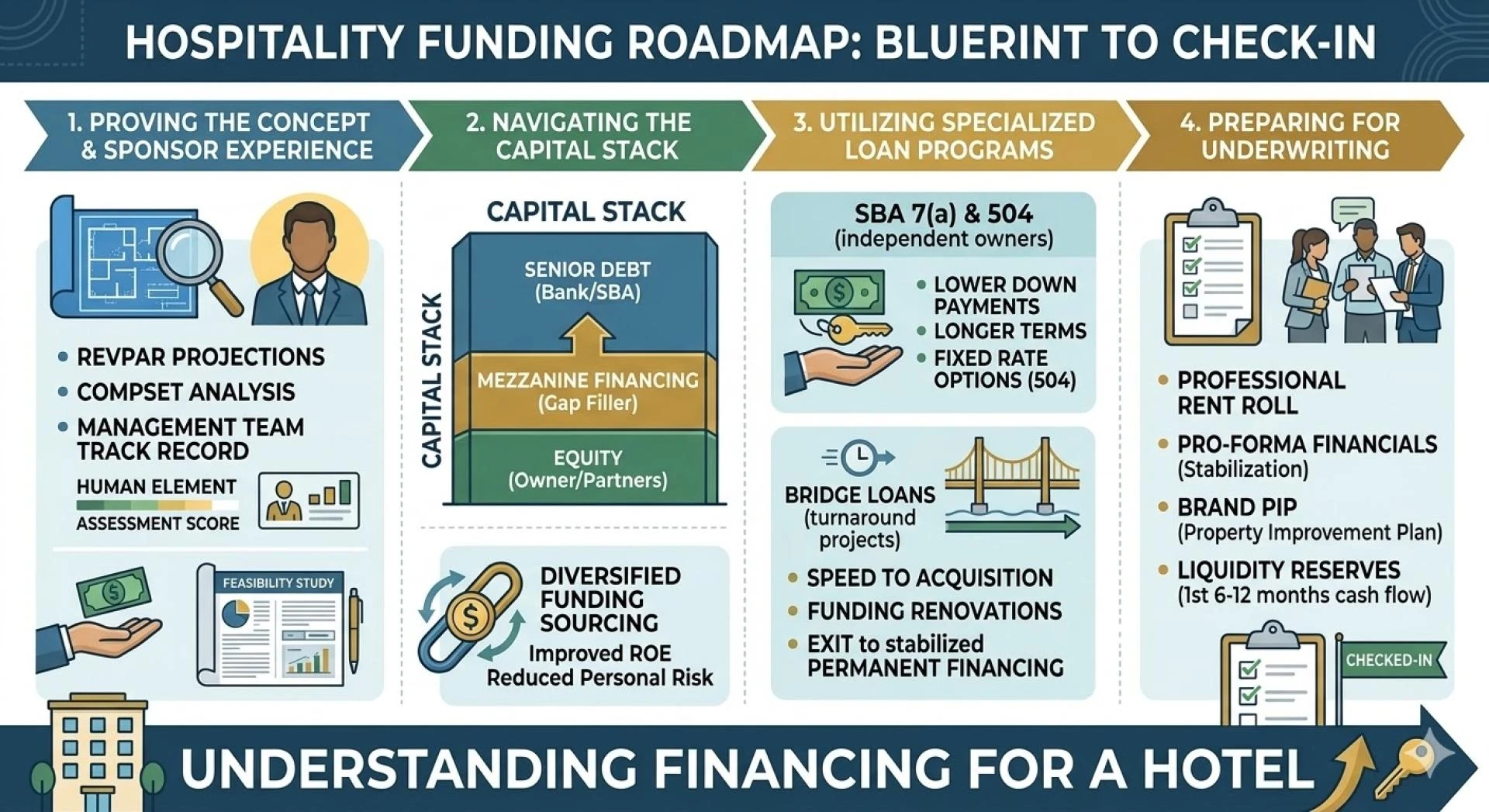
To secure financing for a hotel, a sponsor must prove they understand both the physical real estate and the operational business. This means presenting a comprehensive package that includes RevPAR (Revenue Per Available Room) projections, local competitive set analysis, and a clear plan for property management.
Navigating the Capital Stack
Understanding the "Capital Stack" is essential for any borrower. Most hospitality deals are not funded by a single source. Instead, they are built using a layers-of-capital approach:
- Senior Debt: Typically the largest portion, provided by banks or SBA programs.
- Mezzanine Financing: A secondary layer used to fill the gap between the senior loan and the owner's equity.
- Equity: The investor's own capital or funds raised from private partners.
By diversifying the sources of financing for a hotel, developers can reduce their personal risk and improve the project's overall Return on Equity (ROE).
The Role of Specialized SBA Programs
For many independent owners in the United States, the Small Business Administration (SBA) remains a vital ally. The SBA 7(a) and 504 loan programs are specifically designed to provide financing for a hotel with longer repayment terms and lower down payments than conventional commercial loans.
The 504 program, in particular, is a favorite for hotel acquisitions because it offers a fixed-rate, long-term loan for "major fixed assets." This allows owners to preserve their cash flow for operational expenses, such as marketing and staffing, which are critical during the initial "ramp-up" phase of a new or renovated property.
Preparing for the Underwriting Gauntlet
Underwriting in the hospitality sector is rigorous. Lenders will scrutinize the "Sponsor" (the borrower) as much as the property. They are looking for experience—if you haven't managed a hotel before, you will likely need to hire a reputable third-party management company to satisfy the lender's risk requirements.
When applying for financing hotel, your documentation should be impeccable. This includes:
- Feasibility Study: A professional third-party report confirming the demand for a hotel in that specific market.
- Brand PIP (Property Improvement Plan): If you are buying a franchised hotel (like a Hilton or Marriott), the lender will want to see the cost of required renovations to keep the brand standard.
- Liquidity Reserves: Proof that you have enough "dry powder" to cover interest payments during the first 6–12 months of operation.
The "Bridge" to Stabilization
For properties that are currently underperforming or in need of major renovations, a "Bridge Loan" is often the most appropriate form of financing for hotel. Bridge loans are designed to be temporary. They provide the capital needed to buy and fix a property, with the expectation that once the hotel is stabilized and profitable, the owner will refinance into a lower-interest, long-term conventional loan.
Funding the Vision
Securing the capital for a hospitality project is a marathon, not a sprint. It requires a blend of real estate expertise, operational foresight, and the ability to speak the language of institutional lenders.
As the industry continues to evolve toward boutique experiences and sustainable development, the demand for creative financing for a hotel will only grow. The investors who succeed are those who treat their lender as a strategic partner, ensuring that the financial architecture is as robust as the guest experience they intend to create.































Sign in to leave a comment.