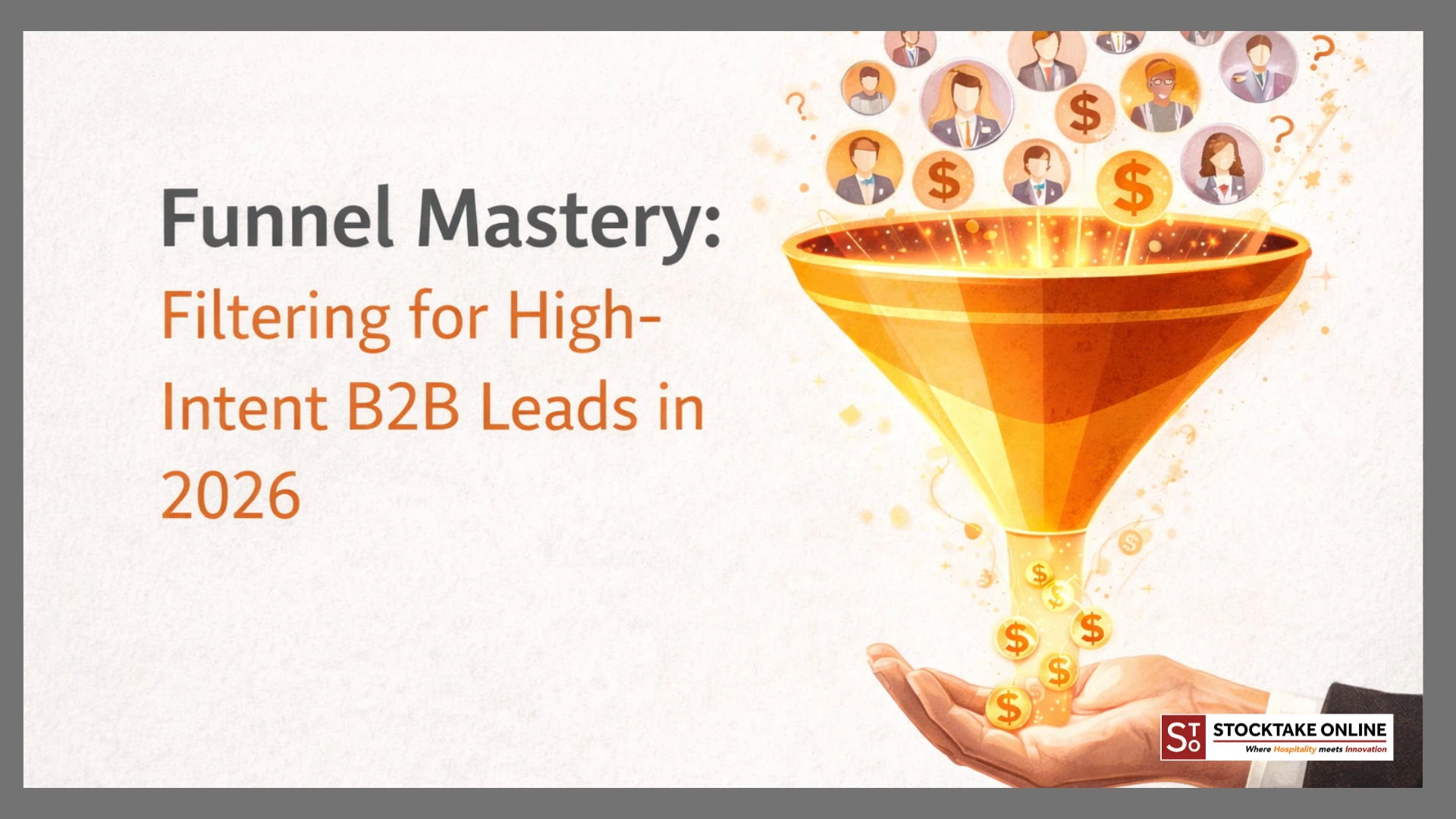

Executive Insight: The Death of the Volume Paradigm
The B2B landscape in 2026 has undergone a fundamental, irreversible shift. For decades, the mantra of "more is better" governed marketing departments across the globe. We became obsessed with the top of the funnel (TOFU)—chasing traffic, impressions, and raw lead numbers as if they were the ultimate indicators of corporate health. However, as we move through 2026, many hospitality technology teams are finding themselves tethered to legacy metrics that no longer produce revenue.
The reality is that pipelines today often feel brittle, not because of a lack of interest, but because of a lack of intent. The lead generation paradigm, as it existed five years ago, is effectively dead. In its place is a new requirement: the ability to distinguish between a "lead" and a "buyer." The issue facing the modern B2B organisation is not a shortage of opportunities; it is the dilution of quality masquerading as scale. When you optimise for volume, you inadvertently invite noise into your system, which eventually chokes your sales team's ability to focus on high-value conversions.
Market & Industry Context: The Silent Researcher
The modern B2B buyer is more autonomous and better informed than ever before. In the hospitality sector specifically, operators—from independent restaurateurs to multi-site enterprise directors—are navigating an increasingly hostile economic landscape. They are dealing with rising COGS (Cost of Goods Sold), severe labour volatility, and the administrative nightmare of multi-site management.
Consequently, their purchasing behaviour has evolved into what analysts call "The Silent Research Phase." By 2026, it is estimated that nearly 80% of the buyer’s journey is completed before they ever click a "Contact Sales" button. They leverage peer networks, read deep-dive technical documentation, and engage with community-driven content in silence.
This means that a significant portion of your digital traffic is no longer commercial. It is academic, benchmarking, or exploratory. While this traffic is beneficial for brand awareness, treating "curiosity clicks" as a sales pipeline is a strategic error that leads to longer sales cycles and lower morale. Funnels that are strictly optimised for reach inevitably become bloated at the top and fragile at the bottom. By contrast, the most resilient funnels in 2026 are those that prioritise filtering at the earliest possible touchpoint, ensuring that only those with a legitimate operational need move forward.
Operational Challenges: The Hidden Cost of Low Quality
In 2026, the cost of pursuing low-intent leads has reached a breaking point. When hospitality groups or restaurant chains seek new solutions, they are often met with generic marketing that fails to address their specific operational hygiene. This creates a friction-filled environment for both the buyer and the seller.
1. The "Volume Trap"
Sales teams in the hospitality tech space often find themselves spending up to 70% of their time qualifying leads that should never have entered the CRM in the first place. This "chasing" culture is expensive. It burns out high-performing account executives and dilutes the focus required to close complex, high-revenue deals.
2. Stagnant Sales Cycles
When a lead enters the funnel too early—before they have identified a specific pain point or secured a budget—they become a "zombie lead." They linger in the pipeline, inflating the projected revenue numbers but never actually moving toward a contract. This creates a false sense of security for leadership while masking a fundamental lack of pipeline velocity.
3. Messaging Misalignment
The market is tired of "why" content. If you are selling to an experienced F&B Director, they already know why they need to control food waste. Content that focuses on basic education rather than "how to reduce waste by 4% in a multi-site environment using real-time data" attracts observers rather than buyers. This misalignment is one of the costliest mistakes a B2B team can make in 2026.
Strategic Solutions: Identifying High-Intent Signals
High-intent leads do not behave like traditional prospects. They have moved past the "what is it?" phase and are focused entirely on the "how do I use it?" phase. To master the 2026 funnel, you must learn to recognise the operational signals of readiness.
High-intent prospects do not ask broad, philosophical questions about industry trends; they ask granular questions regarding:
- Integration: "Will this sync with my current Xero or Sage accounting software?"
- Data Latency: "How quickly does the inventory update across twelve sites?"
- Implementation Timelines: "What is the typical onboarding period for a 50-unit chain?"
When a prospect engages with specific, high-value terms such as "hospitality management" or "restaurant management software," they are signalling a specific need for structural improvement. These are not just keywords; they are declarations of intent. In 2026, high-intent signals are found in:
- Outcome-Oriented Inquiries: A shift from "what features do you have?" to "how does this solve my specific margin problem?"
- Engagement with Practical Tools: High interaction with ROI calculators, audit templates, and detailed pricing pages.
- Operational Readiness: Mentioning specific internal timelines or procurement processes early in the conversation.
The Shift from Traffic to Qualification
Modern funnel mastery involves a deliberate, almost aggressive, pivot from attraction to selection. This is particularly visible in the hospitality industry, where the most successful content strategies have moved away from "thought leadership" fluff and toward practical, process-driven guides.
At Stocktake Online, we have observed that the most successful conversions occur when the prospect is allowed to self-qualify. This is why our focus is on ensuring that visibility is coupled with extreme relevance. By targeting specific search clusters like "hospitality management" and restaurant management software, the aim is to attract leads who are already in the "solution-seeking" phase of their journey.
Transparency vs. Persuasion
The 2026 buyer is friction-averse. They no longer need to be "convinced" by a salesperson; they need to be "informed" by a partner. Funnels that prioritise transparency—showcasing actual value creation, identifying potential implementation costs, and depicting the reality of the software environment—demonstrate significantly higher conversion rates than those trying to dazzle with vague promises.
By providing clear paths to pricing and technical specifications upfront, we respect the buyer's time. This approach filters out the window-shoppers and ensures that when a lead finally hits the "Demo" button, they are already 90% aligned with the solution's value proposition.
Strategic Implementation: How to Filter Effectively
To implement a high-intent filtering system, B2B teams must restructure their digital touchpoints. This isn't just about changing a few headlines; it's about a fundamental change in how data is processed.
1. Intent-Based Keyword Mapping
Move away from broad industry terms that attract students and researchers. Focus on "Problem + Solution" keywords. For example, instead of just "inventory," target "multi-site food waste reduction software." This ensures that the traffic you generate is already looking for a specific outcome.
2. Self-Selection Tools
Incorporate tools that allow the user to see how the product fits their specific environment. An ROI calculator that asks for "Average Monthly Spend" and "Number of Locations" is a powerful filtering tool. If a user is willing to input their actual data, their intent is significantly higher than someone who just downloads a generic PDF.
3. Progressive Profiling
Stop asking for ten fields of information on the first interaction. Use progressive profiling to gather operational data over time. The more specific the information the user provides—such as their current POS provider or their primary operational pain point—the higher their intent score should be.
Industry Takeaways: The Future of BOH Transformation
The best B2B funnels of 2026 will not be the loudest; they will be the most precise. In an industry as tight-margined as hospitality, efficiency is everything. This applies to the sales process just as much as it applies to back-of-house operations.
Filtering for high intent is not a constraint on growth—it is the catalyst for it. By focusing on transparency over persuasion and qualification over volume, B2B teams can build a pipeline that is not only larger in value but higher in velocity. The goal is to move from a "sales conversation" to an "alignment conversation."
When your funnel is constructed correctly, you aren't just selling software; you are providing a pathway to operational maturity. For those looking to see how these intent-led strategies translate into real-world applications, exploring a specialised demo can provide a clear view of how high-intensity keywords and filtered funnels are currently being utilised to secure converting leads.
Final Thought: Building for Longevity
As we look toward the remainder of 2026 and beyond, the companies that thrive will be those that treat their funnel as a precision instrument rather than a wide net. At Stocktake Online, we believe that the hospitality sector deserves technology that respects the complexity of the industry. By focusing on high-intent keywords like "hospitality management" and "restaurant management software," we ensure that we are connecting with the right people at the right time.
The era of chasing every click is over. The era of the high-intent, high-velocity pipeline has begun. Mastering this shift is the only way to ensure sustainable growth in an increasingly competitive B2B landscape.
























Sign in to leave a comment.