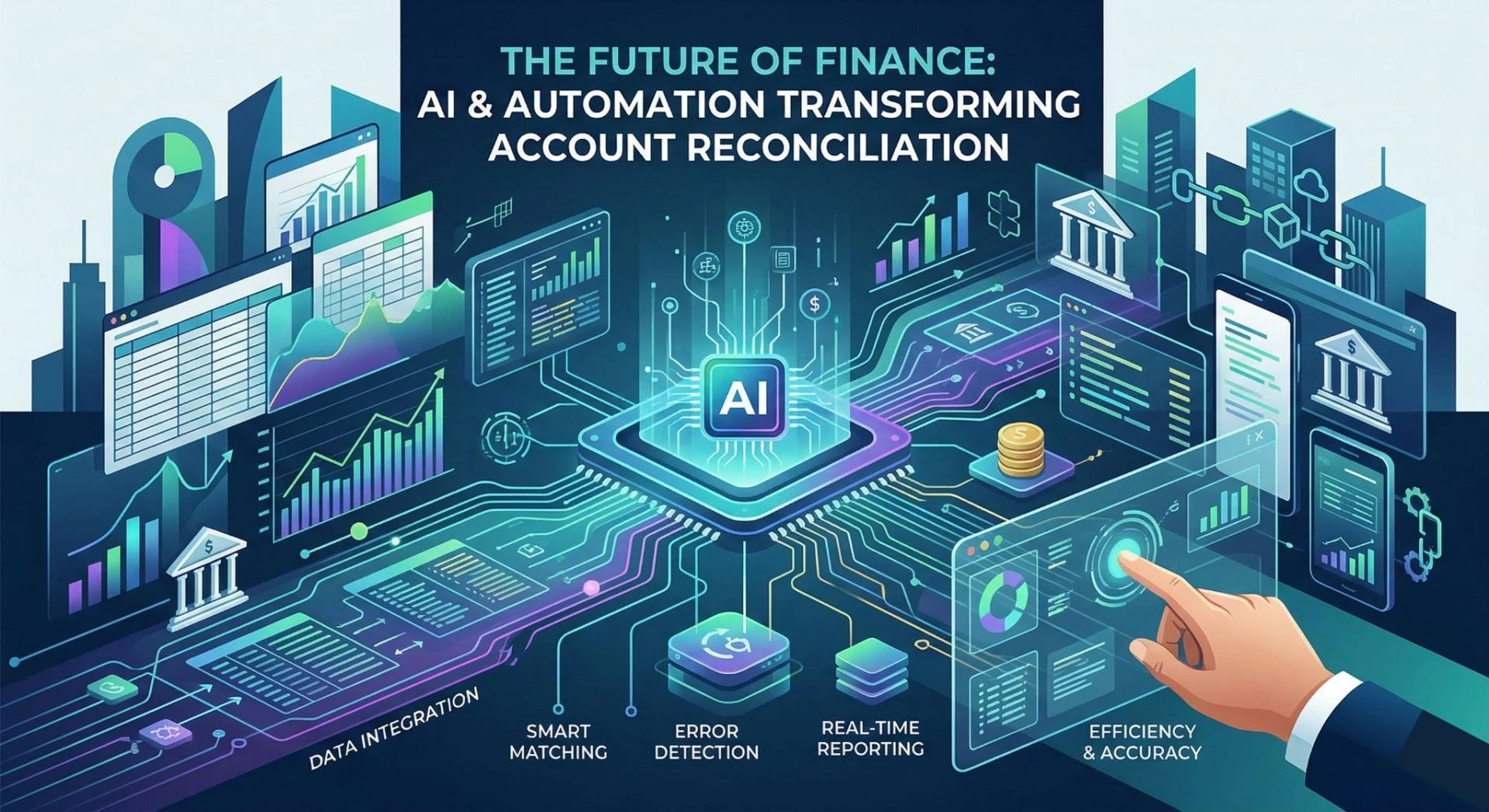

Financial teams manage enormous volumes of transactions across banks, ERP platforms, and internal ledgers. As businesses grow, reconciliation becomes harder to manage through manual processes and spreadsheets. Discrepancies appear across systems, exceptions pile up, and finance teams spend valuable time verifying records instead of analyzing financial performance. These challenges slow financial reporting and increase operational risk.
Artificial intelligence and automation introduce a new way to manage reconciliation at scale. Instead of relying on manual comparisons, finance teams can analyze transactions continuously, identify discrepancies earlier, and maintain consistent records across systems. This article explains why reconciliation is becoming a strategic finance function, how AI supports reconciliation accuracy, and what the future holds for automated financial verification across enterprises.
Why Account Reconciliation Is Becoming a Strategic Finance Function
Account reconciliation has traditionally been treated as a routine accounting activity. Today it plays a larger role in financial accuracy and reporting integrity.
The Expanding Role of Reconciliation in Financial Reporting
Financial statements depend on accurate underlying data. Reconciliation validates that balances across ledgers, banks, and systems match correctly. As reporting expectations increase, reconciliation provides the foundation for reliable financial records.
Why Finance Leaders Are Reexamining Traditional Reconciliation Processes
Growing transaction volumes, multi entity accounting structures, and global financial operations have exposed the limits of manual reconciliation processes. Finance leaders are evaluating automation to manage reconciliation at enterprise scale.
How Reconciliation Accuracy Influences Financial Decision Making
Executives rely on financial reports to guide budgeting, investments, and operational planning. When reconciliation errors exist, financial insights may be misleading.
Understanding this importance highlights why many organizations are reconsidering traditional reconciliation methods.
Limits of Traditional Account Reconciliation Methods
Manual reconciliation processes struggle to keep pace with modern financial data volumes and system complexity.
Manual Matching Across High Transaction Volumes
Finance teams often compare transactions manually across multiple records. As volumes increase, this approach becomes inefficient and prone to oversight.
Fragmented Financial Data Across Systems
Organizations maintain financial data across ERP platforms, payment gateways, and bank systems. Manual reconciliation across these environments requires constant cross checking.
Delayed Detection of Discrepancies
Discrepancies may remain hidden until month end reviews, which increases the risk of reporting errors.
Dependence on Spreadsheets and Manual Review Cycles
Many finance teams rely on spreadsheets to manage reconciliation activity. These files are difficult to maintain across teams and may lack traceability.
A deeper view of Enterprise Account Reconciliation highlights how large organizations must manage reconciliation across multiple entities and systems.
What AI and Automation Bring to Account Reconciliation
Automation introduces advanced data analysis capabilities that allow finance teams to analyze financial records more effectively.
Intelligent Matching of Transactions Across Financial Systems
AI systems compare transactions across ledgers, banks, and financial platforms using multiple attributes such as amount, date, and account references.
Continuous Analysis of Financial Records
Instead of waiting for period end reviews, automated systems evaluate financial data continuously.
Detection of Irregular Patterns in Transaction Data
AI models analyze transaction patterns and identify unusual financial activity that may indicate discrepancies.
Data Standardization Across Ledgers and Subledgers
Automation aligns data formats across systems so that records can be compared accurately.
These capabilities rely on several technologies that analyze financial records at scale.
Core Technologies Powering AI Based Reconciliation
AI reconciliation systems rely on multiple analytical methods.
Machine Learning Models for Transaction Pattern Analysis
Machine learning models study historical financial activity and identify patterns that define normal transaction behavior.
Natural Language Processing for Financial Data Interpretation
Financial records often contain text descriptions. Natural language processing interprets these descriptions and associates them with corresponding transactions.
Anomaly Detection Across Large Accounting Datasets
Anomaly detection models identify transactions that deviate from expected patterns.
Entity Recognition Across Vendors, Accounts, and Transactions
AI identifies entities such as vendors, customers, and accounts to establish relationships between financial records.
With these technologies in place, AI significantly improves transaction matching accuracy.
How AI Improves Transaction Matching Accuracy
AI analyzes multiple attributes simultaneously to identify transaction matches.
Multi Attribute Matching Across Amount, Date, and Entity
Instead of comparing a single field, AI evaluates multiple transaction characteristics to identify potential matches.
Identification of Partial Matches Across Financial Records
Transactions may contain slight differences across systems. AI identifies these partial matches using pattern analysis.
Resolution of Complex One to Many and Many to Many Matches
Certain financial transactions correspond to multiple related entries. AI systems analyze these relationships automatically.
Reduction of False Matches in Reconciliation Reviews
Automated matching reduces incorrect matches that occur during manual reconciliation.
These improvements support automation across the entire reconciliation lifecycle.
Automation Across the Reconciliation Lifecycle
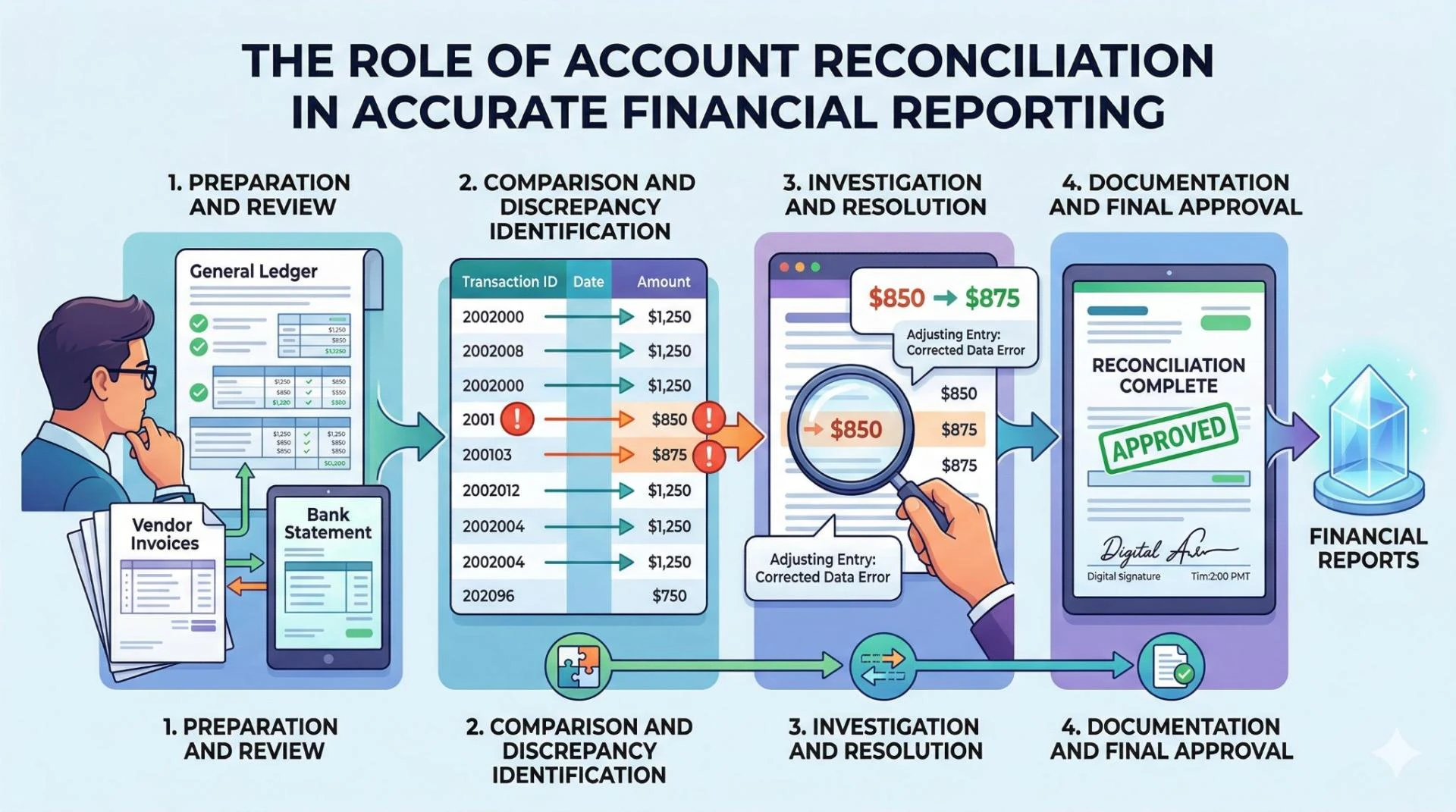
Automation supports every stage of reconciliation, from data collection to reporting.
Data Ingestion From ERP, Banks, and Financial Platforms
Automated systems collect financial data from multiple sources and organize it into structured datasets.
Automated Transaction Matching and Exception Detection
Transactions are matched automatically, while discrepancies are flagged as exceptions for review.
Exception Review and Approval Workflows
Finance teams investigate exceptions and approve adjustments within structured workflows.
Final Balance Validation and Reporting
Once discrepancies are resolved, automated systems validate final balances and produce reconciliation reports.
An overview of account reconciliation automation explains how automated workflows support reconciliation accuracy.
Continuous Reconciliation and Real Time Financial Visibility
Automation allows finance teams to monitor reconciliation activity continuously.
Monitoring Financial Transactions Throughout the Accounting Cycle
Transactions are analyzed throughout the reporting period rather than only during closing cycles.
Early Detection of Discrepancies Before Period Close
Finance teams can investigate discrepancies earlier, reducing pressure during closing periods.
Immediate Identification of High Risk Variances
Automated systems highlight transactions that require attention based on financial risk indicators.
This continuous monitoring also introduces new analytical capabilities.
New Capabilities Emerging From AI Driven Reconciliation
AI systems identify patterns and insights that manual reconciliation rarely detects.
Predictive Identification of Reconciliation Breaks
Historical transaction data allows AI to identify accounts that may experience discrepancies in future periods.
Financial Pattern Learning From Historical Records
Machine learning models continuously analyze historical financial data to refine matching logic.
Intelligent Prioritization of Reconciliation Exceptions
AI assigns priority levels to discrepancies so finance teams can focus on high impact issues.
These insights reveal financial patterns hidden within transaction data.
Hidden Financial Insights Revealed Through AI Reconciliation
AI analysis uncovers patterns across financial records that may otherwise remain unnoticed.
Detection of Repeated Variances Across Accounting Periods
Recurring discrepancies across periods may indicate underlying process issues.
Identification of Unusual Journal Entry Behavior
AI identifies irregular posting activity that deviates from normal accounting behavior.
Recognition of Cross Account Transaction Relationships
Relationships between accounts may reveal hidden reconciliation dependencies.
These capabilities create measurable advantages for enterprises.
Enterprise Advantages of AI Based Reconciliation
Automation introduces several operational benefits across finance teams.
Shorter Financial Close Cycles
Continuous reconciliation reduces the amount of work required during month end closing.
Greater Confidence in Financial Reporting
Finance teams gain confidence that reconciled balances accurately represent financial activity.
Reduced Operational Burden on Finance Teams
Automation reduces repetitive manual verification tasks.
Stronger Financial Control Environments
Consistent reconciliation processes support stronger financial governance.
These operational improvements also influence how finance professionals perform their roles.
How Automation Changes the Role of Finance Professionals
Automation shifts finance teams away from repetitive tasks.
Shift From Transaction Checking to Exception Analysis
Finance professionals spend less time verifying transactions and more time analyzing discrepancies.
Greater Focus on Financial Risk Monitoring
Teams can focus on identifying patterns that signal financial risk.
Increased Collaboration Between Finance and Data Teams
Finance professionals work more closely with data specialists to manage financial systems and analytics.
With automation expanding across reconciliation, governance considerations become increasingly important.
Governance and Control Considerations in AI Reconciliation
Organizations must maintain financial oversight when adopting automated reconciliation systems.
Maintaining Transparent Financial Audit Trails
Every reconciliation action must remain traceable to support audit requirements.
Oversight of Automated Reconciliation Decisions
Finance leaders should review reconciliation logic and exception resolution processes.
Ensuring Data Integrity Across Financial Systems
Consistent and accurate data remains necessary for reliable reconciliation.
Despite these advantages, organizations may encounter challenges during implementation.
Challenges Enterprises May Face During Adoption
Adopting automated reconciliation requires coordination across systems and teams.
Integrating Reconciliation Systems With Existing ERP Platforms
Organizations must connect reconciliation systems with existing financial infrastructure.
Managing Data Quality Across Financial Sources
Financial records must be structured and consistent for automated analysis.
Aligning Reconciliation Policies Across Global Entities
Enterprises must standardize reconciliation procedures across subsidiaries.
Preparing finance teams for automation improves implementation success.
Preparing Finance Teams for AI Enabled Reconciliation
Successful adoption requires operational and technical readiness.
Building Data Readiness Across Financial Systems
Financial data must be standardized across systems before automation can operate effectively.
Establishing Standard Reconciliation Frameworks
Organizations should define consistent reconciliation policies across departments.
Training Finance Teams for Automated Workflows
Finance teams must understand automated workflows and exception management processes.
Modern reconciliation systems continue to develop new capabilities that expand financial visibility.
Future Direction of AI and Automation in Account Reconciliation
Financial automation continues to advance as organizations seek greater financial accuracy.
Self Learning Reconciliation Systems
Machine learning models will refine reconciliation logic as they analyze larger datasets.
Autonomous Financial Monitoring
Automated systems will monitor financial activity continuously and identify discrepancies without manual intervention.
Continuous Financial Verification Across Enterprise Systems
Modern account reconciliation software enables organizations to maintain consistent verification of financial records across systems and entities.

Sign in to leave a comment.