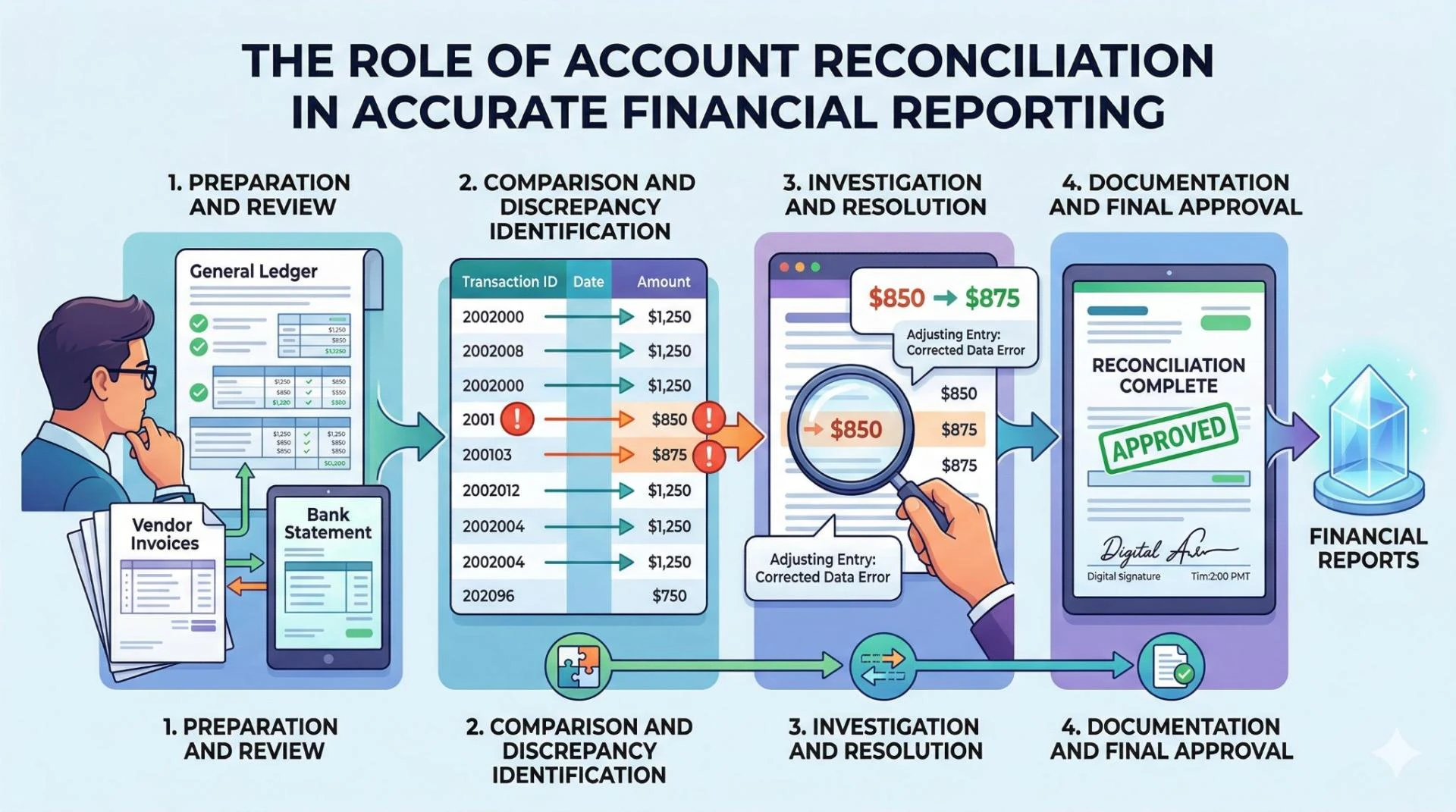

Financial reports guide decisions that affect revenue, investments, compliance, and long-term strategy. Yet many organizations still rely on fragmented reconciliation practices, which allow discrepancies to pass unnoticed until reporting deadlines. These gaps create inconsistent financial statements, delayed closes, and repeated adjustments that weaken confidence in reported numbers.
Account reconciliation plays a direct role in ensuring financial reporting accuracy. It validates balances, aligns records across systems, and ensures that financial statements reflect actual business activity. This article explains how reconciliation supports financial reporting, where errors originate, and how structured and automated practices improve reporting accuracy across enterprises.
Why Financial Reporting Accuracy Depends on Reliable Account Reconciliation
Financial reporting accuracy is directly tied to how well account balances are validated before reporting cycles.
The Link Between Reconciliation and Financial Statement Integrity
Reconciliation ensures that financial statements are based on verified account balances. Without validation, reported numbers may not reflect actual transactions.
How Unverified Account Balances Distort Financial Reports
Unverified balances can include duplicate entries, missing transactions, or incorrect postings. These issues distort financial statements and lead to inaccurate reporting.
Why Finance Leaders Prioritize Reconciliation for Reporting Accuracy
Finance leaders depend on reconciliation to ensure confidence in reported financial data. Accurate reconciliation reduces uncertainty in financial decision making.
With this foundation, it becomes important to define reconciliation within reporting workflows.
What Account Reconciliation Means in the Context of Financial Reporting
Account reconciliation ensures that financial records are aligned and validated before reporting.
Validating Account Balances Against Supporting Records
Reconciliation compares ledger balances with supporting documents such as bank statements, invoices, and subledger records.
Aligning Subledgers With General Ledger Balances
Subledgers such as accounts payable and receivable must match general ledger balances to maintain consistency.
Ensuring Financial Data Completeness Before Reporting
Reconciliation ensures all financial transactions are recorded before financial statements are finalized.
One key example is balance sheet reconciliation, which verifies that asset, liability, and equity balances reflect actual financial positions.
This validation process supports each financial statement.
How Account Reconciliation Supports Core Financial Statements
Reconciliation directly impacts the accuracy of all financial statements.
Impact on Balance Sheet Accuracy
Validated balances ensure assets and liabilities are correctly represented.
Influence on Income Statement Reliability
Accurate reconciliation ensures revenues and expenses are recorded in the correct period.
Role in Cash Flow Statement Consistency
Reconciliation ensures that cash movements are properly recorded and aligned with underlying transactions.
Without proper reconciliation, reporting errors become common.
Common Reporting Errors Caused by Weak Reconciliation Practices
Weak reconciliation processes allow errors to pass into financial statements.
Duplicate or Missing Transactions in Financial Records
Duplicate entries inflate balances, while missing transactions understate financial activity.
Misclassified Entries Across Accounts
Incorrect classification affects financial statement presentation and analysis.
Timing Differences That Affect Reporting Periods
Transactions recorded in the wrong period distort financial results.
These issues often stem from deeper structural causes.
Structural Causes of Financial Reporting Inaccuracies
Reporting inaccuracies are often linked to systemic issues in reconciliation processes.
Fragmented Financial Data Across Systems
Financial data is often spread across ERP systems, spreadsheets, and banking platforms, making validation difficult.
Spreadsheet-Dependent Reconciliation Processes
Manual spreadsheets introduce inconsistencies and increase the risk of errors.
Inconsistent Matching Logic Across Accounts
Different reconciliation approaches across accounts lead to inconsistent outcomes.
These structural issues allow errors to flow into financial reports.
How Reconciliation Errors Flow Into Financial Reports
Errors that are not identified during reconciliation impact financial statements.
Carry-Forward Errors Across Accounting Periods
Unresolved discrepancies carry forward into future reporting periods.
Impact on Consolidated Financial Statements
Errors at the account level affect consolidated financial reporting across entities.
Distortion of Key Financial Ratios and Metrics
Incorrect balances lead to inaccurate financial ratios used for decision making.
This makes reconciliation a central part of financial close processes.
The Role of Reconciliation in Financial Close Processes
Reconciliation ensures financial statements are accurate before close.
Validating Account Balances Before Period Close
Accounts must be reconciled before financial statements are finalized.
Identifying Discrepancies Prior to Reporting Deadlines
Early identification of discrepancies prevents last-minute corrections.
Reducing Last-Minute Adjustments in Financial Statements
Effective reconciliation reduces the need for late adjustments.
Moving from periodic to continuous reconciliation improves accuracy further.
Why Continuous Reconciliation Improves Reporting Accuracy
Continuous reconciliation reduces reporting risk.
Monitoring Transactions Throughout the Accounting Cycle
Transactions are reviewed continuously instead of only during close.
Early Detection of Financial Differences
Discrepancies are identified earlier in the accounting cycle.
Reducing Reporting Pressure During Period-End Close
Continuous monitoring reduces the burden during reporting deadlines.
To achieve this, organizations must adopt structured reconciliation practices.
Key Reconciliation Practices That Improve Reporting Accuracy
Structured practices improve consistency and accuracy.
Standardizing Reconciliation Procedures Across Accounts
Standard processes ensure consistent validation across accounts.
Defining Clear Matching Criteria for Transactions
Defined criteria ensure transactions are matched accurately.
Establishing Structured Exception Handling Processes
Clear processes ensure discrepancies are investigated and resolved.
Exception management plays a key role in this process.
Exception Management and Its Impact on Financial Reporting
Managing discrepancies effectively improves reporting accuracy.
Identifying Reconciliation Breaks Across Accounts
Reconciliation identifies mismatches between records.
Categorizing Exceptions Based on Financial Impact
Exceptions are prioritized based on risk and financial impact.
Tracking Resolution of Financial Discrepancies
Tracking ensures all discrepancies are resolved before reporting.
Documentation supports audit and traceability requirements.
Documentation and Audit Traceability in Reconciliation
Accurate documentation ensures transparency.
Recording Reconciliation Decisions and Adjustments
All reconciliation decisions must be documented.
Maintaining Evidence for Financial Corrections
Supporting evidence ensures adjustments are justified.
Preserving Historical Reconciliation Records
Historical records support audits and future reviews.
Strong documentation also supports internal financial controls.
How Reconciliation Strengthens Internal Financial Controls
Reconciliation enforces financial discipline.
Ensuring Consistent Validation Across Accounts
Consistent validation reduces errors across accounts.
Supporting Segregation of Duties in Financial Processes
Defined roles prevent unauthorized actions.
Preventing Unauthorized Adjustments in Financial Records
Controls ensure only approved adjustments are recorded.
Despite these benefits, traditional reconciliation still has limitations.
Gaps in Traditional Reconciliation That Affect Reporting Accuracy
Legacy processes create visibility and timing issues.
Limited Visibility Into Reconciliation Status
Finance teams may not have real-time insight into reconciliation progress.
Delayed Identification of Financial Differences
Issues are often identified late in the reporting cycle.
Fragmented Evidence Across Emails and Spreadsheets
Supporting documentation is often scattered.
Automation addresses these gaps.
The Role of Automation in Improving Reporting Accuracy
Automation improves consistency and speed.
Automated Matching of Transactions Across Systems
Systems match transactions automatically across data sources.
Continuous Monitoring of Financial Data
Financial data is monitored throughout the accounting cycle.
Centralized Visibility Across Reconciliation Activities
Teams gain a unified view of reconciliation status.
Automation also improves data integrity.
How Automation Improves Data Integrity in Financial Reporting
Automation reduces inconsistencies.
Standardized Financial Data Across Systems
Data is structured consistently across systems.
Reduced Risk of Duplicate and Missing Entries
Automated processes reduce manual errors.
Consistent Validation of Financial Records
Validation rules ensure data accuracy.
Automation also reveals hidden reporting risks.
Hidden Reporting Risks That Reconciliation Can Surface
Reconciliation highlights patterns that may otherwise go unnoticed.
Recurring Small Variances Across Accounting Periods
Small discrepancies can indicate systemic issues.
Unusual Adjustment Patterns in Journal Entries
Frequent adjustments may signal process weaknesses.
Inconsistent Balances Across Related Accounts
Mismatch across accounts indicates reconciliation gaps.
Organizations must monitor signals that indicate reporting issues.
Organizational Signals That Reconciliation Is Impacting Reporting Quality
Certain indicators suggest reconciliation problems.
Frequent Adjustments During Financial Close
Repeated adjustments indicate weak reconciliation.
Inconsistent Financial Reports Across Periods
Variations across periods signal underlying issues.
High Dependence on Manual Corrections
Manual corrections increase reporting risk.
To address these issues, organizations must prepare their teams.
Preparing Finance Teams for High-Accuracy Reconciliation
Preparation ensures consistent reconciliation practices.
Aligning Reconciliation Policies Across Business Units
Standard policies ensure consistency across teams.
Training Teams on Standard Validation Practices
Training improves accuracy and consistency.
Establishing Accountability for Reconciliation Outcomes
Clear ownership ensures responsibility for reconciliation results.
Looking ahead, reconciliation will continue to evolve.
The Future of Reconciliation in Financial Reporting
Reconciliation will become more integrated and continuous.
Continuous Financial Validation Across Systems
Validation will occur throughout the accounting cycle.
Greater Integration With Financial Reporting Platforms
Reconciliation systems will connect directly with reporting tools.
Increasing Role of Data Intelligence in Financial Reporting
Data-driven insights will improve reporting accuracy.
Organizations aiming to improve reporting accuracy are increasingly adopting solutions such as account reconciliation software that standardize validation, improve visibility, and support consistent financial reporting across systems.






























Sign in to leave a comment.