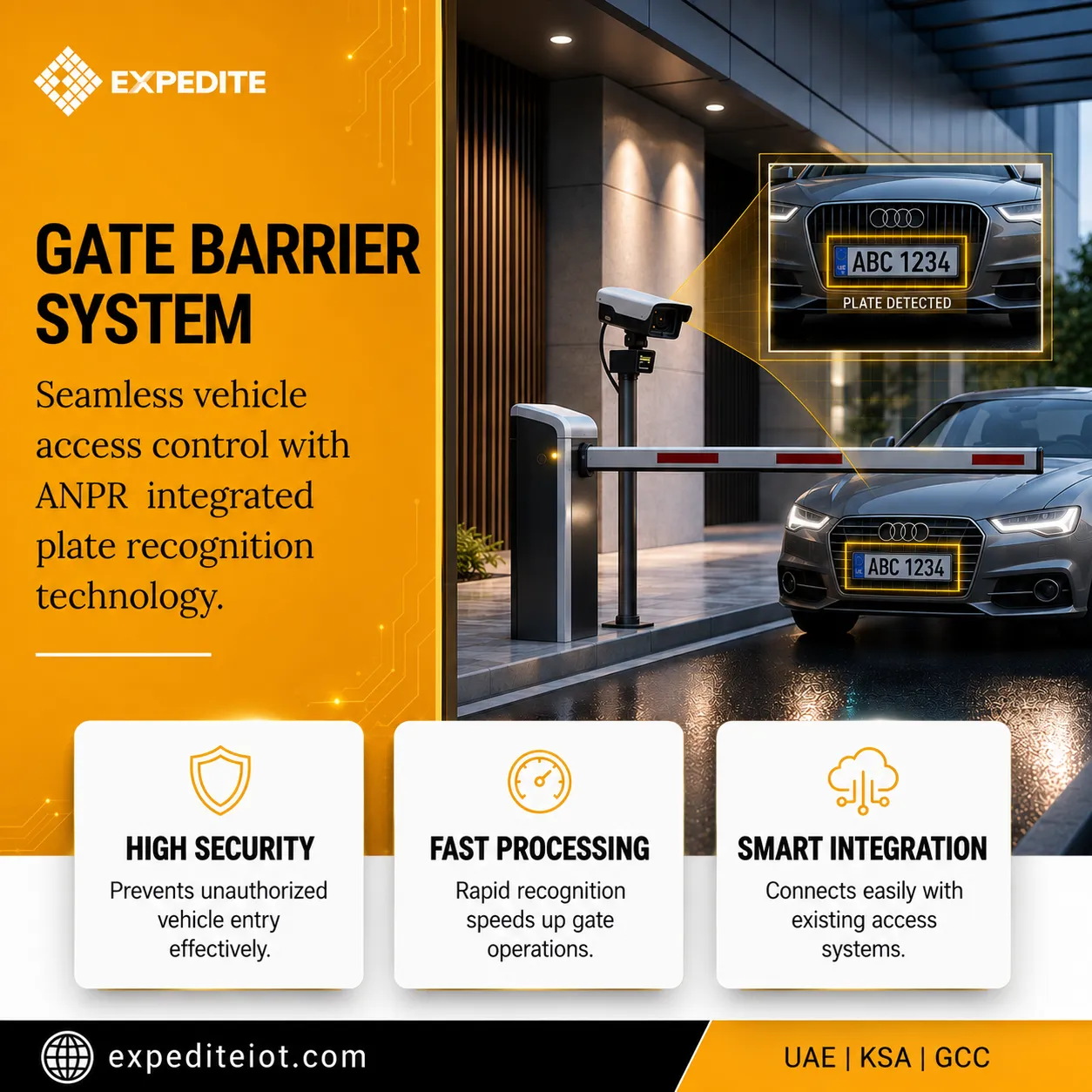

Every vehicle that enters or leaves a Saudi business premises represents a security decision — authorised or unauthorised, controlled or uncontrolled, documented or invisible. In an era where physical security threats, vehicle-based crimes, and liability exposure are growing concerns for enterprises across the Kingdom, an intelligent Gate Barrier System is no longer an optional upgrade but a foundational requirement of responsible site management. From corporate campuses and residential communities to industrial parks and government facilities, Gate Barriers and other automated vehicle access technologies mark the difference between a perimeter that genuinely protects and one that merely suggests a boundary. Expedite IoT's intelligent Gate Barrier System solutions across KSA, Qatar, and Oman deliver the full spectrum of vehicle access technologies — engineered for Saudi Arabia's unique climate conditions, regulatory environment, and operational scale.
Saudi Arabia's Vision 2030 urban development agenda is generating unprecedented demand for sophisticated vehicle access infrastructure. NEOM's smart city zones, the Red Sea Project's resort developments, Qiddiya's entertainment city, and hundreds of mixed-use commercial and residential developments under construction across the Kingdom all require intelligent vehicle management systems that integrate with digital identity platforms, LPR (licence plate recognition) cameras, and centralised security operations centres. Understanding the full range of available technologies — from a standard automatic gate barrier to advanced Security Gate Barrier Systems — and matching the right solution to each operational context is the critical first step toward a vehicle access strategy that delivers long-term security and operational value.
The Business Case for Intelligent Vehicle Access Control in Saudi Arabia
Saudi enterprises face vehicle access challenges that are distinct in scale and character from those encountered in many other markets. The Kingdom's car-dependent urban culture means that most commercial and residential facilities manage large volumes of daily vehicle traffic — a regional shopping mall in Riyadh may process 30,000 to 50,000 vehicles per day, while a major industrial facility might manage thousands of contractor vehicle movements per shift. Without an automatic gate barrier in place, the cost of staffing every entry and exit point with a manual operator is enormous — and manual processes are inherently prone to error, inconsistency, and corruption.
Beyond cost and efficiency, the liability dimension of uncontrolled vehicle access is significant. An unauthorised vehicle on a petrochemical site, a stolen vehicle in a residential compound, or a logistics truck entering a restricted zone without documentation all represent security failures with potentially severe financial, legal, and reputational consequences. Intelligent Gate Barriers eliminate these risks by enforcing access rules consistently, 24 hours a day, seven days a week, and generating an immutable audit trail of every vehicle movement that satisfies both internal governance requirements and external regulatory obligations.
Boom Barrier System: The Workhorse of Automatic Gate Barriers in Saudi Arabia
The Boom Barrier System is the most widely deployed vehicle access control technology across Saudi Arabia, combining robust mechanical performance with low total cost of ownership and seamless integration with the full range of credential and verification technologies. A motorised arm — ranging from 3 metres for standard single-lane entry to 6 metres or beyond for wide-lane industrial entrances — rises and falls under controller instruction, physically blocking unauthorised vehicle passage while achieving opening and closing cycles as fast as 1.5 seconds for high-throughput applications.
As the most common form of automatic gate barrier, modern boom barrier controllers integrate directly with RFID readers, licence plate recognition cameras, intercom systems, access control platforms, and payment terminals — creating an intelligent entry station that verifies vehicle identity, logs the transaction, and opens the barrier without human intervention in the standard case. For industrial and logistics environments requiring continuous high-cycle operation, heavy-duty boom barrier models rated for over five million cycles are available with minimal maintenance requirements.
Boom Barrier Integration Capabilities and Automation Options
•LPR Camera Integration: Licence plate recognition cameras paired with boom barrier controllers enable fully hands-free entry for pre-registered vehicles — drivers do not need to stop, lower a window, or present a credential. The camera reads the plate, the controller verifies it against the authorised list, and the barrier opens automatically.
•RFID and UHF Long-Range Readers: Long-range UHF RFID readers mounted at the barrier approach read vehicle-mounted transponders at distances of up to 10 metres, enabling authorised vehicles to pass without stopping — critical for high-throughput logistics and industrial vehicle flows.
•Payment Terminal Integration: In commercial parking and toll applications, payment terminals — cash, card, or mobile payment — integrate with the barrier controller to release the arm upon validated payment, eliminating the need for staffed payment booths.
•Remote Management and Diagnostics: Cloud-connected barrier controllers allow remote monitoring of operational status, fault diagnostics, barrier cycle counts, and access log review from any internet-connected device — reducing site visit requirements for maintenance teams.
Security Gate Barrier Systems: Core Safety and Engineering Capabilities
A well-engineered Security Gate Barrier System is judged as much by its safety architecture as by its throughput speed. Loop detectors embedded in the road surface at the barrier location provide vehicle presence detection that prevents the boom from lowering onto a vehicle, while safety edges on the arm absorb impact forces if an unexpected collision occurs. Together, these engineering safeguards allow Gate Barriers to operate safely at high cycle counts without compromising site security.
•Vehicle Presence Detection: Induction loop detectors prevent the barrier arm from closing on a vehicle mid-passage, eliminating collision risk at high-traffic entry points.
•Impact-Absorbing Safety Edges: Sensor-fitted rubber edges along the barrier arm detect obstruction and immediately reverse motion, protecting both vehicles and pedestrians.
•High-Cycle Mechanical Durability: Heavy-duty motors rated for over five million operating cycles ensure Security Gate Barrier Systems remain reliable in round-the-clock industrial and logistics environments.
•Redundant Fail-Safe Modes: Configurable open-on-power-failure or closed-on-power-failure behaviour ensures the barrier defaults to the correct state for evacuation routes or security-critical perimeters.
Toll Gate Barriers: Revenue Control and Traffic Management at Scale
Toll Gate Barriers represent a specialised evolution of the standard boom barrier, engineered specifically for high-volume revenue collection environments where transaction speed, system reliability, and payment platform integration are paramount. Saudi Arabia's expanding toll road network — including the Riyadh Ring Road toll system and planned expressway tolling infrastructure under Vision 2030's transport development programme — requires toll barrier hardware capable of processing thousands of vehicles per hour per lane with near-zero downtime and full integration with multi-lane free-flow (MLFF) tolling platforms.
In commercial parking contexts — shopping malls, airport car parks, hospital facilities, and mixed-use development underground parking — toll gate barrier systems manage entry ticketing, duration-based fee calculation, and exit payment processing in an integrated automated workflow. Multi-lane parking management platforms from vendors such as SKIDATA, CAME, and Nedap integrate with barrier hardware, payment terminals, and space guidance systems to create a seamless, fully automated parking experience that maximises revenue capture while minimising operational staffing requirements. Expedite IoT's toll and Parking Gate Barrier solutions are configured to the specific transaction volumes, payment methods, and integration requirements of each client's facility.
Parking Gate Barrier: Transforming Revenue, Occupancy, and User Experience in Saudi Facilities
The Parking Gate Barrier is a critical revenue and liability management asset for any Saudi commercial or residential facility with structured parking. Manual parking management — a guard issuing paper tickets, recording entry times, and collecting cash payments — is costly, inconsistent, and increasingly unacceptable to tenants, visitors, and operators in modern Saudi commercial developments. An automatic gate barrier, integrated with cloud-based parking management software, replaces this manual process with a consistent, audited, and scalable system that captures every vehicle movement and every revenue transaction.
Smart parking gate deployments across major KSA retail destinations — such as facilities in the Nakheel Mall, Al Nakheel Village, and Panorama Mall developments — demonstrate how automated Gate Barriers simultaneously increase revenue by eliminating payment evasion, reduce operational costs by minimising staffing, and improve the visitor experience through faster, frictionless entry and exit. Integration with real-time space availability displays and mobile parking applications — a feature increasingly expected by Saudi consumers — is enabled by the same platform that manages the barrier hardware, creating a connected parking ecosystem from a single management interface.
Vehicle Access Barrier: Securing Perimeters Across Industrial, Commercial, and Residential Sites
A Vehicle Access Barrier in an industrial or security-sensitive context must do far more than simply open and close. It must enforce access rules based on vehicle identity, time of day, and zone permissions — preventing a contractor vehicle from accessing a restricted production area, ensuring that an unregistered delivery truck cannot proceed beyond the gatehouse, and maintaining a documented record of every movement for safety management and regulatory compliance. In oil and gas facilities, pharmaceutical plants, data centres, and government compounds, these requirements are not preferences but obligations embedded in operational safety management systems and security baseline standards.
Expedite IoT integrates vehicle access barriers with comprehensive permit-to-work and contractor management platforms, ensuring that only vehicles associated with active, valid work permits can access restricted zones during authorised time windows. Real-time dashboard visibility of all vehicles currently on site — by zone, by contractor company, by vehicle type — provides safety managers and security operations centres with the situational awareness needed to manage large, complex sites confidently. Automatic alerts for vehicles that have overstayed their permitted access window or entered an unauthorised zone further strengthen the safety management capability of the integrated system.
Bollards: Anti-Ram and Perimeter Protection for KSA's Most Critical Assets
Bollards occupy a distinct and increasingly important position in the Saudi vehicle access control landscape. Unlike barrier arms that control traffic flow, bollards provide physical crash-rated vehicle-stopping capability — protecting buildings, pedestrian areas, and critical infrastructure against both accidental vehicle intrusion and deliberate vehicle-as-weapon attacks. The threat landscape for vehicle-borne attacks on public gatherings, government buildings, and iconic venues is well-documented globally, and Saudi security authorities have progressively tightened perimeter protection requirements for high-risk asset categories.
Retractable hydraulic or electromechanical bollards provide the optimal balance of security and operational flexibility: they can be lowered to allow authorised vehicle access and raised to provide crash-rated protection when the access point is closed or under threat. Fixed decorative bollards — available in a wide range of materials and finishes including brushed stainless steel, galvanised mild steel, and architectural concrete — provide permanent perimeter definition for pedestrianised zones, building frontages, and landscaped areas without the operational complexity of powered units. IWA 14-1 and PAS 68 crash-rated bollards — the internationally recognised standards for hostile vehicle mitigation — are available in Expedite IoT's product range for deployments at government ministries, embassies, royal establishments, and other Category A protected sites across the Kingdom.
Gate Barrier System KSA: Expedite IoT's Regional Deployment Expertise and Proven Credentials
Expedite IoT has delivered vehicle access control projects across the full breadth of Saudi Arabia's industrial, commercial, and governmental sectors. Gate Barrier System Riyadh deployments include corporate campus entrances in the diplomatic quarter and King Abdullah Financial District, government ministry compounds, residential community gates in Al Narjis and Hittin, and industrial park access control systems in Riyadh's Second Industrial City. Gate Barrier System Jeddah projects span port logistics facilities at the Islamic Port, hospital campus vehicle management at King Abdulaziz University Hospital, commercial tower parking systems on the Corniche, and gated residential community access in Al Zahraa and Al Rawdah districts.
The company's engineers are experienced in the specific infrastructure and environmental challenges of KSA vehicle access deployments: designing for ambient temperatures exceeding 50°C at exposed gatehouse locations, specifying corrosion-resistant hardware for coastal Jeddah humidity, managing power infrastructure in remote industrial locations, and navigating the procurement and approval processes of Saudi government and semi-government clients. This localised expertise, combined with Expedite IoT's certified project delivery methodology and long-term maintenance support capability, makes it the trusted partner of choice for Gate Barrier System KSA projects of all sizes and complexity levels.
Key Sector Applications Across the Kingdom
•Petrochemical and Industrial Facilities: Contractor vehicle management, permit-to-work integration, hazardous zone access enforcement, and shift-change traffic management at oil, gas, and manufacturing sites across the Eastern Province and industrial cities.
•Gated Residential Communities: Resident and visitor vehicle verification, guest pre-registration portals, delivery vehicle management, and emergency services access protocols for the Kingdom's expanding portfolio of premium residential developments.
•Commercial and Retail Centres: Automated parking revenue management, VIP and staff access lane differentiation, retail delivery scheduling, and real-time space guidance integration for major shopping destinations across Riyadh, Jeddah, and Khobar.
•Healthcare Campuses: Ambulance priority access, staff parking zone enforcement, patient and visitor drop-off management, and pharmacy delivery vehicle control for hospitals and medical city developments.
•Government and Diplomatic Premises: Crash-rated perimeter protection, security-cleared vehicle pre-registration, guard intercom integration, and comprehensive access audit logging for ministerial buildings, royal establishments, and embassy compounds.
Deployment Best Practices for Intelligent Vehicle Access Projects in Saudi Arabia
•Traffic Flow and Queue Modelling: Entry lane counts, barrier cycle times, and credential processing speeds must be modelled against peak-hour vehicle arrival rates to ensure that the access control system never becomes a congestion bottleneck — particularly critical for large facilities with predictable arrival peaks such as shift changes and prayer times.
•Environmental and Civil Works Specification: Loop detector installation, conduit routing, power supply sizing, and foundation specifications for barrier posts and bollards must account for Saudi Arabia's extreme heat, occasional heavy rainfall, and subsurface conditions that vary significantly between sites.
•Integration Architecture Planning: Early-stage integration planning between the vehicle access system, LPR cameras, access control platform, parking management software, and HR or contractor management systems prevents costly rework during commissioning and ensures a unified operational data environment.
•Fail-Safe and Emergency Access Protocols: Every vehicle access deployment requires clearly defined fail-safe operating modes — open on power failure for evacuation routes, closed on power failure for security-critical perimeters — and emergency override procedures accessible to authorised personnel and emergency services.
•Ongoing Maintenance and Cybersecurity: Electromechanical barriers require scheduled preventive maintenance to sustain high cycle-count performance. Network-connected controllers require firmware update management, network segmentation, and adherence to the Saudi National Cybersecurity Authority's operational technology security controls.
Conclusion
Saudi businesses operating in today's security-conscious, compliance-driven environment cannot afford to treat vehicle access control as an afterthought. An intelligent Gate Barrier System — incorporating the right combination of Boom Barrier System infrastructure for daily traffic management, Toll Gate Barriers for revenue control, Parking Gate Barrier automation for commercial facilities, Vehicle Access Barrier enforcement for restricted zones, and crash-rated Bollards for critical perimeter protection — provides a comprehensive, layered Security Gate Barrier System that protects assets, controls liability, and delivers measurable operational returns.
Expedite IoT's regional expertise, proven project delivery capability, and long-term support commitment across Gate Barrier System Riyadh, Gate Barrier System Jeddah, and the wider Gate Barrier System KSA market position it as the definitive intelligent vehicle access partner for the Kingdom's most demanding enterprise and infrastructure clients.
FAQs
1. What is the difference between a Boom Barrier System and a Parking Gate Barrier?
A Boom Barrier System is a general-purpose vehicle access control barrier used at any controlled entry or exit point — facility perimeters, estate gates, industrial sites, and security checkpoints — where the primary function is authorising or denying vehicle passage based on a credential or remote command. A Parking Gate Barrier is a specialised variant of the boom barrier specifically configured for revenue-generating parking management, integrated with ticketing systems, duration-based fee calculation engines, payment terminals, and parking management software platforms. While the mechanical hardware is often similar, the controller, software integration, and operational workflow differ significantly between these two application contexts.
2. When should Bollards be used instead of a conventional Vehicle Access Barrier?
Bollards should be specified wherever the threat includes deliberate vehicle-as-weapon attacks or accidental vehicle intrusion into pedestrian or critical infrastructure zones — scenarios where a conventional boom arm provides no meaningful physical stopping capability. Crash-rated bollards meeting IWA 14-1 or PAS 68 standards are mandatory at government ministries, embassies, royal establishments, and other Category A protected sites under Saudi security authority guidelines. Boom barriers and bollards are often deployed together at the same entry point as a combined Security Gate Barrier System — the boom barrier managing the authorised flow while crash-rated bollards provide the physical hostile vehicle mitigation capability.
3. How do Toll Gate Barriers integrate with Saudi Arabia's national tolling infrastructure?
Toll Gate Barriers deployed on Saudi expressways and ring roads integrate with the national Absher transport services platform and the multi-lane free-flow tolling systems operated by the Saudi Arabia Roads Authority. Vehicle-mounted RFID transponders are read by overhead gantry antennas as vehicles pass without stopping, and the toll barrier — where present at conventional toll plazas — is released upon validated transponder read or licence plate recognition confirmation. For commercial parking toll applications, Expedite IoT's barriers integrate with SKIDATA, CAME, and custom-built parking management platforms via standard API interfaces, enabling flexible payment method support including Mada, Apple Pay, and Tabby.
4. How does a Gate Barrier System KSA deployment handle the extreme heat of Saudi summers?
Every Gate Barrier System KSA deployment by Expedite IoT specifies hardware rated for the Kingdom's climate extremes. Barrier motors, controllers, and housing enclosures are rated for continuous operation at ambient temperatures up to 70°C — exceeding the maximum recorded temperatures at any Saudi site. Outdoor-mounted RFID readers and LPR cameras carry IP65 or higher ingress protection ratings against dust and occasional heavy rainfall. UV-stabilised powder-coat finishes prevent colour degradation and surface corrosion on all exposed metalwork of every automatic gate barrier installed in exposed locations.
5. Can Gate Barrier System Riyadh and Gate Barrier System Jeddah sites be managed from a single platform?
Yes. Expedite IoT's vehicle access management platform supports unlimited multi-site deployments from a single cloud-based or on-premises management console. Gate Barrier System Riyadh corporate campuses and Gate Barrier System Jeddah logistics facilities — along with any additional sites across the Kingdom or wider GCC — are all visible and configurable from the same interface. Each site maintains independent access rules, authorised vehicle lists, operating schedules, and alert routing, while enterprise-wide reporting, cross-site vehicle movement analysis, and centralised audit log access are all available at the portfolio level.






























Sign in to leave a comment.