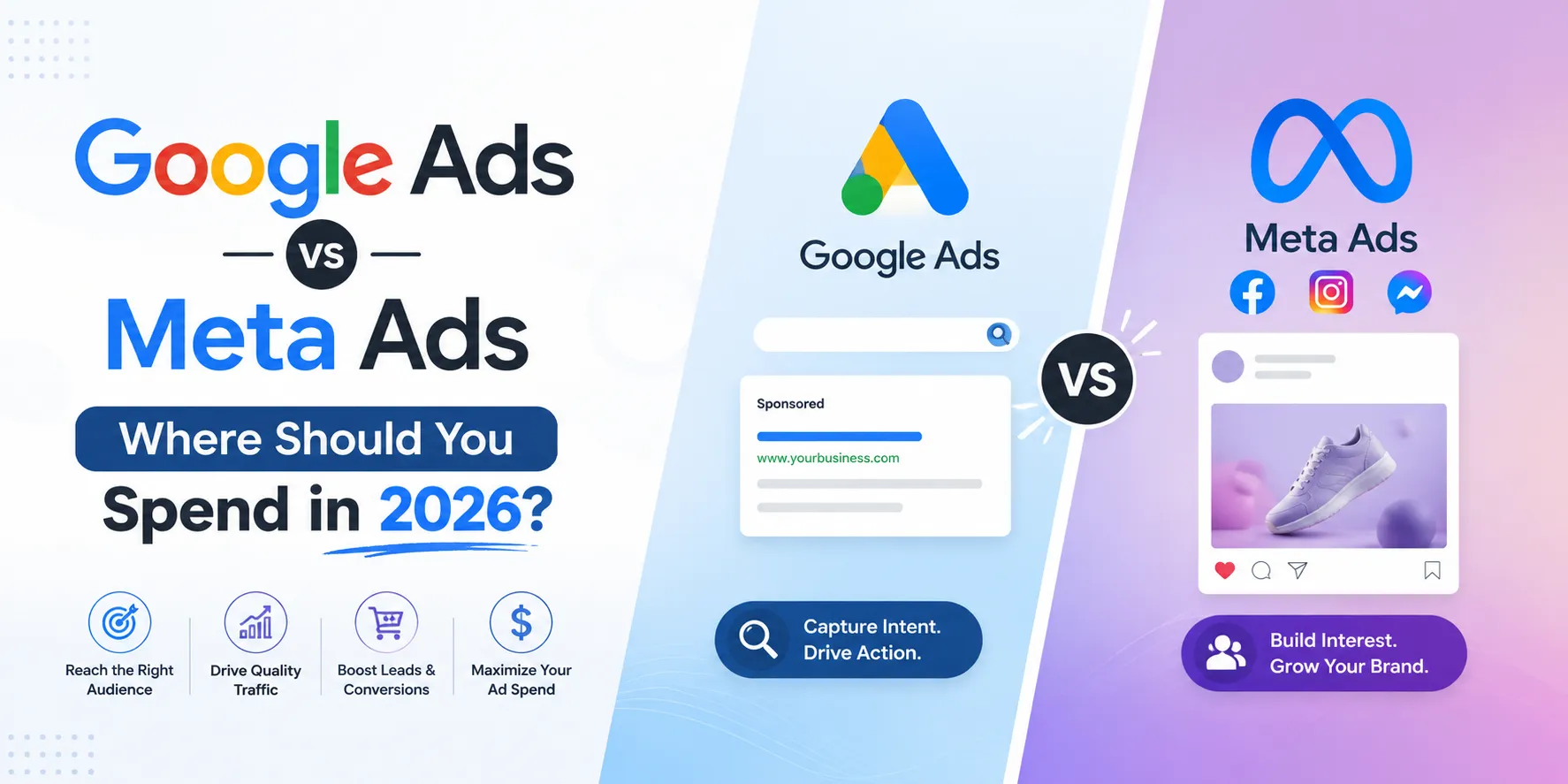

For businesses focused on capturing high-intent buyers ready to purchase, Google Ads delivers stronger conversion rates through search-based targeting. Meta Ads (Facebook and Instagram) outperform for brand awareness, audience building, and visually driven products where discovery drives demand. Most businesses in 2026 get the best results running both platforms together, but if budget forces a choice, align your decision with where your customers are in the buying journey.
Now, let us break down what actually separates these two platforms and how smart marketers are using professional PPC advertising services to maximize returns from each.
How Google Ads Works, and When It Wins
Google Ads operates on search intent. Someone types "emergency plumber near me" or "best CRM for small business," and your ad appears right when they are actively looking for a solution.
That intent is enormously valuable. The user is not scrolling passively; they came to Google with a specific need. This makes Google Ads exceptionally powerful for:
- Service-based businesses (legal, medical, home services, finance)
- High-ticket B2B products with a defined buyer journey
- Local businesses targeting customers in a specific area
- E-commerce with strong branded or category search volume
The average cost per click in Google Search campaigns ranges from $1 to $6 across most industries, though competitive niches like insurance or legal services can push well above $10. According to WordStream industry benchmarks, the average Google Ads conversion rate across industries sits around 3.75% for search, which is significantly higher than most social platforms.
How Meta Ads Work, and When They Shine
Meta Ads (running across Facebook, Instagram, Messenger, and the Audience Network) use interest- and behavior-based targeting. You are reaching people based on who they are, what they like, and how they have behaved, not what they are actively searching for right now.
This creates a different kind of opportunity: demand generation. You can put a visually compelling ad in front of exactly the right person, even before they know they need your product.
Meta Ads perform best for:
- Consumer e-commerce and DTC (direct-to-consumer) brands
- Fashion, beauty, lifestyle, fitness, and food products
- Coaches, course creators, and info-product businesses
- Retargeting warm audiences who have visited your website
- Building brand awareness and growing social followings
Meta's targeting remains among the most sophisticated in advertising. Despite privacy changes introduced by iOS updates, Meta has rebuilt its signal infrastructure with the Conversions API and AI-driven optimization, and 2026 campaigns are performing better than during the post-iOS turbulence of 2021–2022.
Average CPM (cost per thousand impressions) on Meta is typically lower than Google Display. For the right creative, the platform still delivers strong ROAS, particularly for e-commerce brands where a single viral product video can generate thousands of low-cost conversions.
Google Ads vs Meta Ads: Head-to-Head Comparison
| Factor | Google Ads | Meta Ads |
| Audience Targeting | Keyword-based (search intent) | Demographic, interest, behavior |
| Average CPC | $1–$10+ (industry dependent) | $0.50–$3.00 (varies by objective) |
| Conversion Intent | High: users are actively searching | Lower: discovery and awareness phase |
| Best Industries | Legal, finance, home services, B2B, healthcare | E-commerce, fashion, DTC, lifestyle, education |
| ROI Potential | High for purchase-ready audiences | High for top-of-funnel and retargeting |
| Lead Generation | Strong for services and local businesses | Strong with lead forms and retargeting |
| Brand Awareness | Moderate (Display and YouTube) | Excellent — visual, native format |
| Retargeting | Yes — Google Display and YouTube | Yes — highly effective across Meta apps |
| Ideal Business Type | Service-based, local, B2B | Consumer brands, e-commerce, and content creators |
The Budget Question: Where Should Your Money Go?
Here is a scenario many business owners face: $3,000 monthly ad budget and two platforms demanding your attention.
If you run a local law firm, put 80–90% into Google Ads. People searching for "personal injury lawyer Chicago" are ready to call. Meta Ads can complement retargeting, but the immediate ROI comes from search.
If you sell handmade jewelry online, flip that ratio. Meta Ads, especially Instagram, are where product discovery happens. Google Shopping can supplement branded searches, but your growth engine is Meta.
If you offer B2B software, Google Ads for bottom-funnel search terms combined with LinkedIn for account-based targeting often outperforms Meta. But Meta retargeting is still worth a small allocation to stay in front of website visitors.
The pattern here is not about which platform is "better." It is about matching platform mechanics to your sales funnel stage and to your customer's psychology.
Professional PPC advertising services do exactly this — they audit where your customers live, map the funnel, and allocate budget to the channel that earns the return at each stage.
What Has Changed in 2026
A few developments are actively reshaping how both platforms perform:
Google's AI-driven campaigns have matured. Performance Max (PMax) now handles cross-channel optimization across Search, Display, YouTube, Gmail, and Maps from a single campaign. For businesses that struggled to manage multiple Google campaign types, PMax simplifies execution while improving efficiency, though it requires high-quality creative assets and clear conversion data to perform well.
Meta's Advantage+ campaigns are similarly automating audience and creative decisions using AI. For e-commerce brands, Advantage+ Shopping campaigns have consistently delivered stronger ROAS than manual ad sets in numerous advertiser case studies through early 2026.
First-party data is now the edge. With third-party cookies effectively gone and privacy regulations tightening globally, businesses with clean CRM data, strong email lists, and a properly configured Conversions API are outperforming those relying solely on platform-native tracking. This applies equally to both Google and Meta.
Combining Both Platforms: The Full-Funnel Approach
The most effective digital advertising strategies in 2026 do not pick one platform; they assign each platform a role.
- Meta Ads introduce your brand to cold audiences, build awareness, and drive traffic
- Google Ads captures the demand that Meta created, intercepting high-intent searches
- Meta Retargeting re-engages website visitors and cart abandoners with compelling offers
- Google Remarketing keeps your brand visible across millions of websites and YouTube
This full-funnel model consistently outperforms either platform in isolation. When you see a business scaling aggressively, it is almost always structured this way.
Global Key Info Solutions, offering PPC advertising services with experience across both platforms, is better positioned to build these integrated strategies than specialists siloed in just one channel.
Conclusion: Pick the Platform That Matches Your Buyer
The Google vs. Meta debate does not have a universal answer—it has a contextual one.
If your customers are searching for what you sell, Google Ads is where you show up. If your customers need to discover what you sell, Meta Ads is where you build that awareness. Budget permitting, running both with a clear full-funnel strategy is what separates growing brands from stagnant ones.
Wherever you decide to invest, the quality of campaign management matters as much as the platform. Precise targeting, strong creative, clean tracking, and continuous optimization are what turn ad spend into actual business growth.



























Sign in to leave a comment.