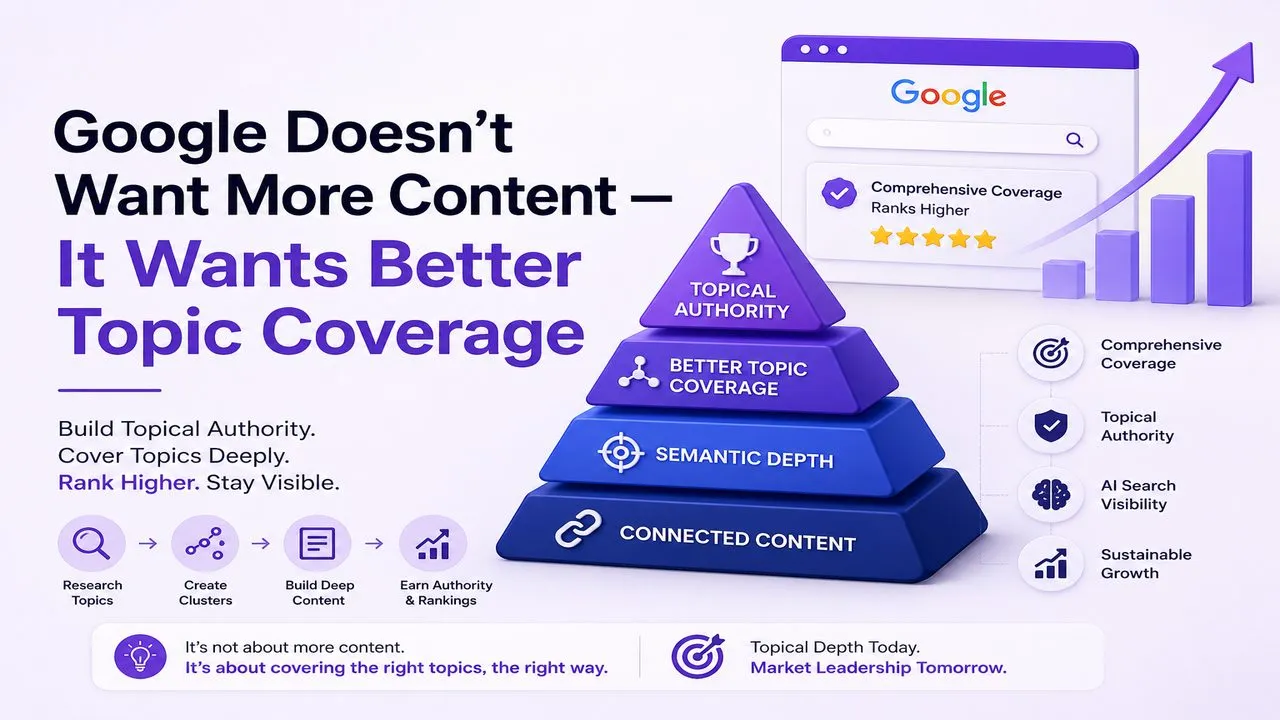

There's a quiet frustration spreading through the SEO community right now. Businesses that have been publishing consistently for years — stacking blog posts, maintaining schedules, hitting every keyword cluster on their list — are watching their traffic flatline or drop. Not because the content is bad. Because it's incomplete.
Google has moved on. And most content strategies haven't caught up.
Something shifted in the way I think about content strategy, and I've been meaning to write this down for a while.
It started with a client conversation about six months ago. Small business, decent website, a content team that had been publishing two to three posts a week for nearly two years. By any output metric, they were doing the work. They had volume. They had consistency. They had a library of articles that would take an afternoon to scroll through.
And yet page two for almost everything. Occasionally page one for a low-competition term, but nothing sticky. Nothing that compounded. Rankings would nudge up after a new article went live, then drift back within weeks.
When I dug into the actual content, the problem became obvious almost immediately. It wasn't that the articles were poorly written. Most were fine, actually — well-structured, readable, covering the topics they claimed to cover. The problem was that they were all covering the same shallow version of each topic. Surface-level. Entry-point only. Never going deep, never building outward, never connecting to the surrounding concepts that would tell a search engine. this website actually understands this subject.
They had content. What they lacked was coverage.
This is where modern topical authority SEO strategies completely change how websites grow organically. And in 2026, that distinction is everything.
Why Volume Stopped Being a Strategy
I think a lot of us — and I include myself in this — built our early content instincts during a period when more genuinely did mean better. Publish frequently. Hit the keywords. Build backlinks. The formula worked for long enough that it became the default.
Then Google's evaluation systems started changing. Slowly at first, then noticeably. The Helpful Content updates the ones that ran through 2023 and kept building into 2025 weren't really about penalizing bad content. They were about rewarding complete content. There's a meaningful difference.
A penalty-based system punishes obvious offenders. A completeness-based system rewards the sites that have done the fullest job of explaining a subject — every dimension of it, every question someone might have at every stage of their understanding. The sites that rank today in competitive spaces aren't necessarily the ones with the most articles. They're the ones that have earned what the SEO industry now calls topical authority. a measurable signal that your domain is a reliable, thorough source on a specific search intent.
I've watched this play out dozens of times now. A business publishes one well-structured pillar page with fifteen supporting articles covering every meaningful subtopic, and within three to four months they're outranking competitors who have been publishing for years. The competitor has more content by word count. The newcomer has better coverage by subject map. Google picks the one with the map.
What "Coverage" Actually Means in Practice
This is where I want to be specific, because "better coverage" can sound abstract.
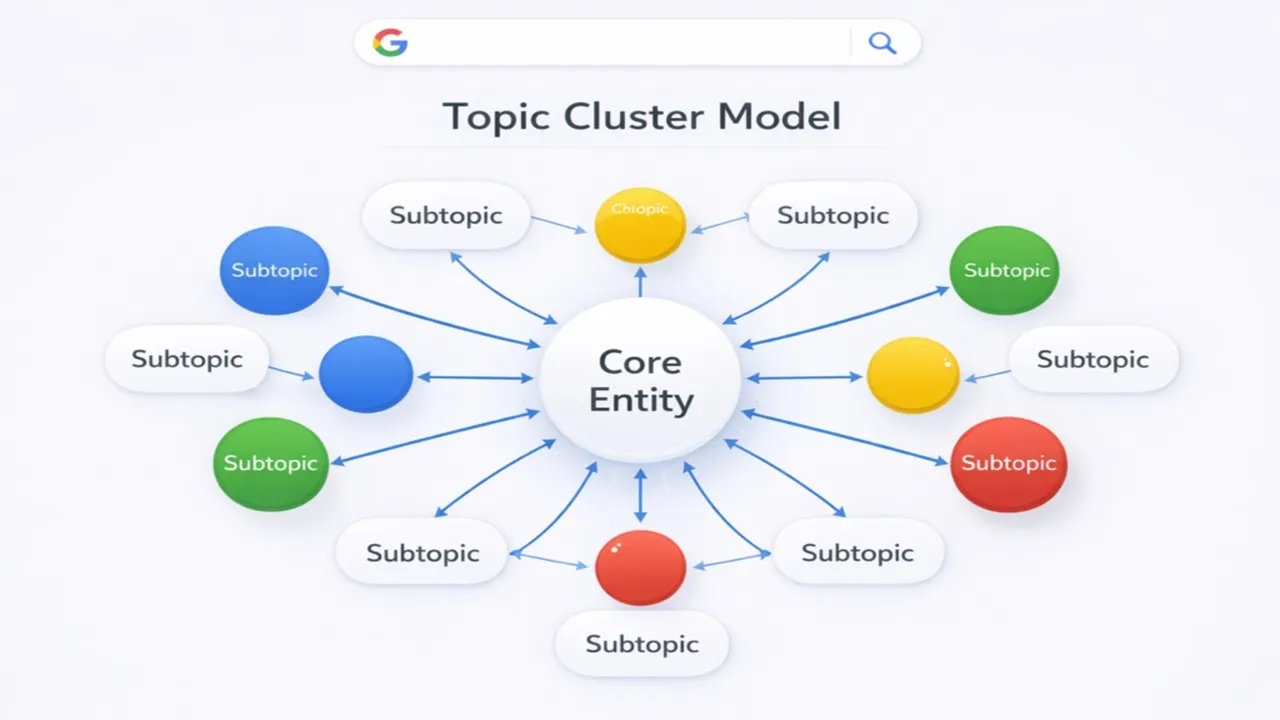
When a search engine evaluates how well a website understands a topic, it's not just reading your pillar page. It's reading the relationships between your pages. It's looking at whether the subtopics surrounding your main topic have been addressed, whether they link to each other intelligently, whether the vocabulary used across your site reflects genuine domain knowledge rather than surface-level keyword insertion.
Think of it this way. If your business sells accounting software for small businesses, Google isn't just asking "do you have a page about accounting software?" It's asking whether your site meaningfully addresses bookkeeping workflows, tax compliance, invoice management, payroll integration, multi-currency support, financial reporting standards — all the adjacent concepts that a real expert in this space would naturally be discussing. If your site has the product page but none of the surrounding context, you read as incomplete. And incomplete doesn't rank.
This is the shift from keyword-based optimization to entity-based optimization. Keywords are inputs. Entities are concepts, real-world objects, ideas, services, processes and the relationships between them. Search engines have been building their understanding of these relationships for years through the google Knowledge Graph and increasingly through large language model-assisted evaluation. What they're now comparing your content against is a kind of mental map of how a subject should be understood, built from millions of authoritative sources. If your content map has gaps, the algorithm sees them even if a human reader might not notice.
The AI Search Layer Makes This More Urgent, Not Less
One thing I keep saying to people who ask whether AI-generated search is going to make SEO irrelevant. it's doing the exact opposite. It's making the underlying quality signals matter more.
When a generative AI system, whether that's Google's AI Overviews, Perplexity, or any of the other answer engines that have proliferated through 2025 and into this year — decides which sources to cite in a response, it's running a much faster version of the same evaluation.
Is this source comprehensive?
Is it specific? Does it demonstrate actual expertise in the claim it's making? Is there enough corroborating signal from other parts of the web that this entity can be trusted on this topic?
That last question is where the backlink and citation ecosystem still matters enormously — just differently than before. It's not raw link count. It's contextual endorsement. When a trusted source links to your content in the middle of discussing a related topic, it's essentially telling the algorithm. "this source is relevant to this conversation." That kind of contextual co-occurrence your brand mentioned alongside the concepts you want to be associated with is one of the cleaner signals of genuine topical authority.
The Uncomfortable Reality for Most Businesses
Here's my honest observation after working through this shift with a lot of different organizations. the topical authority model is simple to understand and genuinely difficult to commit to.
It requires saying no to things. It means choosing a narrower topic scope than feels comfortable, knowing you're leaving potential traffic on the table in other areas. It means resisting the urge to publish on trending topics that are slightly off-niche just because they're getting search volume. It means doing the patient, unglamorous work of covering a subject from twelve different angles before you've seen the rankings move and trusting that the movement will eventually come.
Most content marketing strategies break at that last part. The timeline between planting the semantic seed and seeing the ranking compound is usually three to six months, and a lot of organizations don't have the patience or the internal alignment to hold the line that long. They pivot. They start chasing something shinier. And they reset the clock.
The businesses that are consistently winning organic search in 2026. in competitive categories, not just long-tail niches are almost universally the ones that picked their subject area, committed to covering it fully, and didn't flinch when the first two months of publishing felt like shouting into a void.
A Few Things I've Observed That Seem To Help
Not a framework. Just patterns I keep noticing.
The sites that build topical authority fastest tend to start from a question map, not a keyword list. They literally write down every question a curious person at any stage of understanding, from beginner to practitioner — might ask about their subject area. Then they systematically answer those questions in connected content. The keyword research comes second, as a way to prioritize and phrase, not as the source of the topic itself.
They also tend to treat internal linking as architecture, not afterthought. The relationship between their pages is deliberate and consistent a pillar page that explicitly links out to each subtopic, subtopic pages that reference each other where relevant, and a site structure that a crawler can navigate logically. This isn't technically complex. It's just discipline.
And the ones doing it best in local markets — particularly in emerging digital economies where the competition for authority is still relatively open — are moving fast. The window for establishing topical dominance in a regional niche isn't unlimited. The businesses that recognize this early and build the content infrastructure now are going to be very difficult to displace eighteen months from now.
Where This Is All Going
My read on the next phase — and this is genuinely an opinion, not a prediction, is that the concept of topical authority in seo is going to become more measurable and more explicitly rewarded over time.
As AI search systems become better at evaluating expertise signals, and as Google continues developing its ability to assess E-E-A-T across a domain rather than just a page, the gap between "lots of content" and "deep coverage" is going to widen further. The businesses that have built genuine semantic depth in their niches will have a compounding advantage. The ones still running the publish-frequently-and-hope approach will find the diminishing returns accelerating.
None of this means content volume is irrelevant. It means volume without structure is increasingly worthless. The quantity still matters — you can't build topical authority on three articles. But it matters as a function of coverage, not as a metric in itself.
More pages covering the same surface-level ground isn't topical authority. It's just more noise in an already noisy space.
Google has been telling us this for a while now. I think 2026 is the year most Content strategies will finally have to listen.
If you've been thinking about restructuring your content approach around topic depth rather than output volume, I'd genuinely like to hear what's worked or not worked. Drop a comment these conversations are usually more useful than another blog post on the subject.


























Sign in to leave a comment.