
Anxiety lies to you. It says everything is broken. It scans for threats, replays worst-case scenarios, and loops the same worries until you're exhausted. It does this quietly, in the background, all day long.
Gratitude journaling for anxiety doesn't fix that. But it interrupts it. That small interruption, repeated often enough, changes how much room anxiety takes up. Not overnight. Over time.
Here's what that actually looks like in practice.
Why Gratitude Works on Anxious Thinking
Anxiety pulls your focus toward danger. Psychologists call this a negativity bias. Your brain gets sharper at spotting threats than at noticing what's already fine. Left on its own, that turns into rumination. Same worry, on repeat, going nowhere.
Gratitude gives your mind a second road.
Here's the key part: gratitude and rumination compete for the same mental space. Your brain can't fully hold both at once. When you stop to name something real that you appreciate, the anxious loop has to pause. Even for just a moment.
That moment matters. It creates room to respond instead of react.
Anxiety also lives mostly in the future. Or it drags you back into the past. Gratitude does neither. It pulls your attention into right now. The coffee on the desk. The friend who texted earlier. The fact that today, somehow, you got through it. That shift toward the present is one of the most useful things a gratitude journal actually does for people who struggle with anxious thinking.
What the Research Actually Shows
One well-known study by Fekete and Deichert (2022) looked at gratitude journaling during the COVID-19 pandemic. Researchers split adults into three groups. One wrote daily gratitude entries. Another did expressive writing. A third did neutral writing tasks.
A month later, the gratitude group reported lower stress and less negative emotion. Their sense of gratitude held steady too. In the other groups, it dropped.
That's useful. But the researchers were also honest about the limits. Gratitude journaling didn't show a statistically clear drop in anxiety scores specifically. Not in this sample.
What does that mean for you? It means gratitude journaling is not a cure. It's a coping tool. It can ease stress, quiet rumination, and help you hold a steadier emotional baseline day to day. That's worth something. Just don't oversell it to yourself.
Consistency also showed up as a key factor in the findings. Daily journaling, even with simple reminder emails, outperformed writing done in bursts. Small and regular beats big and occasional. Every single time.
How to Start Without Overcomplicating It
This doesn't require a special notebook or a long morning ritual. It just needs to be easy enough to come back to tomorrow.
Pick a format that removes friction. Paper works well for focus. A notes app works well when anxiety hits mid-afternoon on a Tuesday. Neither one is better than the other. The one you'll actually open again is the one that wins.
Then try this five-minute structure:
- Rate your anxiety from 1 to 10. Just a number, nothing more.
- Write three things you're grateful for today. Specific ones, not general ones.
- Answer one prompt that fits where you're at.
- End with one line of self-compassion or one small hope for tomorrow.
That's the whole thing. Five minutes. Done.
Three sessions a week is a solid place to start. Daily is great if you can manage it. But building pressure into the habit kills it fast. One honest entry beats seven forced ones every time.
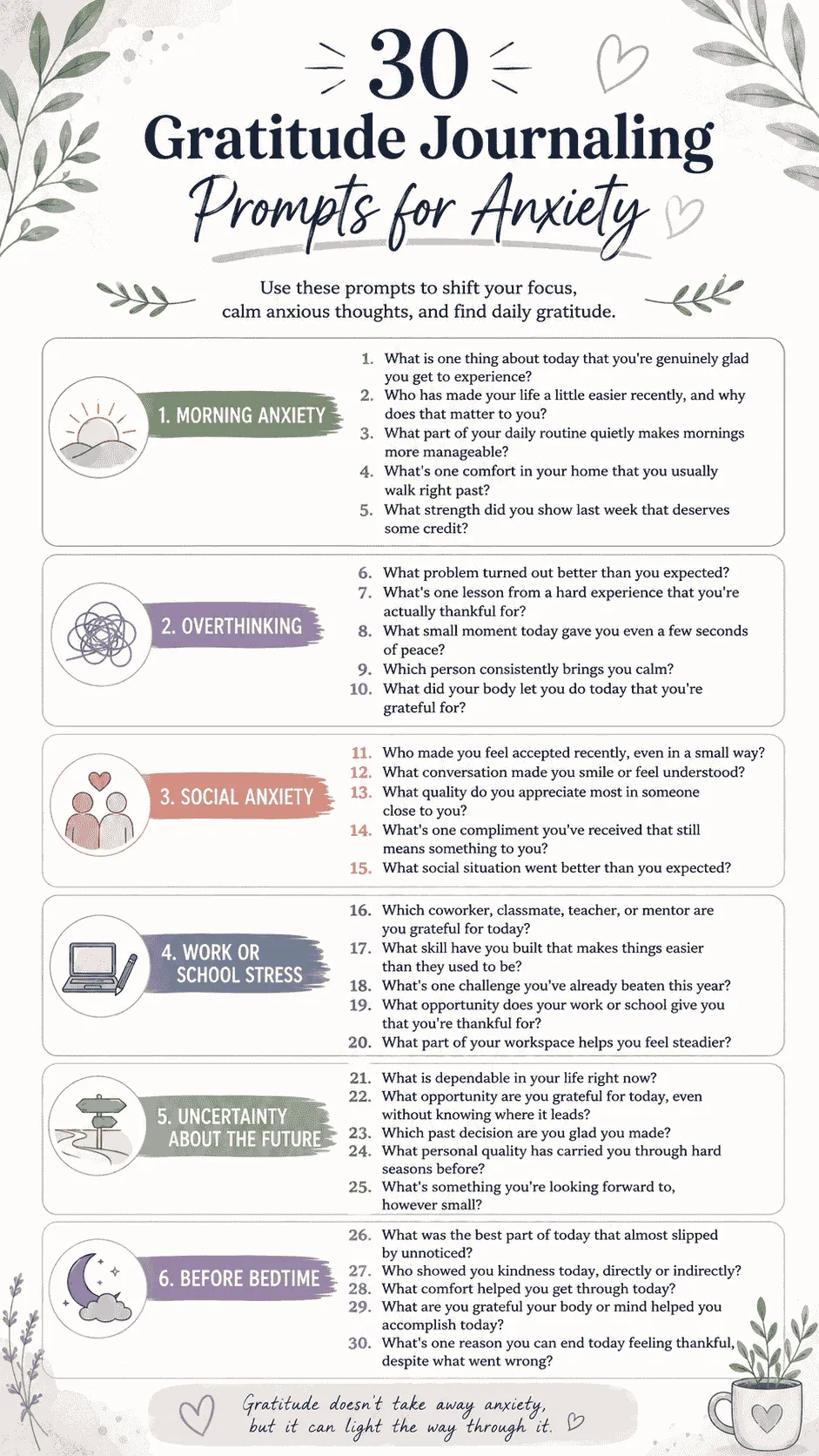
A Few Prompts to Get You Started
Don't stare at a blank page. Use a prompt.
- For morning anxiety: What is one thing you are genuinely glad you get to do today?
- For overthinking: What problem recently turned out better than you expected?
- For social anxiety: Who made you feel accepted recently, even in a small way?
- For work stress: What skill do you have now that you didn't have a year ago?
- For bedtime: What is one good moment from today that almost slipped by unnoticed?
The goal isn't to trick your brain into feeling happy. It's to give your attention somewhere real to land. Somewhere true. Anxiety fills every empty space it finds. Prompts like these take up that space first.
Mistakes That Drain the Practice
Forcing positivity is the biggest one. You don't need to feel cheerful to journal. You don't need to fix your mood before you write. "Today was hard, and I'm glad my friend checked in" is a perfectly good entry. Both feelings can sit together on the same page.
Using gratitude to guilt yourself out of pain is the other trap. Thoughts like "I shouldn't feel anxious, I have so much to be grateful for" are self-punishment wearing a nicer outfit.
Gratitude and anxiety can coexist. Your journal should hold both, not put your feelings on trial.
Watch out for recycled lists too. Family. Health. Morning coffee. Those things matter. But if every entry says the same three things, your brain goes on autopilot.
Dig for something specific. The song that helped. The meal that hit right. The meeting you were dreading that turned out fine. Specific details stick. Vague ones slide right off.
When Journaling Isn't Enough
This part matters. Pay attention to it.
If anxiety follows you all day, won't let up, or starts affecting your sleep, work, or relationships, a gratitude journal is not the right first move on its own. It's one piece of a bigger picture.
Panic attacks need grounding and breathing first, not writing.
Persistent anxiety disorders need professional care. A therapist, a counselor, or medication where it's appropriate. These things work. Journaling works best alongside them, not instead of them.
If you're looking for professional support, the Anxiety and Depression Association of America is a solid place to start.
The Short Version
Anxiety tells one story. Gratitude journaling teaches your mind to notice another one. Not a fake one. Not a better one. Just a fuller one.
Start small. Pick one prompt. Write one honest line. Do that a few times a week and see what begins to shift.
For a deeper guide covering the research, a full daily routine, and 30 prompts sorted by anxiety type, read the complete piece on gratitude journaling for anxiety.































Sign in to leave a comment.