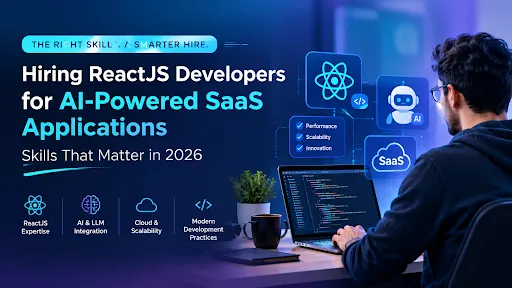

React now runs on nearly 70% of all websites built with a JavaScript framework, and the ecosystem around it is projected to hit a $28.6 billion market value by 2027. That dominance isn't the interesting part, though — plenty of technologies stay popular without changing much. It's not that much of a change in what a “good React developer” is in 2026. The job skills that helped an individual get a job two years ago are only tangentially related to the skills needed for an AI-powered SaaS today.
If you are adding staff to your SaaS build now, it's a big deal. The combination of hiring the wrong folks and paying down technical debt for a year instead of delivering features is an eternity. This is exactly the brief worth having in mind before you Hire ReactJS Developers for your next AI-driven product.
Why ReactJS Is Still the Default Choice for AI-Powered SaaS
It would be easy to assume a decade-old library is due for replacement. The data says otherwise:
• React remains the most-used JavaScript library among professional developers, with a 9.13% preference gap over Vue and a 75% developer retention rate — higher than Angular or Vue
• React 19 and the new React Compiler have meaningfully improved hydration speed and cut unnecessary re-renders, addressing long-standing performance complaints
• The “standard stack” has shifted from Create React App toward Vite and Next.js, both built to support the streaming, AI-assisted interfaces modern SaaS products increasingly rely on
For a SaaS product layering AI features on top of a UI — chat interfaces, live model output, streaming responses — React's component model and mature ecosystem still make it the path of least resistance.
The Skills That Actually Matter in 2026
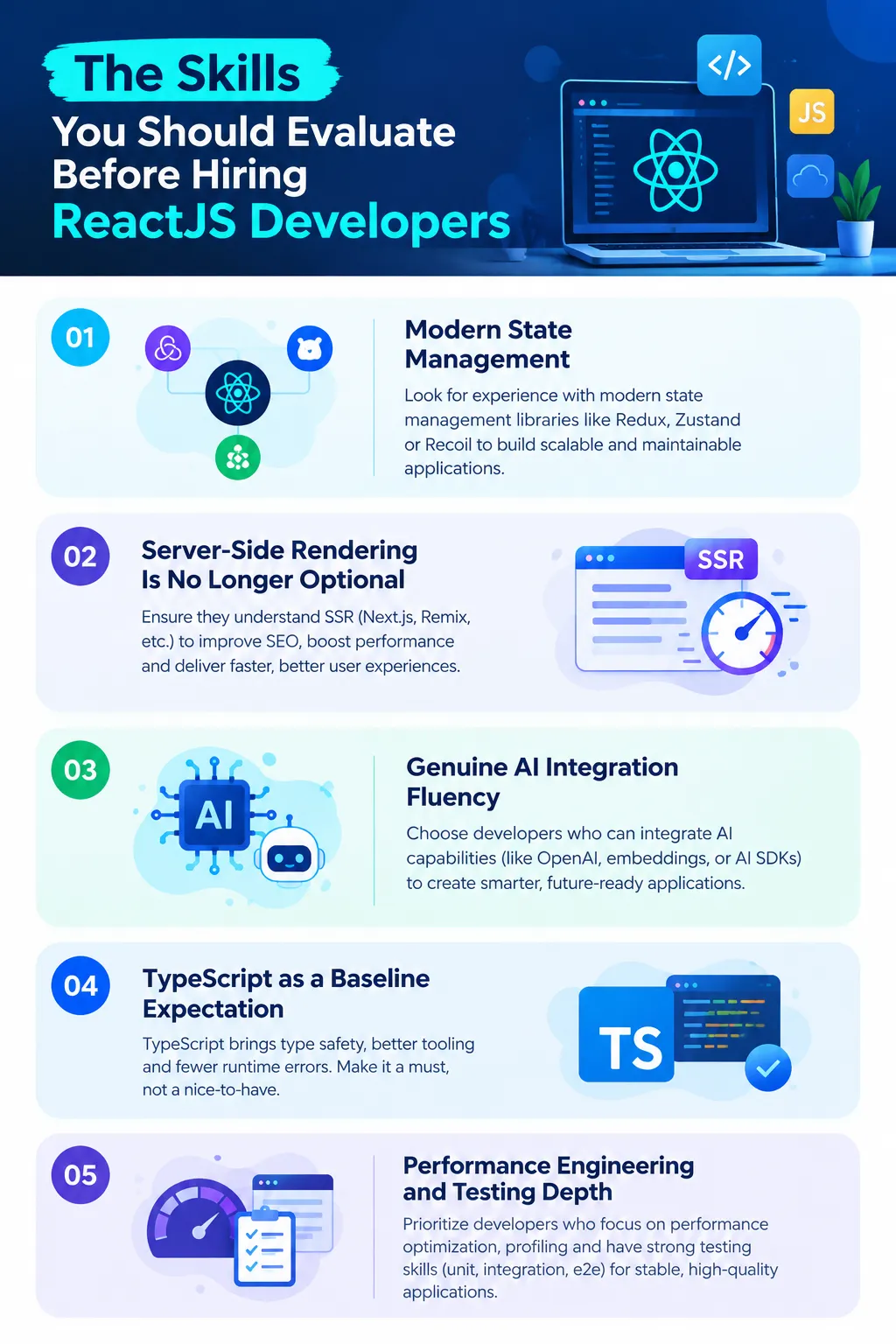
Modern State Management
Redux's older, boilerplate-heavy patterns have given way to leaner tools — Zustand, Jotai, and Redux Toolkit. For interfaces that use intelligence to handle streams of data, show loading signs and update parts of the screen, developers who choose the best way to manage the state instead of using the same method they learned five years ago can really improve how fast the app works.
Server-Side Rendering Is No Longer Optional
Experience with Next.js or Remix has gone from something to have to something most job listings expect. SaaS products that are trying to win by being fast and easy to find on search engines can't use a client-side- React app anymore. Candidates who only know that way of working will need time to get up to speed with a modern build.
Genuine AI Integration Fluency
AI integration is now the growing web development specialization, up 180 percent, in demand. AI does not mean that every React developer needs to train models. AI means that a React developer must comfortably wire up streaming AI responses, handle token-by-token UI updates and manage the latency and error states that come with calling an LLM of a standard REST endpoint. AI introduces a different set of edge cases than a typical CRUD interface.
TypeScript as a Baseline Expectation
TypeScript adoption in frontend job listings has grown from roughly 12% to 38.5% over five years, and it's now required in a third of frontend roles. For a SaaS codebase that's going to live for years and onboard new engineers repeatedly, static typing isn't a preference — it's risk management that pays for itself within the first few sprints.
Performance Engineering and Testing Depth
Core Web Vitals scores increasingly affect both user retention and search visibility.
Therefore, memoization, loading and code‑splitting need to become second nature, not something that is only looked up in the middle of a project.
In addition real testing discipline, with Jest, React Testing Library or Cypress separates developers who ship reliably from developers who ship fast and then fight fires.
What's Changed About the Hiring Market Itself
Beyond the technical skill list, the market you're hiring into looks different than it did even eighteen months ago:
• 77% of developers now use AI coding tools and report roughly 55% faster task completion — yet 55% of companies still plan to grow their developer headcount in 2026
• Junior developer job postings have declined 23%, as AI tooling raises the baseline skill companies expect from every hire, junior or not
• Developers with AI/ML skills command a 25–35% salary premium over peers without them
• Freelance React rates now average $51–$75 per hour, with Next.js or React Native specialisation typically adding another 15–35% on top
• Software developer job postings overall are up 15% since mid-2025, a leading signal that hiring is genuinely recovering, not just AI-role churn
Put together, the message is clear: the market isn't shrinking, but the bar for what counts as “qualified” has moved up noticeably.
Build In-House, Hire Freelance, or Partner With an Agency?
Once you know what skills you need, the next hard question is where to find those skills. There are three paths right now and each works for a different situation.
• In‑house hiring works when the product is a core part of your business, for the long term and when you can handle a recruitment process that takes several months without stopping the work.
• Freelance marketplaces suit short, well-scoped tasks where you can manage the work directly without much oversight overhead
• A custom software development company or bespoke software development agency fits best when you need a team fast, with architecture guidance included, not just a pair of hands
This is where application development outsourcing earns its reputation. A capable custom software company brings vetted React talent, project management, and QA as a package — rather than leaving you to assemble and manage each piece yourself. For SaaS teams under time pressure, that's often the difference between a six-week ramp-up and a six-month one.
When evaluating a software development company or bespoke software solutions provider, a few questions cut through most of the marketing copy fast:
• Can they show React 19, Next.js, and AI-integration work specifically, not just general frontend experience?
• Do they offer bespoke software development services tailored to your product, or a templated build process regardless of the brief?
• What does their QA and testing process actually look like, beyond a line item in a proposal?
• Will you own the codebase and architecture decisions, or are you locked into their tooling and roadmap?
The right custom software development solutions partner should feel less like a vendor and more like an extension of your own engineering team — accountable to the same product goals, not just a delivery deadline.
Following the Software Development Trends That Matter
It's simple to follow every framework story but the software development trends that really matter for hiring in AI SaaS in 2026 are not as wide as people think. The trends include AI helping with development tasks, Server Components becoming better in situations and a hiring market that prefers people who know a lot about one thing instead of being good at many things. Groups that match their hiring rules to these changes. Of using an old job description. Always finish work quicker and find the right people better.
Also Read : From MVP to Enterprise: Scaling with React Developers Without Compromising Quality
Conclusion
React isn't going anywhere in 2026, but the version of “React developer” worth hiring has quietly changed. Modern state management, Next.js fluency, real AI-integration experience, and TypeScript are no longer differentiators — they're the baseline. Whether you build that team in-house, hire freelance, or partner with a custom software development company, the businesses shipping AI-powered SaaS products successfully right now are the ones hiring against 2026's actual skill bar, not the one from a few years ago.






















Sign in to leave a comment.