
A smart home system that works well in Germany can behave very differently in a flat in Pune or a house in Ludhiana. Same product, same app, different result.
The reason is simple. Indian homes have conditions that most systems were never built for. If you know what those are, you can ask the right questions before you spend any money.
Wohnux is engineered in Germany by Impac Labs GmbH, but the India product is built differently on purpose. Home automation in India has to handle things European automation never sees.
Here is what to check.
1. Voltage
Power supply in India goes up and down. Not once in a while, but regularly, and worst in summer when everything is running together.
Hardware made for a steady supply does not fail loudly. It just stops working earlier than it should, usually in the second year.
Ask: what voltage range is this hardware built for?
2. Power cuts
The cut itself is not the issue. What matters is what happens when the power comes back.
A good system starts again on its own, in the same state it was in before. A weak system comes back confused. Schedules are gone, devices are in the wrong state, and sometimes things need setting up again.
If you have to fix your living room three times in a month, the system stops feeling useful.
Ask: does everything come back on its own after a power cut?
3. Internet
This is the most important question, and most brands avoid answering it clearly.
If your system runs through a cloud server, then no internet means no control. Your wall panel stops working for your own lights.
A good system works locally. Panels work, switches work, timers run. Only phone control from outside the house waits for the internet to come back.
This cannot be added later. It is decided when the system is designed.
Ask: if the internet is off, will the wall panel still switch my lights? Get a yes or no.
4. Neutral wire
Many Indian houses only have the live wire coming to the switch. The neutral goes straight to the light.
That is fine for a normal switch. It is a problem for most smart modules, which need both wires to stay powered.
This does not mean rewiring your house. It means some switchboards may need work, and it means nobody can give you a correct price without opening one.
Ask: will you check for neutral before you give me a price?
5. Heat and humidity
A panel in Delhi in May sits in a room at 45 degrees. A panel in Kochi sits through the monsoon in heavy humidity.
Panels made for European homes are not automatically fine here. It has to be in the specification.
Ask: what temperature range is this panel rated for?
6. Service after two years
This one has nothing to do with technology, and it is the most common regret we hear.
Hardware can come from anywhere. Service cannot. When a panel stops working after eighteen months, you need someone who can reach your house, not an email address in another country.
Ask: where is your nearest service team, and how long do they take to come?
What you actually get day to day
Once these things are sorted, using it is simple.
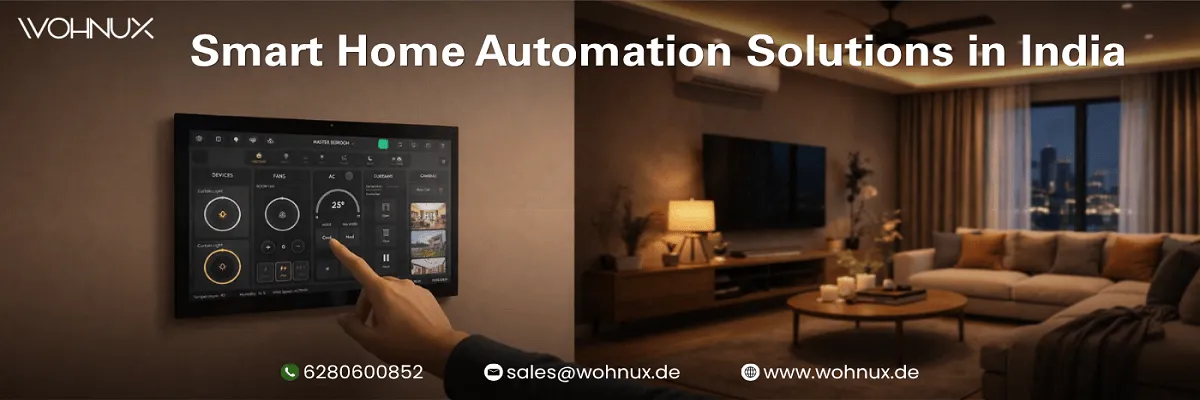
Lights, fans and AC run from a wall panel, your phone, or your voice. You can switch off a light in another room without getting up, which is the thing most families use every day. The AC can turn warmer at 2 AM on its own, or switch on from the car before you reach home. Curtains open in the morning by themselves. The video door phone, smart lock and fire detection all send alerts to the same phone.
One button called Good Night handles the downstairs lights, the bedroom AC and the curtains together.
None of it is dramatic. It removes many small problems from a normal day and stops electricity going to waste.
Start small
You do not need to automate the whole house at once.
Most people who ask about home automation in India start with the bedroom and the living room, then use it for a month. You will learn which features you use daily and which ones you forgot about after a week. Then spend the rest of the budget with that knowledge.
Price is based on point count, not floor area. A point is one thing you control, like a light or a fan. Two flats of the same size can differ a lot depending on how many points they have. This is why a proper price comes after a site visit, not over the phone.





















Sign in to leave a comment.