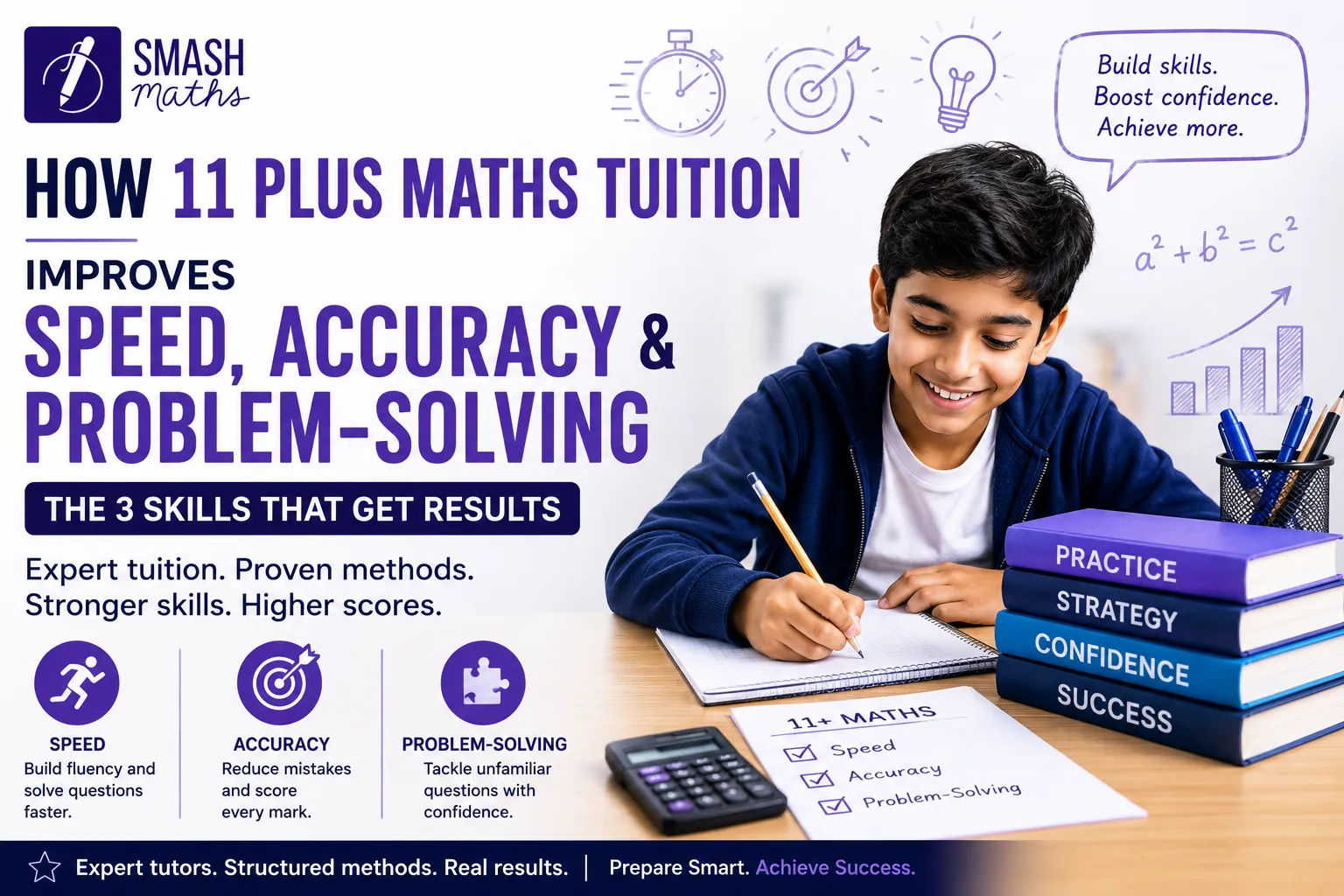

There's a version of 11 Plus preparation that goes like this: the child does practice papers, the parent marks them, repeat until exam day. And for a small number of children who are already very strong in maths, that's enough. For most, it isn't — and the results show it. According to GL Assessment, the largest provider of 11+ tests in England, the maths paper is consistently where children drop the most marks, and the gap between strong and weak performance almost always comes down to three things: speed, accuracy, and the ability to solve unfamiliar problems. If you're researching 11 plus maths tuition in the UK and wondering whether it actually moves the needle on those three things — here's the honest answer.
What Does "Doing Well" in 11 Plus Maths Actually Mean?
It's worth being precise about this, because parents often focus on the wrong thing.
Getting into a grammar school isn't just about knowing the KS2 maths curriculum. Most children sitting the 11+ have covered most of the content at school. The ones who score highest are the ones who can access that knowledge quickly, apply it accurately under time pressure, and handle questions that look different from anything they've seen before.
Those are three distinct skills. And they can all be trained — but not by doing practice papers alone.
Why Practice Papers Alone Don't Fix the Problem
Here's something most families find out too late.
A child can sit thirty practice papers and still lose the same marks in the same places. Because practice papers, without targeted review and structured teaching, just confirm what a child already does — including the errors they keep making.
It's a bit like practising golf with a flawed swing. The more you practise, the more automatic the wrong technique becomes.
The Education Endowment Foundation is clear on this: retrieval practice and targeted feedback are the highest-impact strategies for academic improvement. Practice without feedback is low-impact, regardless of how much of it you do.
Structured tuition breaks this cycle. Here's how.
How Good 11 Plus Maths Tuition Builds Speed
Speed in maths doesn't come from rushing. It comes from fluency — the point where a calculation or method is so well-practised that it doesn't require conscious effort anymore.
Think about reading. A young child reads letter by letter, sounding everything out. An adult reads whole words and phrases in a single glance, without thinking about individual letters at all. The process is the same — it's the fluency that's different.
Maths works the same way. A child who has to consciously think through 8 × 7 every single time is using cognitive effort that should be going towards the actual problem. A child who knows it instantly has that capacity free for the harder thinking.
What Tuition Does to Build Speed
Good 11 plus maths tuition addresses speed in specific, practical ways:
- Times tables until they're truly automatic — not just "known" but instant, under pressure, in the middle of a longer calculation
- Mental arithmetic in short daily bursts — not calculator practice, but rapid mental computation that builds fluency over weeks
- Timed mini-sessions — ten questions in eight minutes, not as a test but as a training tool, building the habit of working quickly without sacrificing accuracy
- Removing the "working memory bottleneck" — by drilling foundations until they're automatic, freeing mental space for harder reasoning
This isn't about teaching children to guess faster. It's about reducing the cognitive load of basic calculation so their brain has room for the actual problem.
How Good 11 Plus Maths Tuition Builds Accuracy
Speed without accuracy is useless in the 11+. A fast wrong answer is still a wrong answer.
The accuracy problem in 11+ maths tends to come from a few specific sources — and good tuition targets all of them directly.
Misreading the question
This is, by a considerable margin, the most common source of avoidable errors. Children rush, assume they know what's being asked, and answer the wrong question entirely. Structured tuition builds the habit of underlining the key instruction word — difference, remaining, perimeter, fraction of — before doing any calculation whatsoever. It takes three seconds. It prevents three or four wrong answers per paper.
Shaky foundations causing downstream errors
If a child's understanding of fractions is surface-level, every question involving fractions will be unreliable — even if the specific calculation required isn't complex. Good tuition identifies exactly where the foundation is weak and repairs it properly, rather than patching over it with more practice.
Arithmetic slips under pressure
These aren't knowledge gaps. They're pressure-induced errors that happen when a child's working memory is overloaded. Building fluency (as above) reduces them. So does practising the habit of rough estimation before calculating — if the answer should be "around 60" and you've got 540, something's gone wrong before you move on.
How Good 11 Plus Maths Tuition Builds Problem-Solving
This is the one that separates the highest-scoring children from the rest. And it's the one most difficult to develop through practice papers alone.
Problem-solving in the 11+ means encountering a question that looks unfamiliar — maybe the maths is familiar, but the context is strange, or maybe it requires combining two concepts you've only ever seen separately — and working through it anyway.
That skill doesn't come from memorising methods. It comes from understanding why methods work well enough to adapt them.
The Role of the Spiral Curriculum Here
This is where the Smashmaths approach makes the most visible difference.
The Spiral Curriculum — a framework developed by psychologist Jerome Bruner and the foundation of how Smashmaths structures its 11+ programme — works on a simple but powerful principle: children don't truly understand a topic after seeing it once. They understand it after coming back to it repeatedly, each time in a slightly different context, at a slightly deeper level.
Picture building a house. You don't lay the ground floor and immediately jump to the roof. You keep returning — checking the foundations are solid, adding the next layer, testing whether it holds. The Spiral Curriculum does this with maths concepts.
At Smashmaths, fractions aren't covered in week three and abandoned. They come back in week six (combined with decimals), in week ten (in the context of ratio), in week fourteen (in word problems). Each time the context is different. Each time the understanding deepens.
This is exactly what builds the flexible, transferable problem-solving ability the 11+ reasoning papers test. The child who has seen fractions in five different contexts handles a novel fractions question far better than the one who has only ever seen them in one format.
Problem-Solving Strategies Taught Explicitly
Beyond the spiral approach, good tuition also teaches explicit problem-solving strategies:
Step 1 — Read and re-read. What is the question actually asking? What information is given? What's missing?
Step 2 — Identify the maths type. Is this a ratio question? A percentage question? Does it involve fractions? Naming it helps.
Step 3 — Estimate first. Before calculating, what should the answer roughly be? This catches gross errors before they're committed.
Step 4 — Work in stages. Multi-step problems need to be broken into pieces. Write each piece down separately.
Step 5 — Check the answer makes sense. Not just "did I get a number?" but "is this number plausible given what the question describes?"
These aren't complicated strategies. But children who practise them consistently, under exam conditions, perform measurably better than those who don't.
What Does the Research Actually Say?
The evidence base for structured maths tuition is strong.
The Education Endowment Foundation's Teaching and Learning Toolkit rates one-to-one and small group tuition as among the highest-impact interventions in education — equivalent to five additional months of progress compared to no tuition.
Research from the National Foundation for Educational Research (NFER) has consistently shown that structured, targeted preparation has a measurable effect on selective school entrance exam results.
And the University of Cambridge's work on maths anxiety makes clear that up to 20% of children experience anxiety significant enough to impair their performance — and that structured, confidence-building approaches directly address this, not just content gaps.
Good tuition doesn't just teach maths. It changes how a child feels about maths — and that changes how they perform.
Comparing Approaches: What Parents Actually See
| Preparation Method | Speed Improvement | Accuracy Improvement | Problem-Solving | Confidence |
|---|---|---|---|---|
| Practice papers only | Minimal — no deliberate speed training | Slow — errors repeat without correction | Weak — same formats, no adaptation | Often decreases with repeated failures |
| Weekly private tutor | Moderate — depends on tutor quality | Variable — depends on what's reviewed | Moderate — depends on tutor's approach | Depends on rapport |
| Smashmaths Spiral Programme | Strong — fluency built systematically | High — gaps identified and fixed at source | Strong — spiral approach builds transfer | Grows consistently through structured wins |
The table above isn't a marketing claim — it reflects a genuine difference in method. The approach determines the outcome far more than the number of hours spent.
Real-World Example: What This Looks Like in Practice
Picture a child in Year 5 in Birmingham. She's bright, works hard at school, and has already done ten practice papers. Her maths is "generally fine," but she keeps losing marks on reasoning questions — the multi-step ones that require several calculations in sequence.
Her problem isn't content knowledge. It's that she's never been taught to break those questions into stages, and she panics when the answer isn't immediately obvious.
Six weeks of structured tuition — with explicit problem-solving strategy work, spiral revision of the underlying topics, and timed mini-sessions to build confidence under pressure — and the picture is different. The reasoning marks are no longer the weak point. The anxiety has reduced because she now has a process to fall back on.
That's not a rare outcome. It's a predictable one, when the preparation is structured correctly.
Frequently Asked Questions
When should 11 plus maths tuition start? Year 4 for light, consistent groundwork. Year 5 for full structured preparation. Most grammar school tests in England take place in September or October of Year 6 — leaving Year 5 as the key year for building the foundations that will carry the child into exam conditions.
How often should tuition sessions happen? Frequency matters more than duration. Three to five short sessions per week — twenty to thirty minutes each — is more effective than one or two longer sessions. Regularity is what builds fluency.
My child is already doing well in school maths. Does tuition still help? Yes — because school maths and 11+ maths are not the same thing. School maths focuses on curriculum coverage. The 11+ tests speed, accuracy, and problem-solving under pressure. A child can be achieving well at school and still need specific preparation for the exam format.
What's the difference between a good tutor and a great one? A good tutor knows the content. A great tutor understands how a specific child processes information, where their confidence breaks down, and how to structure sessions so that understanding deepens rather than just covering ground. That second thing is much harder to find — and much more valuable.
Is online tuition as effective as face-to-face? When it's properly structured — yes. The evidence suggests that what matters is the quality of teaching and the consistency of practice, not whether the child is sitting in the same room as the tutor. Online programmes also offer more scheduling flexibility, which often makes consistent practice more achievable for busy families.
Conclusion
Speed, accuracy, and problem-solving. These are the three things that determine an 11+ maths result — and all three can be deliberately trained with the right preparation.
The key word is right. More practice papers without structured review doesn't build speed — it just adds volume. Covering topics once without revisiting doesn't build accuracy — it just builds short-term familiarity. And memorising methods without understanding them doesn't build problem-solving — it just creates rigid recall that breaks down under pressure.
Smashmaths was designed to address all three, specifically. The Spiral Curriculum ensures topics are revisited and deepened rather than covered once and forgotten. The focus on fluency and timed practice builds the kind of speed that holds up under exam conditions. And the explicit teaching of problem-solving strategies gives children a process to rely on when a question looks unfamiliar.
That combination — content, fluency, and strategy — is what actually moves the needle on 11+ maths results. And it's what separates children who walk into the exam room feeling prepared from those who've just done a lot of papers and hope for the best.
Key Takeaways
- Doing well in 11+ maths requires three distinct skills: speed, accuracy, and problem-solving — and all three need to be trained deliberately
- Practice papers alone are low-impact without targeted feedback and structured review
- Speed comes from fluency, not rushing — specifically, making basic maths automatic so working memory is free for harder thinking
- Accuracy improves most when foundation gaps are fixed properly, not patched over
- Problem-solving develops through varied, repeated exposure to concepts — exactly what the Spiral Curriculum delivers
- The EEF rates structured tuition as one of the highest-impact educational interventions — equivalent to five extra months of progress
- Maths anxiety (affecting up to 20% of children) is reduced by consistent, confidence-building structured sessions
- Smashmaths combines all of these approaches in one online programme — accessible to families across the UK



























Sign in to leave a comment.