

Let’s not pretend.
If you’re reading this, the 11+ exam is close. Very close.
Every year, thousands of children sit the 11+ hoping for a grammar or selective school place. In some areas of England, competition is fierce. According to the UK Government’s secondary school admissions data, grammar schools admit only a small percentage of applicants in highly competitive areas. More children apply than there are seats available. That alone is enough to make parents nervous.
So now you’re searching for 11 plus tutors online and wondering if it’s too late.
Here’s the honest answer: it’s not too late — but you can’t afford to waste time on the wrong things.
Last-minute revision isn’t about doing more. It’s about doing what actually works.
What Does “Last-Minute Revision” Really Mean?
It doesn’t mean cramming every topic from the past two years.
It means:
- Fixing weak areas.
- Improving exam speed.
- Boosting confidence.
- Avoiding silly mistakes.
Think of it like servicing a car before a long trip. You don’t rebuild the engine. You check what might go wrong.
That’s the mindset you need now.
First, Let’s Talk About the Panic
Most families panic at this stage. Completely normal.
Parents worry about:
- Not doing enough.
- Starting too late.
- Other children are “ahead”.
- Cut-off scores.
Children pick up on that tension very quickly.
If you’re already feeling Worried About Exam Pressure, that’s common too. Pressure builds fast in the final month.
Here’s my personal judgement after years in education:
Too much pressure hurts performance more than a lack of revision.
I’ve seen well-prepared children freeze because they felt everything depended on this one exam.
It doesn’t.
What Usually Works (From Real Experience)
Let’s keep this practical.
These strategies tend to work well in the final few weeks:
1. Focus on Weak Spots Only
Not everything needs equal time.
Look at recent mock papers.
Where are the repeated mistakes?
Fractions?
Multi-step word problems?
Verbal reasoning codes?
Start there.
One focused topic per session works far better than random worksheets.
2. Short, Timed Practice
Children need to feel time pressure — but in small doses.
Try this:
- 10 mixed maths questions.
- 5-minute timer.
- Stop when it rings.
Do this daily.
Speed improves because the brain learns to think faster under gentle pressure.
Long, two-hour practice papers every evening?
Usually a bad idea. Tired brains don’t learn well.
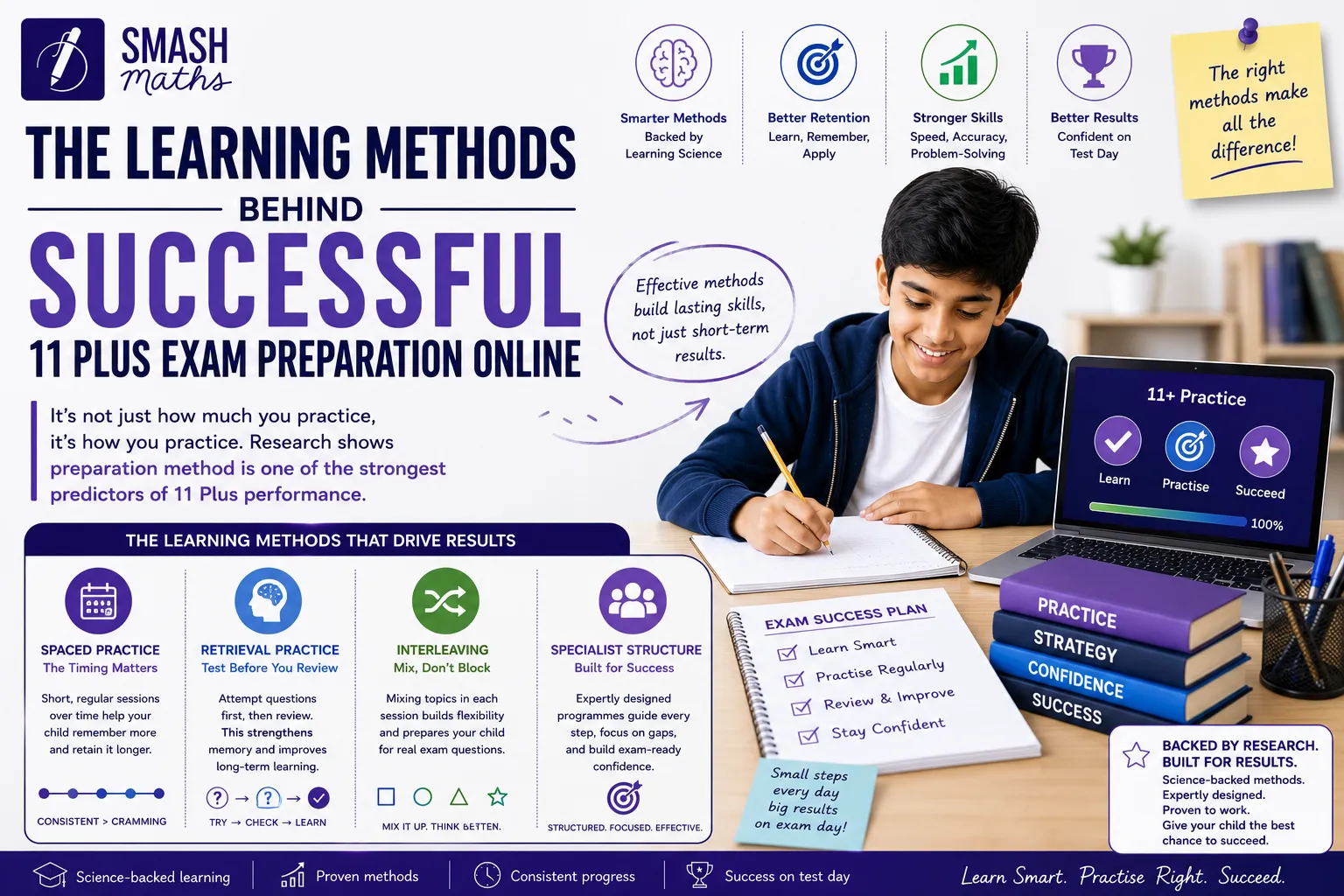
3. Spiral Revision (It’s More Powerful Than People Think)
The Spiral approach is simple.
You don’t revise one topic for an entire week.
Instead, you mix topics in small chunks:
- 10 minutes fractions
- 10 minutes of reasoning
- 10 minutes vocabulary
Then repeat different combinations the next day.
It’s like practising football skills. You don’t only practise shooting for three hours. You pass, defend, and dribble — all in one session.
At Smashmaths, this spiral structure is built into sessions so children revisit topics again and again, but slightly harder each time. That’s how knowledge sticks.
What Often Fails (And I See This A Lot)
Let’s be honest here.
These things usually don’t work:
- Starting brand new topics two weeks before the exam.
- Printing 100 worksheets.
- Comparing your child to your neighbour’s child.
- Increasing revision from 30 minutes to 3 hours overnight.
Cramming feels productive. It looks busy.
But it rarely improves understanding.
And children burn out fast.
How Much Revision Is Enough?
In the last month:
- 45–60 minutes on weekdays.
- Around 90 minutes at weekends.
- Break every 20 minutes.
Anything more usually leads to silly mistakes and frustration.
And sleep matters more than most parents realise.
A tired child will underperform — even if they “know” the content.
Should You Do Mock Papers?
Yes. But carefully.
Mock exams help with:
- Timing.
- Familiarity.
- Stamina.
But too many can knock confidence.
Two or three full-time papers per subject in the final month is plenty.
The real magic happens when you review mistakes properly.
That’s where improvement happens.
Is It Worth Getting Help This Late?
Short answer: sometimes, yes.
Targeted help can work quickly if the tutor focuses on patterns instead of trying to cover everything.
That’s why many families turn to 11 plus tutors online in the final stretch. Online sessions save time and allow for direct focus on weak areas.
But here’s the key: sessions must be focused and calm. Not rushed.
A good tutor won’t overwhelm your child. They’ll simplify things.
Vocabulary – The Silent Mark Booster
Verbal reasoning often comes down to word knowledge.
And vocabulary is one area that can improve surprisingly quickly.
Simple method:
- 10 new words a day.
- Use each word in a sentence.
- Review them every third day.
It’s boring sometimes. I won’t lie.
But it works.
The Final 7 Days Before the Exam
This is where many parents go wrong.
They panic.
They increase revision.
They bring out new papers.
Don’t.
In the final week:
- Light mixed questions.
- Review common mistakes.
- Keep evenings calm.
- Prioritise sleep.
The day before the exam?
Very light work only. Maybe 20 minutes. Then relax.
Confidence on the day matters more than squeezing in one more worksheet.
A Real Example
I worked with a pupil last year who scored 60% in maths mocks six weeks before the exam.
The issue wasn’t knowledge. It was panic with word problems.
We didn’t redo the whole syllabus.
We practised breaking down questions slowly:
- Underline key numbers.
- Circle what the question is asking.
- Solve step by step.
After four weeks, scores rose to the mid-70s.
Not dramatic. But enough.
Sometimes small improvements make a big difference.
Quick Comparison: Calm vs Panic Revision
| Panic Approach | Calm Approach |
|---|---|
| Long revision hours | Short focused sessions |
| Constant mock papers | Selective timed practice |
| New topics added | Weak areas refined |
| High stress | Steady confidence |
Guess which one works better long term?
Frequently Asked Questions
Is one month enough?
For polishing and improving technique, yes.
For learning everything from scratch, no. But progress is still possible.
Should we prioritise maths or reasoning?
Prioritise weaker subjects first. Balance matters, but weaknesses matter more.
How do I reduce my child’s stress?
Lower your own visible stress. Children mirror adults.
Do online tutors help close to the exam?
They can — if sessions are targeted and structured properly.
Final Thoughts
The 11+ feels big. I understand that.
But here’s something I truly believe after years in this field:
Children perform best when they feel supported, not pressured.
Last-minute revision is about sharpening skills. Not creating fear.
Stay focused. Keep sessions short. Protect sleep. Encourage effort.
At Smashmaths, we’ve seen calm, structured preparation outperform frantic cramming every single time.
You don’t need perfection.
You need consistency and confidence.
And that’s far more achievable than most parents think.






























Sign in to leave a comment.