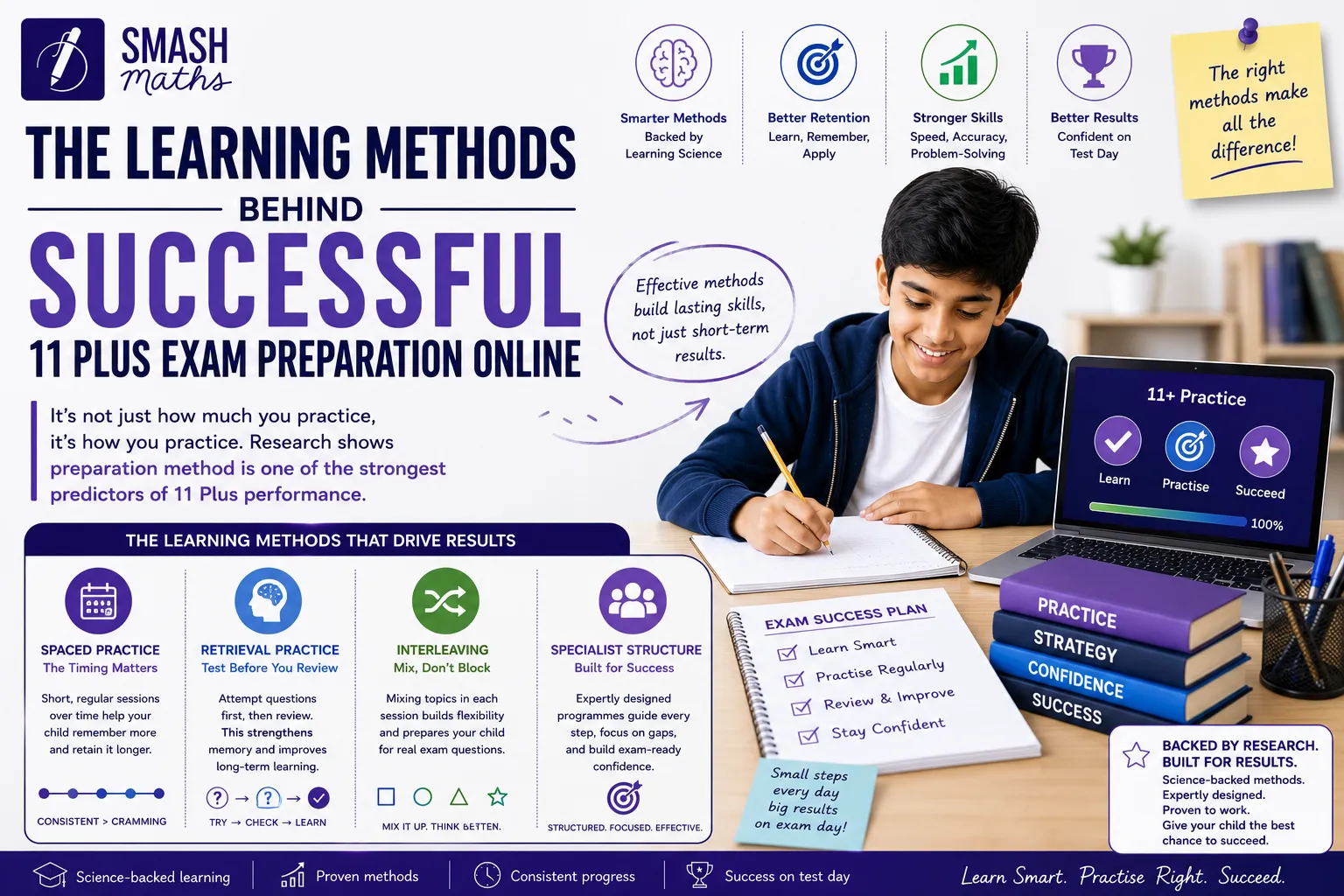

Most families approach the 11 Plus the same way: buy a stack of practice papers, work through them, and hope the results improve. Some do. Many don't — and the reason is rarely about ability. According to the National Foundation for Educational Research (NFER), preparation method is one of the strongest predictors of 11 Plus performance, independent of a child's starting point. In other words, it's not just how much preparation a child does — it's how that preparation is structured. If you're looking into 11 Plus exam preparation online in the UK and trying to understand what actually separates effective programmes from ineffective ones, this article goes straight to the learning science behind it.
What Does "Successful" 11 Plus Preparation Actually Look Like?
Let's define this clearly, because it's worth being precise.
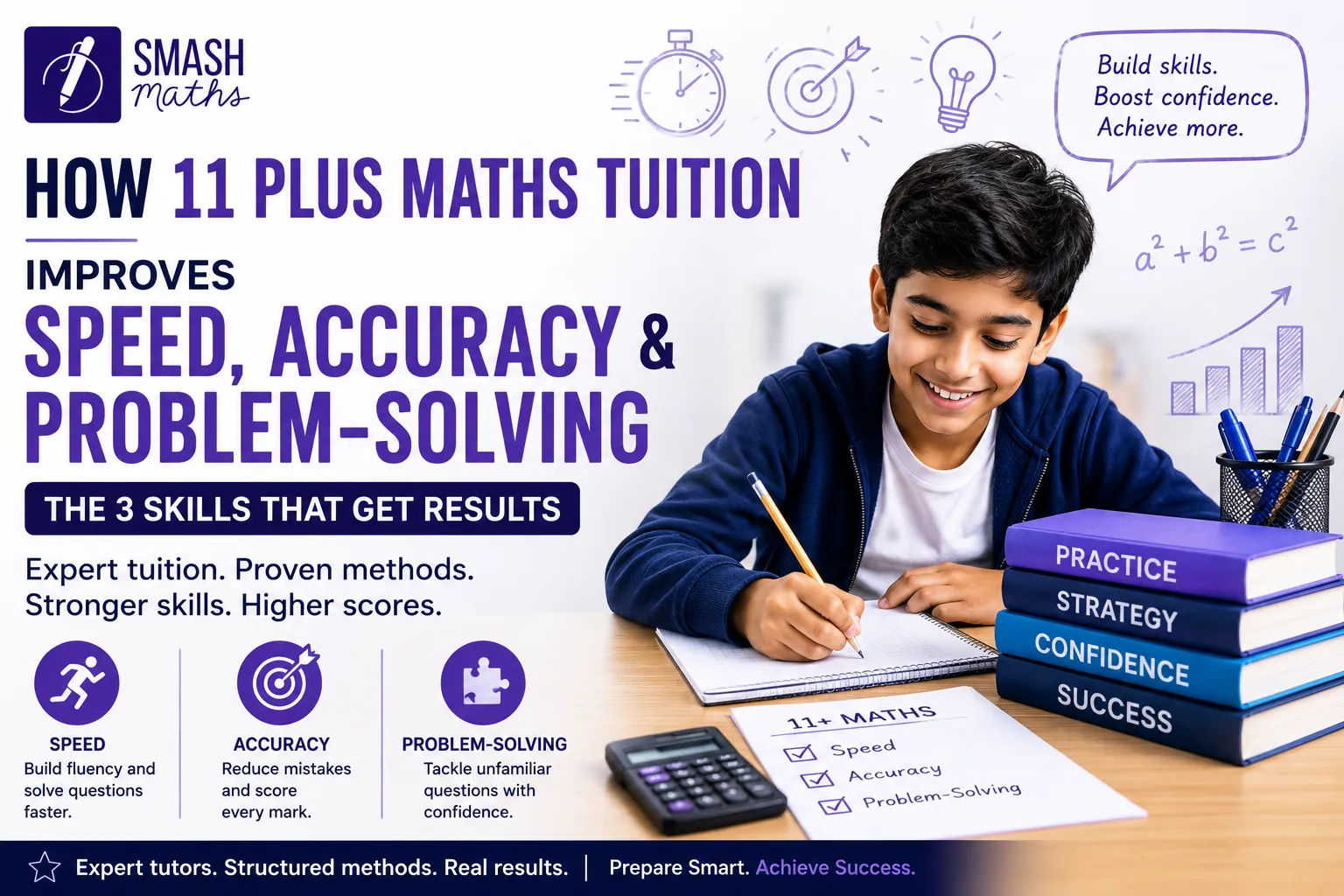
Successful 11 Plus preparation doesn't just mean a child knows the KS2 maths curriculum. Most children sitting the exam have covered most of the content at school. What separates the highest scorers is that they can access what they know quickly, apply it accurately under time pressure, and handle question formats they haven't seen before.
Those three capabilities — speed, accuracy, and flexible application — are not natural talents. They're trained skills. And the learning methods used during preparation are what determine whether a child develops them or not.
Why Generic Practice Papers Fail to Build These Skills
Here's the uncomfortable truth about the most common approach to 11 Plus preparation.
Practice papers, done repeatedly without structured review, primarily test what a child already knows. They don't build new skills. They don't close specific gaps. They don't teach exam technique. And they don't develop the kind of flexible problem-solving that the 11+ reasoning papers specifically test.
The Education Endowment Foundation has consistently found that unstructured practice without targeted feedback is among the lowest-impact educational interventions available. It's not that practice papers are useless — it's that they need to be part of a method, not the whole method.
What actually works is different. And it starts with understanding how children genuinely build knowledge.
The Learning Methods That Actually Drive 11 Plus Results
Spaced Practice — The Timing of Learning Matters
One of the most consistently replicated findings in educational psychology is the spacing effect: information is retained far better when practice is spread across multiple sessions over time than when the same amount of practice is compressed into one block.
Think about learning song lyrics. Listening to a song once doesn't mean you know it. But hearing it five times across a week — without trying — means it's stuck. The brain consolidates memory during the gaps between practice, not during the practice itself.
For 11 Plus preparation, this means daily short sessions — twenty to twenty-five minutes — consistently over months, produce far stronger retention than one or two longer sessions per week. Not because more hours are being put in, but because the spacing allows the brain to consolidate what it's learning.
Retrieval Practice — Testing Before Reviewing
This is the method most children never use — and most parents have never heard of — but it's one of the highest-impact strategies in education.
Standard revision looks like this: review the material, then practise questions. Retrieval practice reverses it: attempt the questions first, without looking at notes or examples, then review what went wrong.
The uncomfortable feeling of trying to recall something before you've reviewed it is exactly what makes it work. That effort — called "desirable difficulty" in cognitive science — forces the brain to strengthen the memory trace. The Education Endowment Foundation consistently rates retrieval practice as one of the most effective and accessible revision strategies available.
For 11 Plus maths specifically: close the book. Try the problem. Then check. That sequence is significantly more effective than reviewing the method first and then practising it.
Interleaving — Mixing Topics Instead of Blocking Them
Here's something that goes against most parents' instincts.
Most revision is "blocked" — spend a week on fractions, then a week on percentages, then a week on algebra. Blocked practice feels productive because the child gets better at fractions over the course of that week. But the improvement is often shallow and fades quickly when the topic isn't revisited.
"Interleaving" — mixing different topics within a single session, rather than blocking by topic — produces slower initial progress but much stronger long-term retention. This is because interleaving forces the brain to identify which concept applies to which problem, rather than applying the same method on autopilot.
The 11+ reasoning papers test interleaved thinking by design. Questions don't arrive labelled by topic. Children have to figure out what kind of maths is required before they can apply it. Interleaved practice builds exactly this skill.
The Benefits of Specialist Structure
This is where working with a properly designed programme, rather than generic resources, makes a measurable difference. The Benefits of 11 Plus maths tutor support go beyond content knowledge — a good specialist programme or tutor identifies which learning methods suit an individual child, spots recurring error patterns, and adapts the approach accordingly. Generic workbooks cannot do this. A weekly tutor who doesn't use evidence-based methods cannot reliably do this either.
The learning science above — spaced practice, retrieval, interleaving — needs to be built into the structure of preparation, not left to chance.
Metacognition — Teaching Children to Think About Their Thinking
This one is less well known but consistently high-impact.
Metacognition means a child being aware of their own thinking process — knowing when they understand something and when they don't, knowing which strategies work for them and which don't, being able to plan, monitor, and evaluate their own work.
In 11 Plus terms, this looks like: a child who reads a question and thinks "this is a ratio problem — I need to find the unit first, then scale up" rather than just trying numbers until something looks right. Or a child who finishes a paper with five minutes left and uses them systematically checking specific question types where they know they're most likely to have made errors.
These aren't personality traits. They're taught behaviours. And they're built through consistent, structured practice that includes reflection on process, not just marking for correctness.
The Spiral Curriculum: The Method That Brings All of This Together
The individual learning methods above — spaced practice, retrieval, interleaving, metacognition — are most powerful when they're embedded in a coherent programme structure, not applied piecemeal.
The Spiral Curriculum, developed by psychologist Jerome Bruner, is the framework that does exactly this. The principle is that topics are revisited repeatedly over time, each time at a slightly deeper level, in slightly different contexts, combined with other concepts in increasingly complex ways.
This isn't just a theory. It's the structural backbone of the Smashmaths 11 Plus programme.
Fractions don't appear once in week three. They appear in week three, then week six (combined with decimals in multi-step problems), then week ten (in the context of ratio), then week fourteen (in a reasoning paper format requiring algebraic thinking). Each visit is slightly harder. Each visit makes the previous one more secure.
Picture building a wall. You don't lay one row of bricks and immediately jump to the top. You return to each row repeatedly — checking it's level, adding the next layer, letting the mortar set before you build on it. The Spiral Curriculum does this with maths concepts, so knowledge doesn't just accumulate — it consolidates.
The result, for children going through the programme, is that topics feel familiar in the exam room rather than threatening. They've seen fractions in multiple contexts, at multiple levels of difficulty, across months of preparation. The question format on the day is rarely one they haven't encountered before.
What This Looks Like in a Real Preparation Week
Here's a concrete example of how these methods work together in structured weekly preparation:
Monday — Retrieval warm-up + Spaced revisit: Five questions from last week's topic, attempted without notes. Review every wrong answer specifically. Then fifteen minutes on this week's new focus area.
Tuesday — Interleaved practice: Ten mixed questions across three topic areas — fractions, percentages, and multi-step word problems. No topic-labelling. Child has to identify what kind of problem each is before solving.
Wednesday — Timed arithmetic: Twelve arithmetic questions, eight minutes. Focus on accuracy first, then speed. Review every slip — not just wrong answers, but near-misses.
Thursday — Reasoning paper practice: Five reasoning questions from a past paper. Full working written out. Child explains each step aloud before writing.
Friday — Metacognition review: Go through the week's mistakes. Ask: "What type of question was this?" "Where did the thinking go wrong?" "What would you do differently?" Five to ten minutes. This is the session most families skip — and it's the one that cements everything else.
Comparing Learning Methods: What the Evidence Shows
| Learning Method | How It Works | Impact Level | Used in Smashmaths? |
|---|---|---|---|
| Blocked topic practice | Cover one topic, then move on | Low — fades quickly | No — replaced by spiral |
| Spaced practice | Short sessions across time | High — strong retention | Yes — daily structure built in |
| Retrieval practice | Recall before reviewing | High — strengthens memory | Yes — every session |
| Interleaving | Mix topics within sessions | High — builds flexible thinking | Yes — reasoning paper format |
| Metacognition | Reflect on process, not just answers | Very high — builds independent thinking | Yes — review sessions built in |
| Spiral curriculum | Revisit topics at increasing depth | Very high — consolidates and deepens | Yes — programme foundation |
The difference between a programme built on these methods and one built on "more practice papers" is not small. It's the difference between surface-level familiarity and genuine, exam-proof understanding.
What to Look for in an Online 11 Plus Programme
Not all online preparation is the same. Based on the learning science above, here's what a genuinely effective programme should do:
- Space practice across daily sessions — not weekly blocks
- Build retrieval into every session — not just review-then-practise
- Mix topics deliberately — especially in the later stages of preparation
- Revisit topics in spiral format — not cover-and-forget
- Track progress at topic level — so you can see which gaps are closing
- Build exam technique explicitly — not assume it transfers from content knowledge
- Address confidence and anxiety — not just content gaps
If a programme only offers practice papers and marking, it's missing most of what the research says actually works.
Real Example: What Structured Online Preparation Changes
Consider a child in Year 5 in Birmingham — confident at school, but loses marks consistently on reasoning questions in mock papers. The questions aren't beyond her ability. She just freezes when she can't immediately see the method to use.
Standard approach: more practice papers. Outcome: the same freezing, slightly faster.
Structured approach using the methods above: interleaved practice that forces her to identify the problem type before solving it; metacognition sessions that teach her to talk through the process out loud; spiral revisiting of the specific topics that appear in reasoning questions. After eight weeks, the freezing is largely gone — not because she's learnt more content, but because she's learnt how to think through unfamiliar problems.
That's not a rare outcome. It's what evidence-based preparation consistently produces.
Frequently Asked Questions
How is online 11 Plus preparation different from just doing practice papers at home?
Done well, online preparation applies spaced practice, retrieval, interleaving, and spiral revisiting — all structured into a daily programme. Practice papers done at home, without these methods embedded, primarily test what a child already knows rather than building new capability.
How early should structured preparation start?
Year 4 for light, consistent groundwork. Year 5 for full structured preparation. Grammar school tests in England typically take place in September or October of Year 6, so the preparation year is largely Year 5. Starting late limits how much the spiral approach can compound.
My child does well in class. Why isn't that enough for the 11+?
Because the 11+ tests different things than classroom maths. It tests speed under time pressure, unfamiliar question formats, and the ability to combine concepts in multi-step problems. All of these need specific training — they don't transfer automatically from doing well in lessons.
How many hours per week of preparation is realistic?
Two to three hours, spread across daily sessions of twenty to twenty-five minutes. More than this tends to produce diminishing returns and increases anxiety. Quality, structure, and consistency matter far more than volume.
Can a child who is significantly behind still succeed in the 11+?
Yes — but it requires starting early and using genuinely effective methods. Closing a significant gap in twelve months is achievable with structured, spiral-based preparation. Closing it with practice papers alone in the final term is not.
The Method Is the Message
Here's the thing that gets lost in most conversations about 11 Plus preparation: the content isn't the hard part. The KS2 maths curriculum is well-defined. Bright children cover most of it at school. The hard part — the part that actually determines results — is how that content is practised, consolidated, and applied under exam conditions.
The learning methods in this article aren't new ideas. They're backed by decades of educational research. What's new is the idea that they should be deliberately built into 11 Plus preparation — not left to chance, not replaced by more practice papers, not assumed to happen on their own.
Smashmaths was built precisely to apply these methods in a way that works for real UK families. The Spiral Curriculum ensures every topic is revisited and deepened over time. The daily session structure applies spaced practice. The mixed topic approach builds the interleaved thinking that reasoning papers demand. And the programme tracks progress at topic level so both children and parents can see exactly where preparation is working and where more focus is needed.
If you're preparing a child for the 11 Plus, the most important question isn't "how many practice papers have we done?" It's "what learning methods are behind the preparation?" The answer to that question predicts the outcome far more reliably than the number of hours put in.
Key Takeaways
- Preparation method — not just preparation volume — is the strongest predictor of 11 Plus success
- Spaced practice across daily short sessions produces stronger retention than weekly longer blocks
- Retrieval practice (recall before reviewing) is one of the highest-impact revision strategies available
- Interleaving topics within sessions builds the flexible thinking that 11+ reasoning papers specifically test
- The Spiral Curriculum — revisiting topics repeatedly at increasing depth — is the structural framework that brings all these methods together
- Metacognition (teaching children to reflect on their own thinking process) is high-impact and consistently overlooked
- Generic practice papers without these methods embedded are low-impact by comparison
- Smashmaths applies all of these methods within a structured, flexible online programme built for UK families




























Sign in to leave a comment.