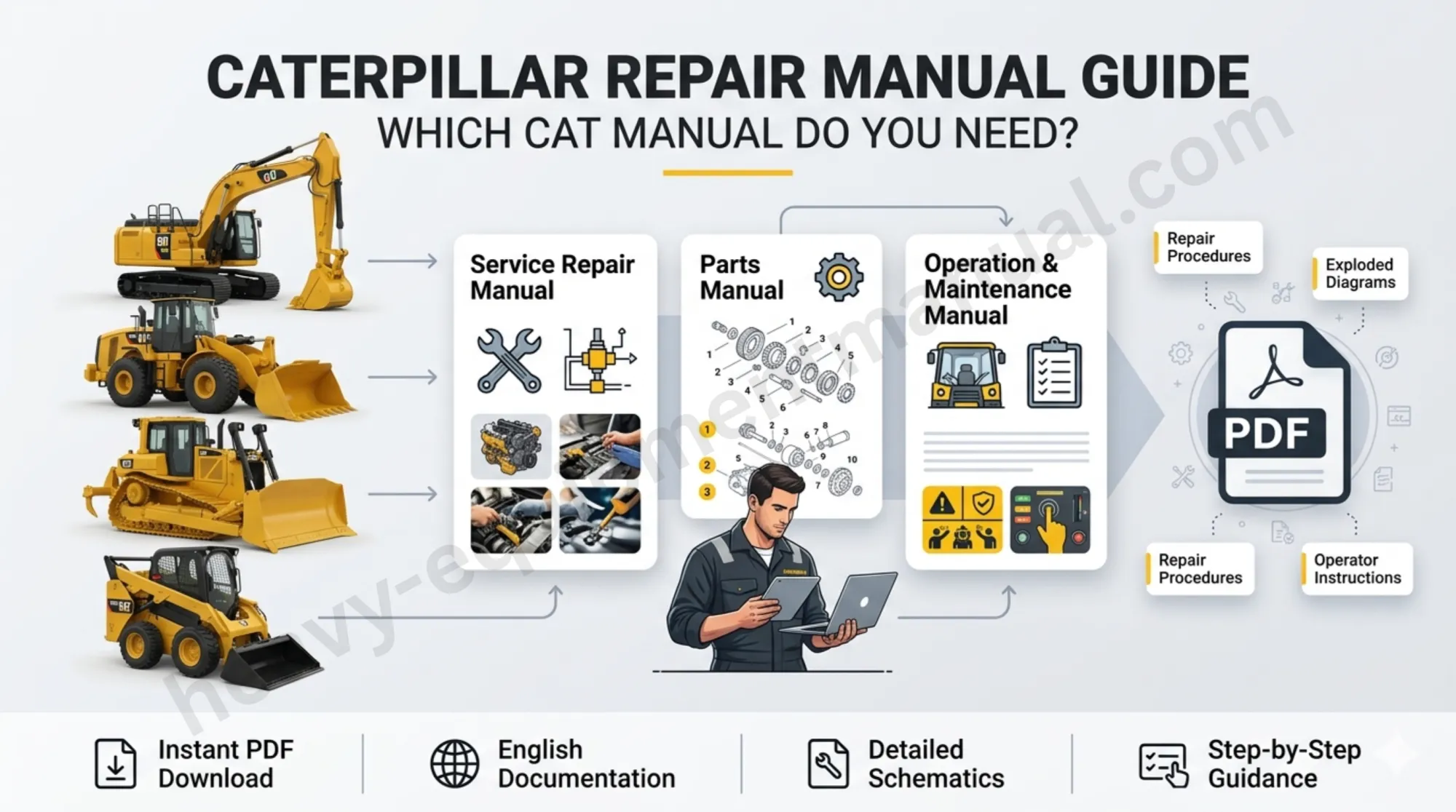

A Caterpillar repair manual is the factory-level documentation that walks a technician through diagnosing and fixing a specific CAT machine, step by step. Anyone who owns or services Caterpillar equipment eventually reaches a point where a repair depends on knowing the exact torque spec, wiring layout, or teardown sequence for that machine — and that's information a repair manual is built to provide.
Why This Topic Matters
Equipment downtime rarely comes down to a lack of mechanical skill. More often, it comes down to not having the right documentation for the exact machine in front of you. Caterpillar produces equipment across many build variations, and even machines that share the same model number can have different component arrangements depending on serial number and production year.
This creates a real and common problem. A technician searches online, finds a repair walkthrough that looks close enough to their machine, and follows it anyway. When the steps don't actually match the unit — a different hydraulic layout on a track loader, or a different torque sequence on an engine head — the result is often a repair that has to be redone, sometimes with added damage from the first attempt.
How It Helps / Main Benefits
Using the correct, model-matched repair manual solves this problem at the source.
- Reduces trial-and-error diagnosis by giving a clear, tested sequence for identifying the actual fault
- Prevents repeat repairs caused by following mismatched or generalized instructions
- Supports in-house repair work instead of requiring a dealer visit for every issue
- Saves time by organizing troubleshooting steps by system, so technicians aren't searching blindly
- Builds long-term familiarity with a machine rather than relying on guesswork each time
What to Look For / What's Included
A genuine Caterpillar repair manual typically includes general service information, full disassembly and reassembly procedures, system operation explanations, testing and adjusting steps, torque specifications, and a troubleshooting section organized by system.
For track-driven machines like the CAT 247B/257B Multi Terrain Loader, this usually means dedicated sections for hydrostatic drive testing, track tension adjustment, and the electrical fault codes specific to that control system — details that don't apply to wheeled skid steers. For a machine like the CAT 320 excavator, the manual instead centers on hydraulic schematics, swing system specs, and pump calibration steps.
Before choosing a manual, it helps to confirm that it's matched to the machine's actual serial number range rather than just the model name, since specifications can shift between production phases of the same model. For anyone unsure which manual type applies to their repair, this guide to choosing the right Caterpillar repair manual breaks down the differences before you start.
Related Use Cases
This kind of documentation applies to a wide range of everyday repair situations:
- A rental fleet technician diagnosing a hydrostatic drive fault on a 247B/257B Multi Terrain Loader
- A workshop tracing a swing circuit issue on a CAT 320 excavator
- An owner-operator working through a full teardown on a CAT C15 truck engine
- A small repair shop handling routine electrical fault diagnosis on an older CAT skid steer
- A contractor maintaining multiple CAT machines across different job sites without regular dealer access
Repair Manual vs Parts Manual: What's the Difference?
These two document types are often confused, but they serve different jobs.
A repair manual (also called a service or workshop manual) focuses on diagnosing and fixing the machine — it covers torque specs, testing procedures, and troubleshooting steps for engine, hydraulic, and electrical systems. A parts manual is built around component identification instead, using exploded diagrams and OEM part numbers to support accurate ordering.
Most complete repair jobs end up needing both — the parts manual to order the right component, and the repair manual to actually complete the fix using the correct sequence and specification.
Who Can Use This?
This kind of documentation supports a broad group of people working with CAT equipment:
- Independent technicians and small repair shops without direct dealer access
- Equipment owners looking to reduce repair costs by handling routine diagnostic work themselves
- Rental and fleet operators maintaining several machines across multiple sites
- Contractors working with older CAT equipment that has limited remaining factory support
Final Thoughts
A Caterpillar repair manual isn't a nice-to-have reference — it's often the difference between a repair that's done right the first time and one that has to be redone. For anyone regularly working on CAT equipment, matching the manual to the machine's exact model and serial number is the first step worth taking before any diagnostic work begins.
FAQs
Q1. What is a Caterpillar repair manual?
A Caterpillar repair manual is factory-level documentation covering diagnostic steps, repair procedures, torque specifications, and system operation details for a specific CAT machine, matched to its model and serial number range.
Q2. How does it help users?
It reduces repeat repairs and downtime by giving technicians a tested, model-specific sequence for diagnosing and fixing a fault, instead of relying on generalized instructions that may not match the exact machine.
Q3. Who should use or consider it?
Independent technicians, equipment owners, rental and fleet operators, and contractors working on CAT equipment without regular dealer access all benefit from having accurate repair documentation on hand.
Q4. What should users check before choosing a repair manual?
Users should confirm the manual matches their machine's exact model and serial number range, since specifications and system layouts — especially on track-driven machines like the 247B/257B — can differ between production phases of the same model.





























Sign in to leave a comment.