
Most dentists who get serious about chairside photography go through the same progression. They start with their phone and whatever light is in the room. The photos are inconsistent but usable enough. Then they pick up a clip-on ring light or a single LED attachment and things improve a little. The glare gets better on some shots, the shadows get better on others, but there is always something that is not quite right depending on the angle or the part of the mouth they are photographing.
The jump from a single light to a twin light for dental photography is where that "something is always not quite right" feeling finally goes away. Not because a twin light rig is complicated or technical, but because it solves the core problem of intraoral photography in a way a single light source physically cannot.
The Problem a Single Light Always Leaves Behind
Here is what happens with any single light source attached to or near a smartphone lens. The light travels from one point, hits the teeth and surrounding tissue, and reflects back. Whatever is on the opposite side of that light sits in relative shadow. For a ring light, that shadow forms in the center of the shot. For a clip-on LED on one side, the shadow falls on the opposite arch wall, the posterior teeth on the far side, or the lingual surfaces.
You can reposition, you can add ambient light, you can try to bounce light off a mirror, but you are always compensating for the fundamental limitation of a single source. The shadow moves, it does not disappear.
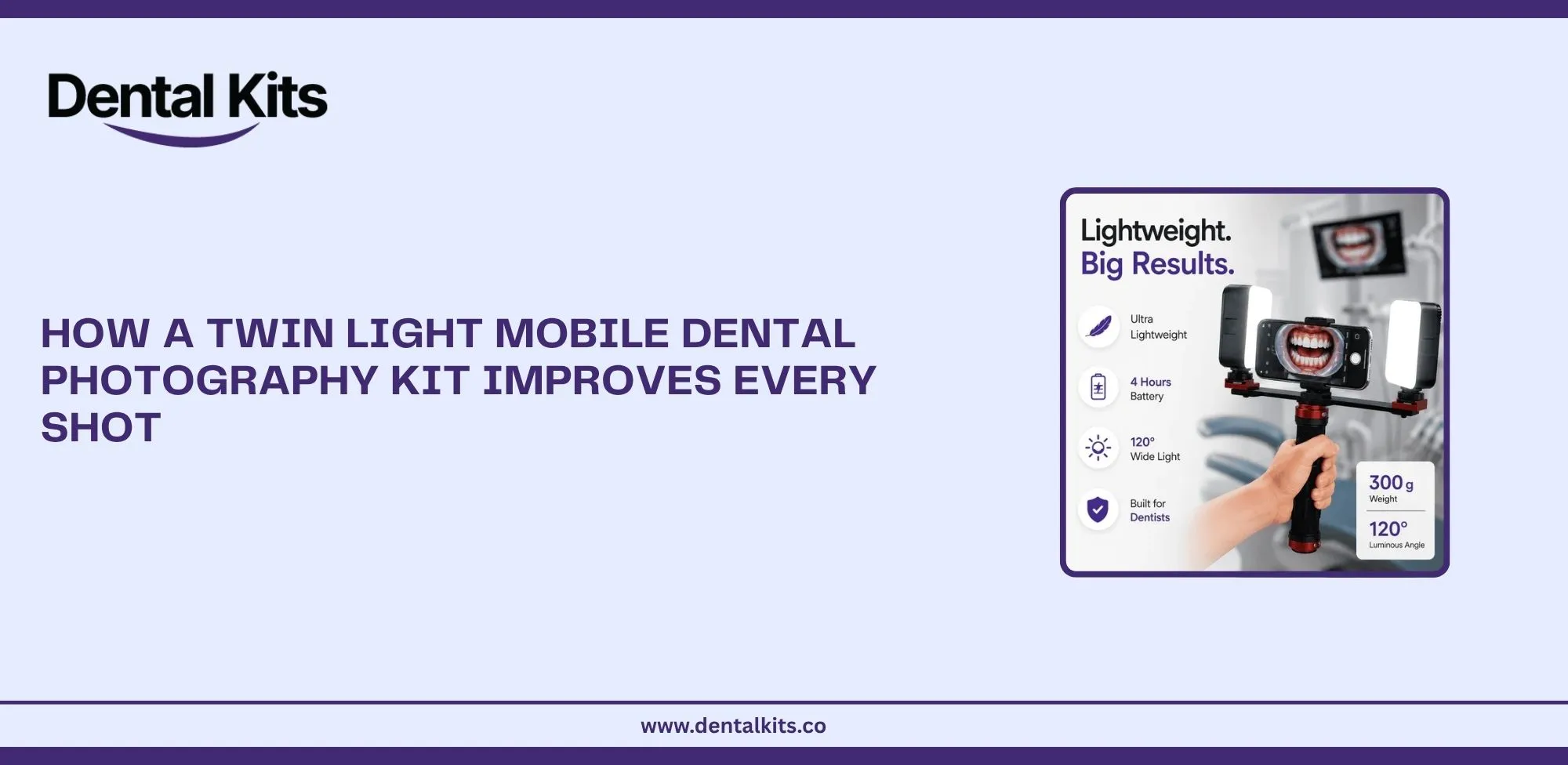
A mobile twin light for dental photography removes this problem at the source. Two LED panels, one on each side of the phone, send light into the oral cavity from opposite directions simultaneously. The shadow that the right panel would create gets filled by the left, and vice versa. What you end up with is even, balanced illumination across the full width of the shot, from the left buccal corridor to the right, without any area being brighter or darker than another.
Why the Handheld Rig Matters as Much as the Lights
The twin light setup is one part of what makes a dedicated kit work. The handheld grip is the other part, and it matters more than people initially expect.
Think about how most chairside smartphone photos actually get taken. The dentist holds the phone in one hand, tries to manage a retractor with the other, and takes the photo at a moment when everything is roughly in position. The result is a photo that is close to what was intended, but not quite. The angle shifts slightly between patients. The distance from the teeth changes depending on how the phone was held that day. The framing drifts in ways that make before and after comparisons harder to read than they should be.
A handheld rig with a proper grip gives you a stable platform to hold consistently shot after shot and patient after patient. The phone mounts securely in a fixed position relative to the lights, so the relationship between the light source and the lens stays constant. You are not trying to hold a phone steady while also managing a patient. You are holding one object, a balanced rig that was designed to be held, with both your hand wrapped around a proper grip rather than pinching the edge of a glass screen.
That stability translates directly into sharper photos, more consistent framing, and less time spent reshooting because the angle was slightly off.
Every Part of the Mouth, Covered
One of the quiet advantages of a twin light for mobile dental photography is how it handles the shots that always give single-light setups trouble. Posterior shots, where there is limited space and the light needs to reach past retractors and cheek tissue, benefit significantly from dual-side illumination because there is always light coming from an angle that reaches around whatever is partially blocking the other side.
Occlusal shots, where the mirror is reflecting the arch from above or below, benefit because both sides of the reflected image are lit evenly rather than one side being noticeably brighter than the other. Anterior shots, which are the easiest with most setups, look cleaner too because the light is balanced across both the left and right central incisors without the slight gradient that a single offset light creates.
A phone twin light for dental photography essentially removes "difficult shots" from the list. The challenging angles become manageable because the lighting accommodates the geometry of the mouth better than a single source can.
Shade Matching Gets More Reliable
There is a practical clinical benefit to even lighting that goes beyond aesthetics. Shade matching done from smartphone photos depends entirely on the photo being a color-accurate representation of what is actually in the mouth. Uneven lighting introduces a color gradient across the arch, where teeth on the lit side appear slightly warmer or brighter than teeth on the shadow side, even if they are the same shade.
When you are sending a photo to a lab as a shade reference, that gradient creates ambiguity. The lab is looking at a photo where the shade appears to shift across the arch and has to make a judgment call about which part of the photo to trust. With even illumination from a twin light setup, the color is consistent from one side of the frame to the other, which gives the lab a reliable reference and reduces the chance of a remade restoration.
A Kit That Earns Its Place in the Operatory
The best dental photography equipment is the equipment you actually use on every patient, not just for formal case documentation. A setup that is fast to pick up, easy to hold, and produces reliable results every time gets used consistently. A complicated setup that requires adjustment, repositioning, or troubleshooting before every shot gets skipped.
A twin light mobile dental photography kit earns a permanent place in the operatory precisely because it makes good photography the easy option rather than the effortful one. The grip is comfortable, the lights are already in position, the phone slots in and stays put. Pick it up, position it, shoot.
That is what making every shot better actually looks like in practice.



















Sign in to leave a comment.