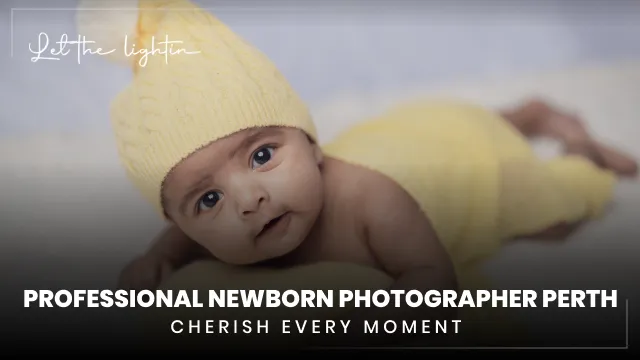

There's a small window of time — really just a handful of days — when your baby still carries the softness of the womb. The knees are still tucked up. The hands still curl instinctively around a finger. The sleep is deep and unguarded, the kind that only exists before the world has fully arrived. As a photographer, I chase that window every time, because I know it won't last.
I'm Hirak, and I run Let the Light In Photography here in Perth. Over the years — and through the AFIP and AFIAP distinctions I've been fortunate enough to receive for my portrait work — I've learned that the best newborn photographs aren't the ones where everything is perfectly arranged. They're the ones where nothing feels arranged at all. And that kind of image is only possible in a very particular stretch of time: the first two weeks.
Why Timing Is Everything
Newborns change fast. At day three or four, they're still curled into the same positions they held before birth — that gentle folding of arms and legs, the tiny fists near the chin. They sleep more deeply and more often, which means those peaceful, ten-minutes-at-a-time poses are actually achievable without a fight. Skin is at its softest, hasn't yet gone through the normal newborn peeling or breakouts, and babies are generally more flexible and easier to settle into cosy, curled positions.
Wait past that window — say, three or four weeks in — and you'll still get beautiful photographs, but they'll be a different kind of beautiful. Baby will be more alert, less bendy, and far less inclined to sleep through a gentle repositioning. There's no wrong time to capture your baby, but if that "fresh from the womb" look is what you're after, the first fourteen days are genuinely the sweet spot.

What Actually Happens During a Session
I know newborn sessions can sound intimidating if you've never done one, so let me walk you through it honestly. Sessions are unhurried — I usually block out two to three hours, because babies work on their own schedule, not mine. We feed when baby needs feeding. We pause when baby needs settling. Nothing is rushed.
Safety always comes first. I'm trained in safe newborn handling and posing, the room is kept warm (newborns are far more content when they're cosy), and I never leave a baby unsupported for a composite pose — every gentle bend or fold is either fully supported by me, spotted by a parent just out of frame, or created safely in post-production. A photograph is never worth a risk.
I work with a mix of natural light and studio lighting depending on your home or our studio space. Natural window light gives that soft, airy, documentary feel I love for candid family moments — hands, glances, the way an older sibling looks at the new baby. Studio lighting gives me more control for the classic, timeless newborn portraits parents often want as anchor images. Most sessions blend both, because your gallery should feel layered, not one-note.
Practical Tips for Your First Newborn Shoot
A little preparation goes a long way toward a relaxed, successful session:
1. Book early — ideally during pregnancy. Because the window is so narrow, I recommend securing your date around 30–32 weeks. That way, once baby arrives, we simply confirm timing and I can be flexible if baby comes early or late.
2. Keep baby awake a little longer before the session. A short awake window and a full feed right before we start genuinely helps baby settle into a deeper sleep once we begin — much easier for everyone.
3. Warm the room in advance. Newborns sleep more soundly when they're warm, so if we're shooting at your home, having the space cosy beforehand helps baby ease in faster.
4. Don't stress about "perfect." You don't need a spotless house, a matching outfit, or a newborn who cooperates on command. Bring yourselves, bring your baby, and let me handle the rest. Some of my favourite images have come from the in-between moments — a yawn, a stretch, a parent's hand resting protectively over baby's back.
Our Approach at Let the Light In
If you've looked through my portfolio, you'll notice I don't chase the stiff, catalogue-style poses. I'm drawn to real moments — the crook of a tired arm, the unguarded expression on a new mum's face, a toddler kissing their new sibling's forehead without being asked to. That candid, documentary style is where I feel most at home as a photographer, and it's the same instinct that's shaped my award-winning portrait work more broadly.
I also love including the whole family where parents want that — siblings, grandparents, the family dog curled up nearby. A newborn session isn't just about the baby; it's about capturing the shape of your family in this specific, fleeting chapter. Posed portraits have their place too, and we'll absolutely get a few beautifully composed images for the wall. But the heart of the gallery, for me, is always the honest, unposed in-between.
Let's Capture This Chapter Together
If you're expecting or you've recently welcomed your baby into the world, I'd love to be part of this moment with you. Sessions do book out during that first-two-weeks window, so reaching out early — even before baby arrives — makes all the difference.
You can view examples of my recent work in the newborn portfolio, and whenever you're ready, get in touch and we'll find a time that works for your family.
This season passes so quickly. Let's make sure you have something to hold onto from it.
— Hirak






















Sign in to leave a comment.