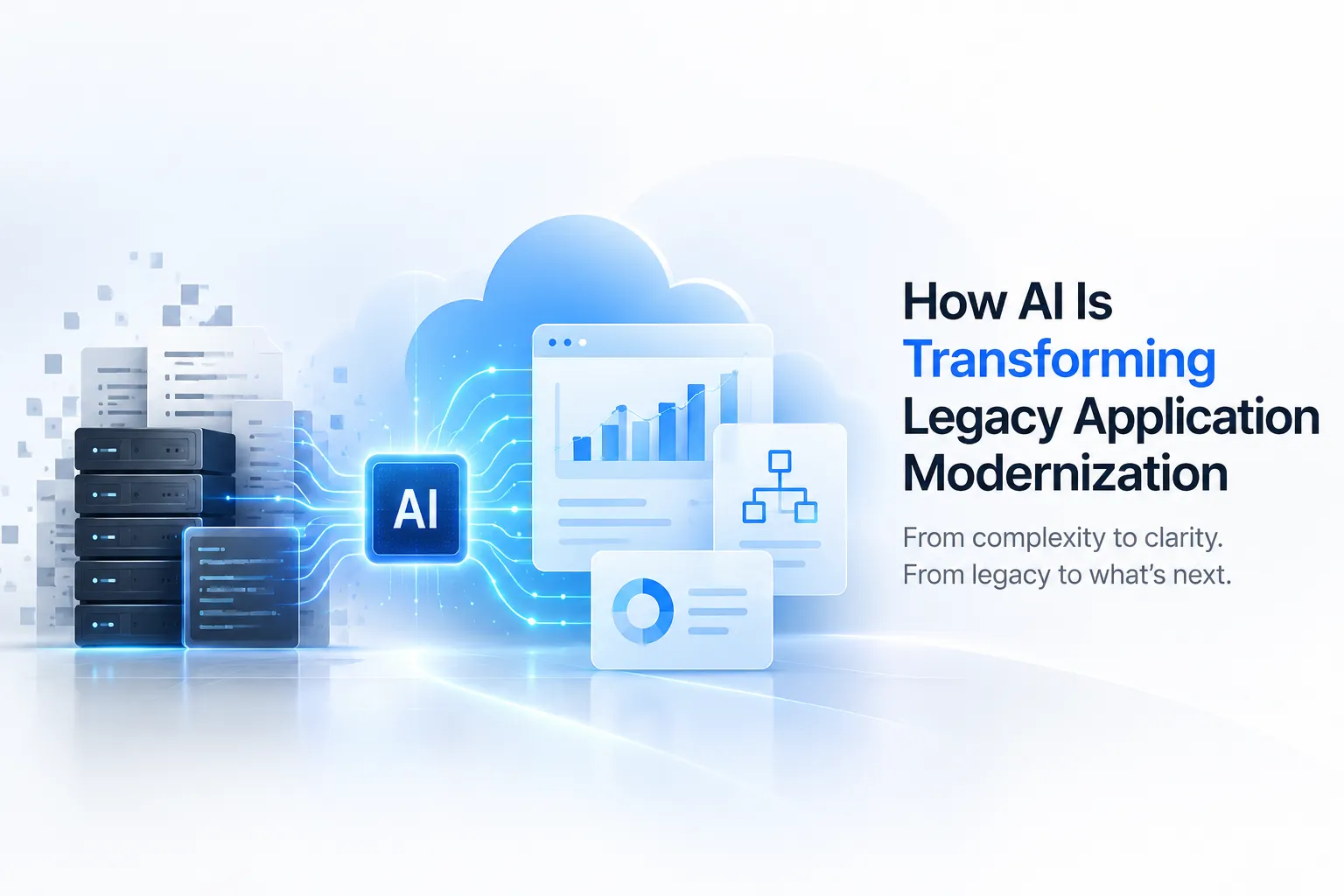

Legacy modernization remains a major challenge for enterprises managing decades-old technology estates. Deloitte’s 2026 Global Technology Leadership Study estimates that technical debt accounts for 21% to 40% of an organization’s IT spending, highlighting the financial burden aging systems can place on technology teams.
Today, the challenge extends beyond outdated technology. Enterprise applications often contain undocumented business rules, tightly coupled architectures, and lost technical context, making it difficult for modern teams to understand what should change without affecting critical operations.
To bridge that gap, organizations are turning to AI for legacy application modernization to reconstruct application knowledge, improve system understanding, and support evidence-driven transformation decisions through code analysis, system intelligence, and engineering validation.
Why Legacy Application Modernization Remains Difficult
Modernizing legacy applications is not only a technology replacement exercise. The challenge lies in understanding how existing systems function, which business capabilities they support, and how changes may affect interconnected operations. Years of incremental modifications often leave organizations with limited visibility into their application landscape, increasing uncertainty during modernization decisions.
1. Business Knowledge is Hidden Across Decades of Evolution
Enterprise applications accumulate business logic over years of enhancements, with critical rules distributed across source code, databases, integrations, and technical artifacts. As documentation becomes outdated and teams change, the original context behind system behavior can become difficult to reconstruct. This makes it challenging for modernization teams to determine which capabilities are essential and what functionality must be preserved.
2. Hidden Dependencies Increase Modernization Risk
Legacy applications rarely operate independently. They are connected with shared databases, APIs, batch processes, external platforms, and downstream systems through dependencies that may not be fully documented. As a result, even small changes can create unexpected impacts across connected workflows, making it difficult to accurately assess modernization risks before implementation.
3. Selecting the Right Modernization Approach Requires Deep System Understanding
Modernization does not follow a single path. Organizations may choose refactoring, API modernization, service extraction, cloud migration, or replacement depending on business requirements and technical constraints. However, selecting the right approach requires a clear understanding of application architecture, data flows, dependencies, and business capabilities, which is often difficult to establish in complex legacy environments.
How AI is Changing Legacy Application Modernization
The real value of AI in modernization projects is not that it writes code faster or documents old systems. Those are visible but relatively shallow benefits. The deeper problem AI addresses is the loss of institutional knowledge that happens when legacy systems outlive the people who built and maintained them.
1. AI Builds Application Intelligence Through Code and Context Analysis
Artificial intelligence in legacy application modernization is becoming increasingly valuable during the discovery phase by helping teams analyze complex application environments through code intelligence and contextual understanding.
Traditional analysis tools can identify classes, methods, dependencies, database interactions, and control flows. AI extends this capability by interpreting these relationships and allowing engineers to interact with application knowledge through natural language queries.
This deeper understanding goes beyond summarizing legacy code or translating older technologies such as COBOL into modern languages. The real value lies in recovering the institutional knowledge embedded within decades of application evolution, helping teams understand why systems behave the way they do, which capabilities are critical, and what must be preserved during modernization.
2. AI Agents are Creating Connected Modernization Workflows
The next evolution of AI in legacy modernization is moving from individual AI assistants toward specialized agents that support connected modernization workflows.
Rather than independently modifying production systems, modernization agents operate within controlled engineering processes where each activity is evaluated against technical standards, security policies, and human approval checkpoints.
Different agents can support specific modernization activities:
Discovery Agents
Discovery agents analyze application inventories, repositories, technology stacks, and technical debt indicators to create an initial understanding of the modernization scope.
Architecture Agents
Architecture agents evaluate application structures, dependencies, and business capabilities to support modernization planning and identify potential transformation approaches.
Migration Agents
Migration agents assist with transformation activities by generating migration recommendations, suggesting code changes, and helping maintain modernization documentation.
Testing Agents
Testing agents analyze existing validation coverage, identify potential gaps, and recommend additional scenarios to verify application behavior.
These collaborating agents compile their individual findings into connected knowledge graphs that map application components, dependencies, business rules, and system behaviors. Over time, this creates a shared intelligence layer that helps teams reconstruct lost institutional knowledge and build a more accurate understanding of complex legacy environments.
3. AI Strengthens Behavioral Validation Through Intelligent Testing
A major challenge in modernization is ensuring transformed applications preserve the behaviors that made the original system valuable. Legacy systems often contain undocumented business rules, edge cases, and operational patterns that code analysis alone may not reveal.
AI can help bridge this knowledge gap by analyzing application workflows, historical transactions, interfaces, and existing system behavior to surface patterns that may need preserving during transformation. This creates a stronger behavioral understanding of the application, allowing teams to validate whether the modernized system still reflects the original business intent.
Modern validation approaches include:
- Differential Testing
- Contract Testing
- Production Replay
- Shadow Traffic
- Synthetic Transactions
These approaches allow teams to validate modernization outcomes against a deeper understanding of existing system behavior, reducing the risk of unintentionally changing critical business logic during transformation.
5. Digital Twins Enable Safer Modernization Decisions
While testing validates whether a modernized application behaves correctly, digital twins help teams evaluate modernization approaches before implementing major changes in production environments.
A modernization digital twin creates a simulated representation of an application environment by modeling:
- Application Behavior
- System Dependencies
- Transaction Flows
- Workload Patterns
- Integration Relationships
This allows teams to evaluate potential changes and understand their possible impact before modifying critical systems.
For example, before extracting components from a monolithic application, teams can simulate dependency interactions and workload behavior to assess potential performance and operational risks.
Combined with AI analysis, digital twins can help architects compare modernization options, identify potential bottlenecks, and prioritize transformation activities based on expected outcomes. This enables organizations to make more informed decisions before committing significant engineering effort to large-scale changes.
The Future of Legacy Modernization is Continuous Intelligence
Legacy modernization has traditionally been treated as a large transformation initiative completed over a defined period. However, enterprise applications continue to evolve after modernization through new integrations, technology changes, security requirements, and business demands.
The future approach is moving toward continuous modernization, where AI-enabled engineering environments help teams identify and address modernization opportunities throughout the application lifecycle.
These environments can support ongoing analysis of:
- Architecture Changes
- Outdated Dependencies
- Security Risks
- Technical Debt Patterns
This shifts modernization from a periodic migration exercise into an ongoing engineering capability. Organizations can address application complexity earlier, prioritize improvements more effectively, and maintain systems that keep pace with changing business requirements.
The Takeaway: Build an Evidence-Driven Modernization Operating Model
The biggest challenge in legacy application modernization is not replacing old technologies but understanding complex systems well enough to change them safely. AI is helping organizations reduce this uncertainty by improving application intelligence, accelerating transformation activities, and strengthening validation. However, successful modernization will depend on combining AI capabilities with engineering expertise, security controls, automated testing, and architectural governance.
The future of enterprise application modernization will not be fully autonomous migration. It will be a collaborative model where AI expands engineering capabilities and helps organizations modernize complex applications with greater confidence, control, and speed.























Sign in to leave a comment.