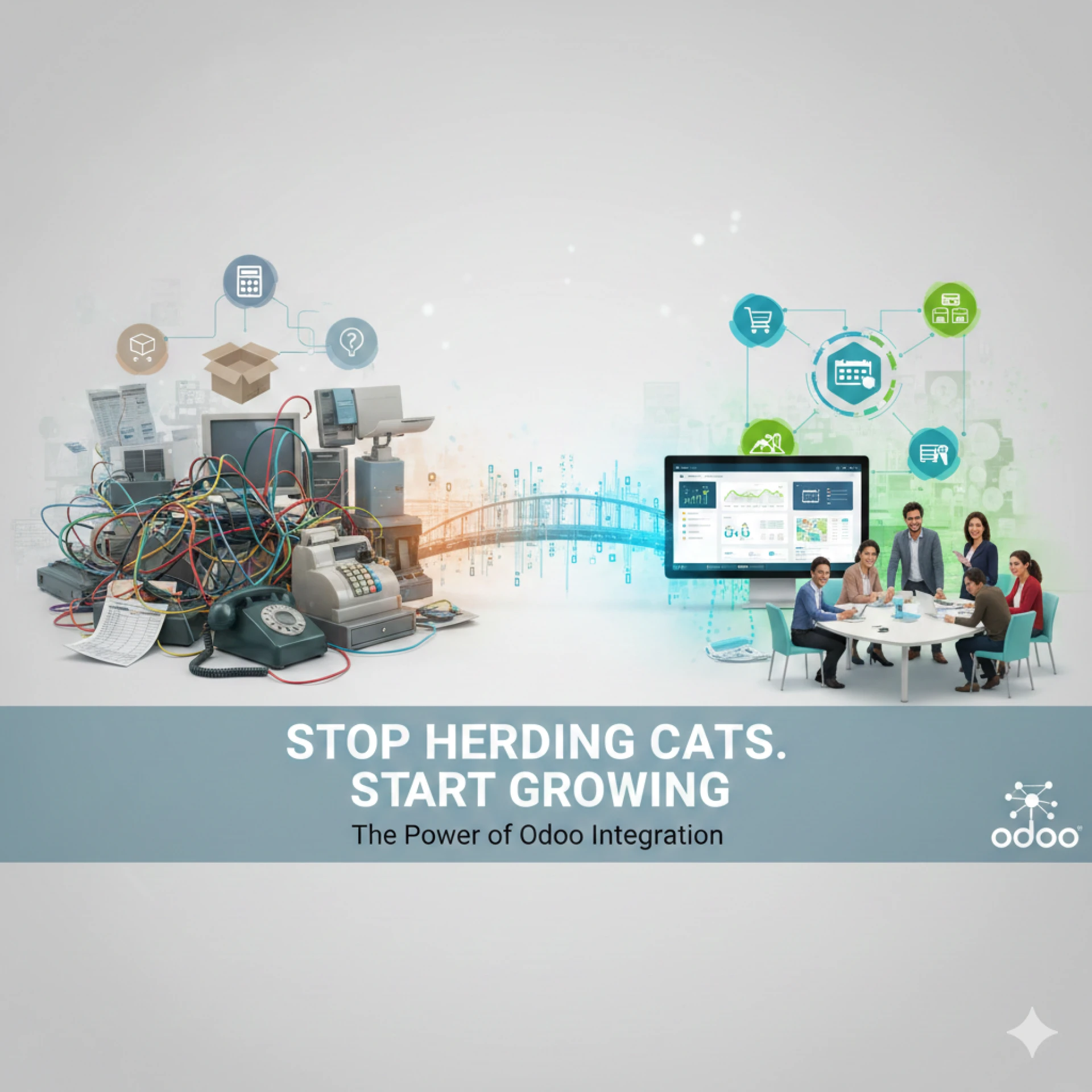

Running a business with disconnected tools is exhausting. Your sales team uses one system. Accounting uses another. Inventory lives in a spreadsheet somewhere. And getting everyone on the same page feels like herding cats.
Sound familiar? You're not alone.
This is exactly where an Odoo integration company steps in. They take all those scattered systems and connect them into one smooth-running machine. No more copy-pasting data between apps. No more wondering if your numbers are accurate.
Let me show you how this actually works in real life.
What Exactly Does Odoo Integration Mean?
Let's keep this simple.
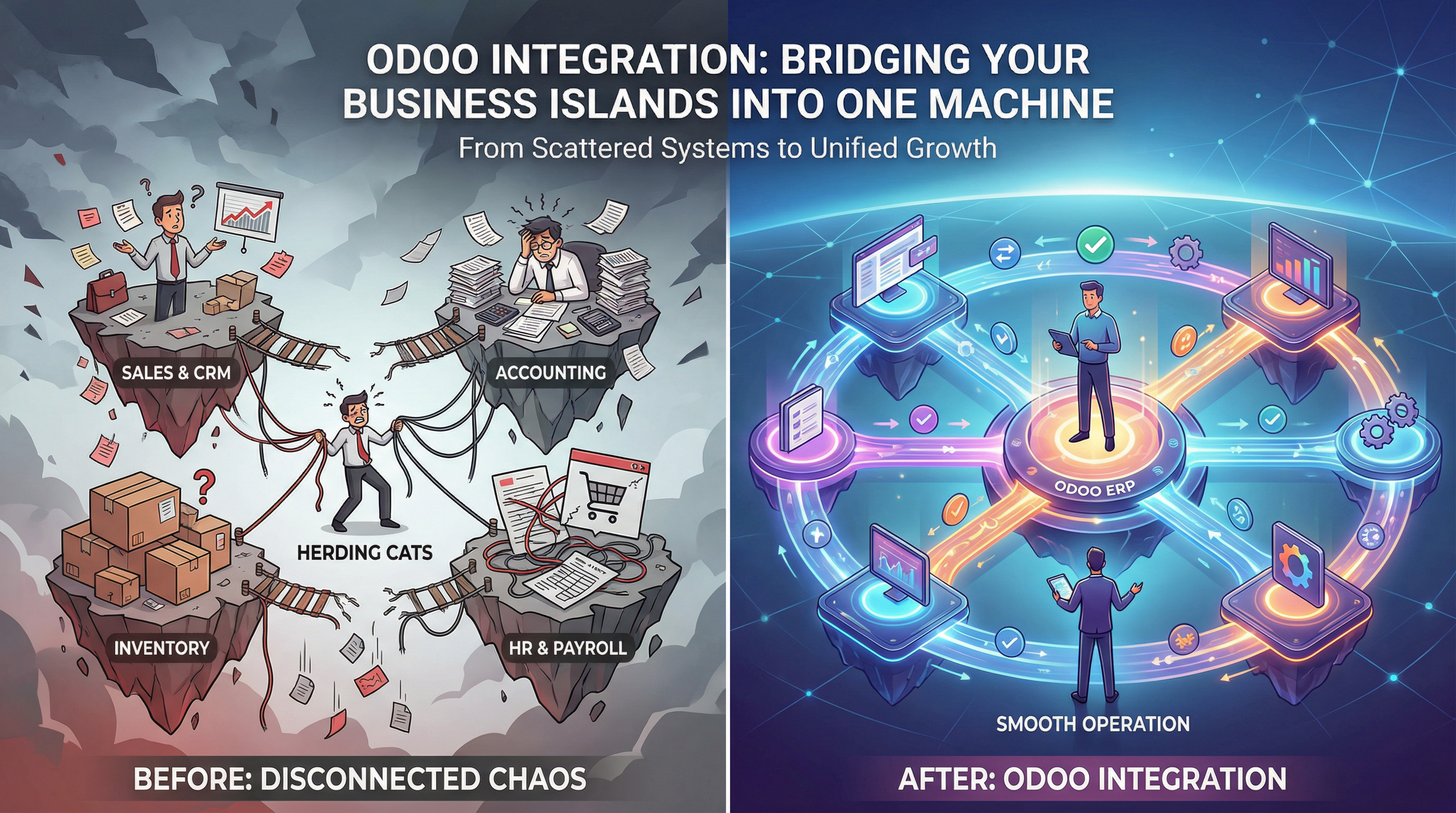
Odoo integration means connecting Odoo ERP with all the other tools and platforms your business already uses. Think of it like building bridges between islands. Each department is an island and integration creates pathways so information flows freely between them.
An Odoo integration company specializes in building those bridges. They understand both the technical side and the business side which is exactly why they're valuable.
Without proper integration your business ends up with:
- Data living in silos nobody can access easily
- Teams duplicating work without realizing it
- Reports that don't match because numbers come from different sources
- Customers getting inconsistent experiences
- Hours wasted on manual data entry
None of that is fun. And none of it helps your business grow.
How an Odoo Integration Company Actually Connects Everything
Here's where things get interesting. Let me walk you through the key areas where integration makes the biggest difference.
1. Sales and CRM Integration
Your sales team talks to customers every day. They need instant access to order history, payment status, and inventory availability.
What integration does:
- Connects your CRM directly with sales orders
- Automatically updates customer records across all systems
- Shows real-time product availability to sales reps
- Tracks the entire customer journey from first contact to closed deal
Real impact: Your sales team stops saying "let me check and get back to you" and starts saying "yes I can see that right here."
2. Accounting and Finance Integration
Money flows through every part of your business. When accounting is disconnected from everything else things get messy fast.
What integration does:
- Syncs invoices and payments automatically
- Connects bank feeds directly to Odoo
- Links purchase orders with expense tracking
- Generates financial reports using real-time data from all departments
Real impact: Month-end closing goes from a week-long nightmare to a couple of days. Your accountant will actually smile.
3. Inventory and Warehouse Integration
Knowing what you have where you have it and when you need more is critical. Guessing leads to either empty shelves or overstocked warehouses.
What integration does:
- Connects inventory levels with your online store in real time
- Automatically triggers reorder points when stock runs low
- Syncs warehouse operations with shipping carriers
- Links barcode scanners directly to your Odoo inventory module
Real impact: You stop overselling products you don't have and stop sitting on inventory you don't need.
4. E-commerce Integration
If you sell online your website needs to talk to your backend systems constantly. Otherwise orders fall through the cracks.
What integration does:
- Syncs product catalogs between your store and Odoo
- Automatically pushes online orders into your fulfillment workflow
- Updates inventory across all sales channels simultaneously
- Connects customer accounts between your website and CRM
Real impact: A customer orders at 2 AM and by morning it's already being packed without anyone lifting a finger.
5. HR and Payroll Integration
Your people are your biggest asset and managing them across disconnected systems creates headaches for everyone.
What integration does:
- Connects attendance tracking with payroll processing
- Links leave management with project planning
- Syncs employee data across recruitment and onboarding tools
- Automates expense reimbursements from submission to payment
Real impact: HR stops drowning in paperwork and starts focusing on people.
6. Third-Party Application Integration
Most businesses use tools outside of Odoo. Payment gateways. Shipping platforms. Marketing tools. Communication apps. An Odoo integration company connects all of these.
Common integrations include:
- Payment processors for seamless transactions
- Shipping carriers for automated label generation
- Email marketing platforms for customer engagement
- Communication tools for team collaboration
- Business intelligence tools for advanced reporting
Real impact: Your tech stack works together instead of against each other.
Why You Can't Just Do This Yourself
I know what you're thinking. Can't I just watch some tutorials and connect everything myself?
Technically yes. Practically it's a different story.
Here's why businesses choose an Odoo integration company instead:
They know what breaks.
Integration isn't just about connecting two systems. It's about knowing what happens when data conflicts arise, when APIs change, or when one system updates and another doesn't.
They save you time.
What takes you weeks of trial and error takes them days because they've done it dozens of times before.
They plan for the future.
A good integration company doesn't just fix today's problems. They build connections that scale as your business grows.
They handle the ugly stuff.
Data mapping, error handling, security protocols, testing. None of it is glamorous but all of it is essential.
Signs You Need an Odoo Integration Company Right Now
Not sure if you need professional help? Here are clear signals:
✅ Your team spends hours manually entering the same data into multiple systems
✅ Your reports never match because different departments use different numbers
✅ Customers complain about inconsistent information from your team
✅ You've lost orders because inventory wasn't updated in time
✅ Your accounting team dreads month-end because reconciliation takes forever
✅ You added new tools but they don't talk to Odoo
✅ Your business is growing but your systems can't keep up
If you checked even three of these it's time to talk to an integration specialist.
What to Look for in an Odoo Integration Company
Not all integration companies are created equal. Here's what separates the great ones from the mediocre:
Deep Odoo expertise – They should know Odoo inside and out not just surface level
Proven integration experience – Ask for examples of similar integrations they've completed
Understanding of your industry – Industry knowledge means fewer explanations and faster results
Post-integration support – Integration isn't set-it-and-forget-it. You need ongoing help
Clear communication – They should explain things in plain language not just technical jargon
Structured approach – A proper process from analysis to testing to go-live
The Real Business Impact of Proper Integration
When everything is connected properly here's what actually changes:
- Decisions happen faster because data is available instantly
- Errors drop dramatically because manual entry is eliminated
- Customers are happier because they get consistent accurate information
- Teams collaborate better because everyone works from the same data
- Costs go down because efficiency goes up
- Growth becomes easier because systems scale with you
The Bottom Line
Your business ecosystem is only as strong as the connections between its parts. Disconnected systems create chaos. Connected systems create growth.
An Odoo integration company doesn't just plug things together. They transform how your entire business operates by making sure every tool, every team, and every process works as one unified system.
If your business tools are working in isolation you're leaving money on the table and burning out your team in the process.
The question isn't whether you need integration. The question is how much longer you can afford to operate without it.



























Sign in to leave a comment.