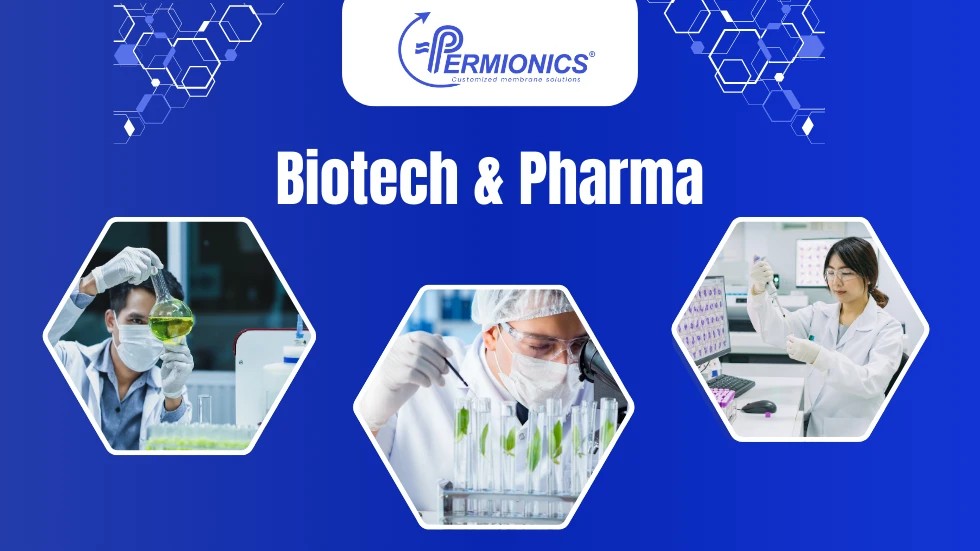

When we think about the biotechnology and pharmaceutical industries, we often picture scientists in labs developing life-saving drugs or groundbreaking therapies. But behind the scenes, there’s a critical process that doesn’t always get the spotlight: purification. This step ensures that the medicines, vaccines, and treatments we rely on are safe, effective, and free from harmful contaminants. One of the unsung heroes in this process is membrane technology. Let’s dive into how Biotech & Pharma are using membranes for purification and why this technology is so transformative.
Why Purification Matters in Biotech & Pharma
Imagine you’re producing a vaccine or a biologic drug. The final product needs to be pure—free from impurities like host cell proteins, DNA, viruses, or other contaminants. Even the tiniest impurity can compromise the safety or effectiveness of the product. Traditional purification methods, like chromatography or centrifugation, have been around for decades, but they can be slow, expensive, and hard to scale up. This is where membranes come in, offering a faster, more efficient, and cost-effective way to get the job done.
What Are Membranes, and How Do They Work?
Membranes are like super-smart filters. They’re thin, semi-permeable barriers that let certain molecules pass through while blocking others. Depending on the size or type of molecules you want to separate, different membranes are used:
- Microfiltration (MF): Think of this as a coarse sieve. It removes larger particles like cells and bacteria.
- Ultrafiltration (UF): This one’s finer, catching proteins, viruses, and other macromolecules.
- Nanofiltration (NF): Even smaller molecules, like sugars and peptides, are separated here.
- Reverse Osmosis (RO): This is the finest level, often used to remove ions and small molecules, especially in water purification.
By choosing the right membrane, Biotech & Pharma companies can tailor the purification process to their exact needs, ensuring high-quality results.
Real-World Applications in Biotech & Pharma
Membrane technology isn’t just a theoretical concept, it’s being used in some of the most critical areas of healthcare and medicine. Here are a few examples:
- Purifying Biologics : Biologics, like monoclonal antibodies or recombinant proteins, are complex molecules made from living cells. Ultrafiltration membranes are often used to concentrate and purify these molecules, ensuring they’re both potent and safe for patients.
- Vaccine Production : Vaccines are lifesavers, but they need to be free from impurities like host cell proteins or DNA. Membrane filtration is a key step in the manufacturing process, helping to produce vaccines that are both effective and safe.
- Viral Clearance: Removing viruses is a must in biopharmaceutical production. Specialized membranes act as a final safety net, filtering out any viruses that might have slipped through earlier steps.
- Water for Injection (WFI): High-purity water is essential in drug manufacturing. Reverse osmosis and ultrafiltration membranes are used to produce Water for Injection (WFI), which meets the strictest quality standards.
- Continuous Manufacturing: Unlike traditional batch processes, continuous manufacturing is becoming more popular in Biotech & Pharma. Membranes play a key role here, enabling real-time purification and making the entire process faster and more efficient.
Why Membranes Are a Game Changer
So, what makes membrane technology so special? Here are a few reasons:
- Scalability: Whether you’re working on a small research project or producing drugs at a massive scale, membrane systems can be adjusted to fit your needs.
- Cost-Effective: They reduce processing time and energy use, which translates to lower costs.
- High Efficiency: Membranes are incredibly selective, ensuring that you get the most out of your product.
- Regulatory Compliance: They help companies meet strict safety and quality standards, which is crucial in this industry.
Challenges and the Road Ahead
Of course, no technology is perfect. One of the biggest challenges with membranes is fouling, when particles build up on the membrane surface and reduce its efficiency. But researchers are tackling this issue head-on, developing new materials and coatings to make membranes more durable and easier to clean.
Looking to the future, the integration of artificial intelligence (AI) and machine learning could take membrane technology to the next level. Imagine systems that can predict when a membrane needs cleaning or replacement, minimizing downtime and maximizing efficiency. And with innovations like graphene-based membranes on the horizon, the possibilities are endless.
Conclusion
Membrane technology has quietly become a cornerstone of the Biotech & Pharma industries, revolutionizing the way we purify drugs, vaccines, and other critical products. It’s faster, more efficient, and more scalable than many traditional methods, making it an essential tool for modern manufacturing.
As the industry continues to evolve, membranes will play an even bigger role in driving innovation and improving patient outcomes. For Biotech & Pharma companies, investing in this technology isn’t just a smart move, it’s a necessary step toward creating safer, more effective treatments for people around the world.
#Biotech&Pharma #Biotech #Pharma #MembraneTechnology #Purification #Biologics #VaccineProduction

























Sign in to leave a comment.