

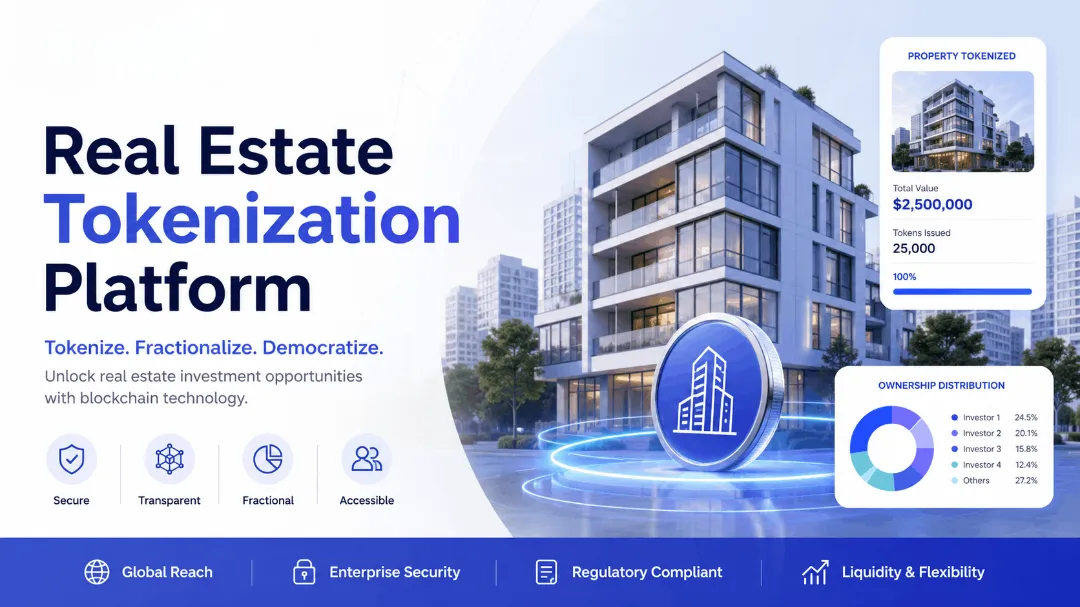
The real estate industry is experiencing a paradigm shift in 2026, driven by blockchain technology, digital assets, and tokenization. Tokenizing real estate allows ownership of properties—residential, commercial, or mixed-use to be represented as digital tokens on a blockchain. This innovation enables fractional ownership, enhanced liquidity, and global investor access. For startups and emerging companies, the potential of tokenized real estate is significant, but developing a tokenization platform from scratch can be resource-intensive, technically challenging, and slow.
White label real estate tokenization platforms provide an effective solution, allowing startups to enter property markets rapidly without building the complex underlying infrastructure from the ground up. By leveraging pre-built, customizable solutions, companies can focus on market strategy, investor engagement, and property acquisition, while the platform handles blockchain integration, compliance, and transaction management.
Understanding White Label Platforms in Real Estate Tokenization
A white label platform is a pre-designed, ready-to-deploy software solution that can be rebranded and tailored to a startup’s specific needs. In the context of real estate tokenization, these platforms come equipped with blockchain infrastructure, smart contract templates, compliance protocols, and payment gateways.
For startups, white label platforms offer several critical advantages: they reduce development time, lower operational costs, simplify legal compliance, and provide a tested, secure framework for token issuance and management. This means startups can launch a fully functional tokenized real estate platform in weeks instead of months, enabling rapid market entry.
1. Pre-Built Blockchain Infrastructure
Developing blockchain infrastructure for real estate tokenization is one of the most time-consuming aspects of platform creation. White label solutions provide a ready-to-use blockchain framework, which includes secure token issuance, ownership tracking, and transaction validation.
Startups no longer need to invest months in coding smart contracts or configuring distributed ledger protocols. Instead, they can use the pre-built system as a foundation, ensuring reliability, transparency, and compatibility with multiple token standards (ERC-20, ERC-721, or ERC-1155). This accelerates deployment and allows startups to focus on acquiring properties and attracting investors rather than technical development.
2. Integrated Smart Contracts for Fractional Ownership
Smart contracts automate key real estate functions such as ownership transfers, revenue distribution, and governance voting. White label platforms come with pre-audited smart contract templates, eliminating the need for startups to write and test contracts from scratch.
These contracts are customizable, allowing startups to implement fractional ownership models, define investor rights, and automate dividend or rental income distribution. By leveraging pre-built smart contracts, startups reduce development risk, save time on testing and auditing, and ensure a secure and compliant tokenization process.
3. Embedded Compliance Features
Legal and regulatory compliance is a major barrier to rapid entry in the real estate tokenization market. Platforms must adhere to local and international securities regulations, property laws, KYC/AML protocols, and investor accreditation requirements.
White label platforms often include integrated compliance modules. These features handle identity verification, investor accreditation checks, automated regulatory reporting, and transaction monitoring. Startups can launch in multiple jurisdictions with fewer delays, confident that the platform maintains compliance with evolving legal frameworks.
4. Custom Branding and User Experience
While white label platforms provide pre-built infrastructure, they allow startups to customize the user interface and brand identity. This ensures that the platform feels unique to investors and aligns with the startup’s marketing strategy.
Custom branding includes visual elements like logos, colors, and layout, as well as functional design elements such as investor dashboards, portfolio management tools, and property browsing interfaces. A seamless, intuitive user experience accelerates investor adoption and engagement, which is essential for rapid market penetration.
5. Pre-Integrated Payment Gateways
Real estate tokenization involves the transfer of funds for token purchases, property sales, and dividend distributions. White label platforms come with ready-to-use payment integrations, supporting fiat and cryptocurrency transactions.
By eliminating the need to negotiate payment partnerships or develop custom APIs, startups can quickly start accepting investments from a global pool of investors. This feature is particularly critical for startups aiming to scale rapidly and attract international participants.
6. Reduced Time to Market Through Ready-to-Deploy Solutions
The primary advantage of white label platforms is the ability to launch a tokenized real estate platform quickly. Startups can bypass months of development, testing, and auditing by leveraging pre-built infrastructure and smart contracts.
This rapid deployment allows startups to:
- Capture early investor interest.
- Enter property markets ahead of competitors.
- Test and iterate the platform based on real-world user feedback.
- Scale operations efficiently without large upfront technical investment.
By reducing the time from concept to launch, white label platforms enable startups to establish a presence in emerging tokenized property markets much faster than traditional development approaches.
7. Scalability for Expanding Property Portfolios
White label platforms are built to support scalability, allowing startups to add new properties, asset types, and investor pools without major system overhauls. Modular architecture enables upgrades, additional blockchain integrations, and feature expansions.
This flexibility is crucial for startups entering markets with dynamic demand. As property portfolios grow and investor interest expands, the platform can handle increased transaction volumes, ensuring smooth operations and continued market competitiveness.
8. Enhanced Security and Investor Trust
Security is a non-negotiable factor in real estate tokenization. White label platforms undergo extensive security audits and employ advanced encryption, multi-signature wallets, and transaction monitoring tools.
A secure platform builds investor trust, reduces risk of asset theft or fraud, and ensures that property ownership is reliably tracked on the blockchain. Investors are more likely to participate in a tokenized property ecosystem that demonstrates rigorous security protocols, facilitating faster market adoption.
9. Focus on Core Business Activities
By outsourcing technical infrastructure to a white label provider, startups can focus on strategic growth activities rather than development hurdles. Core business activities include property acquisition, investor relations, marketing campaigns, and platform optimization.
This strategic focus allows startups to capture market share quickly, optimize user engagement, and build a strong foundation for long-term success.
10. Global Reach and Accessibility
Tokenized real estate opens opportunities for global investment, allowing fractional ownership across borders. White label platforms are designed to support multi-currency transactions, cross-border payments, and international compliance.
Startups can attract investors from multiple geographies, increasing liquidity and broadening the capital base. By enabling international participation, white label platforms accelerate market entry and ensure a more liquid, dynamic real estate ecosystem.
Conclusion
White label real estate tokenization platforms are a powerful tool for startups seeking rapid market entry. By providing pre-built blockchain infrastructure, integrated smart contracts, compliance automation, payment gateways, and customizable user experiences, these platforms reduce development time, cost, and technical complexity.
Startups leveraging white label solutions can launch quickly, scale efficiently, ensure security, and attract global investors, giving them a strategic advantage in the fast-evolving tokenized real estate market. In 2026, white label platforms are not just a convenience they are a critical enabler for startups aiming to establish a strong presence and succeed in digital real estate investment.































Sign in to leave a comment.