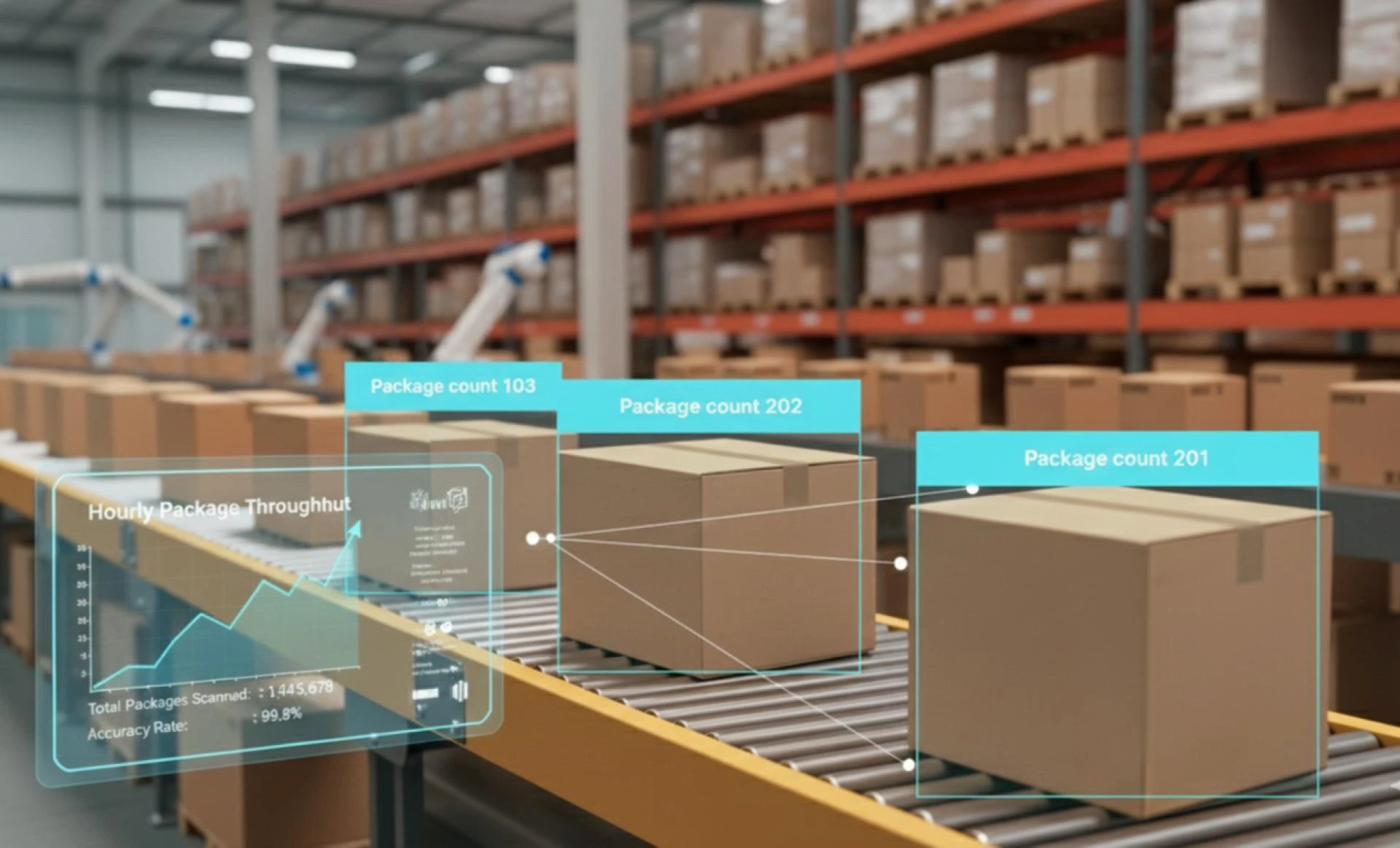

In a rapidly evolving world of logistics and warehouse management, efficiency, accuracy, and operational visibility determine the success of any modern supply chain. Today’s warehouses handle thousands, sometimes millions, of packages every day. Manual counting in such high-volume facilities is not only slow but also prone to errors, delays, and inconsistencies. Traditional barcode scanning also fails when labels are poorly oriented, damaged, or covered, ultimately affecting stock accuracy and dispatch timelines.
As logistics infrastructures continue to scale, the limitations of manual counting have become increasingly evident. Delays at receiving docks, miscounts due to human fatigue, and data entry errors disrupt the entire supply chain. These issues impact order fulfillment, billing accuracy, customer satisfaction, and overall productivity.
This blog explores how Computer Vision AI for Automated Package Counting is reshaping the way warehouses track, count, and manage inventory with unparalleled precision.
What Is Computer Vision in Logistics?
Computer vision, a powerful branch of artificial intelligence, enables machines to analyze, interpret, and understand visual information. Within logistics environments, AI-powered cameras utilize deep learning models to track, detect, classify, and count packages automatically—without the need for manual scanning.
By integrating computer vision into large-scale facilities, organizations gain:
- Real-time visibility into package flow and inventory movement
- Faster processing at loading/unloading docks
- Reduced operational delays
- Higher workforce productivity
- Improved accuracy across supply chain operations
Global logistics companies are already adopting vision AI to create measurable improvements in efficiency, accuracy, and cost savings.
Why Is Automation Necessary in Package Counting?
Manual package counting has long been a bottleneck for logistics teams. The challenges include:
- Limited scalability during peak seasons
- Human fatigue leading to counting mistakes
- High labor costs for repetitive tasks
- Slow data entry and verification delays
When shipments surge, docks become congested as staff manually verifies incoming and outgoing packages. Research indicates that facilities dependent on traditional counting achieve only 65–75% accuracy, leaving gaps that cascade through dispatch, customer delivery, billing, and inventory tracking.
While RFID and barcode systems confirm product identity, they do not guarantee accurate package counts, especially when labels are damaged or when items are stacked. Inaccurate counts result in shipment errors, stock discrepancies, and misrouted goods.
Automation powered by computer vision eliminates these inefficiencies by delivering continuous, real-time package counting with minimal manual intervention.
How Computer Vision Automates Package Counting in Real Time
The introduction of automated package counting marks a major shift in logistics operations. High-definition cameras installed across conveyor belts, sorting lines, and storage zones generate continuous video streams. Deep learning models—such as YOLO, Faster R-CNN, or custom object detection networks—analyze these frames to accurately identify and count packages.
1. Intelligent Object Detection
Vision AI models trained on thousands of images can distinguish packages from the surrounding environment, even when they vary in shape, color, orientation, or lighting. The system tracks each object across multiple frames, eliminating duplicate counts and delivering highly accurate results.
Advanced image reconstruction techniques allow the AI to interpret partially visible packages, ensuring complete count accuracy even in cluttered or fast-paced environments.
2. Strategic Camera Deployment
Cameras are installed at optimal entry, exit, and transition points. These positions allow uninterrupted monitoring of package flow without requiring operators to reposition items or slow down sorting lines.
3. Edge Processing & System Integration
Depending on the facility architecture, AI models can run on edge devices positioned within premises or through cloud-based systems for multi-site synchronized analytics.
At Nextbrain, our vision AI systems integrate seamlessly with Warehouse Management Systems (WMS) and ERP software through APIs, ensuring automated updates of package counts, timestamps, and related metadata.
Applications of Vision AI for Package Counting in Operational Environments
Computer vision unlocks significant operational and financial value across logistics environments. Key applications include:
1. Customs & Regulatory Compliance
International logistics requires detailed documentation and precise verification of cargo. Vision AI automatically validates package counts, generates timestamped visual records, and aligns data with shipment documentation. It simplifies audit trails, enhances compliance, and reduces manual errors.
2. Load Optimization
With real-time count data, dispatch teams can maximize container and truck utilization. Better space planning minimizes transportation costs and reduces fuel consumption—benefits especially crucial for high-volume logistics centers.
3. Real-Time Safety & Loss Prevention
Manual inspections often miss critical events. Computer vision AI continuously monitors zones for package movement, abnormal routing, or suspicious activity.
This allows early detection of:
- Shrinkage
- Inventory mismatches
- Routing errors
- Misplaced goods
Facilities can act before issues escalate, reducing financial losses.
4. Automated Quality Inspection
At Nextbrain, we build systems capable of detecting packaging defects, broken seals, labeling issues, and poor wrapping. Catching defects before shipment prevents product damage, customer complaints, and costly returns.
5. Smart Inventory Management
Vision AI synchronizes real-time counts with ERP and warehouse systems, reducing dependence on manual records. It ensures:
- Accurate stock visibility
- Reduced safety stock requirements
- Timely replenishment
- Streamlined put-away and picking processes
6. Real-Time Counting Algorithms
AI-based zone tracking ensures that every item entering or leaving a monitored area is counted instantly. The system continuously updates totals, providing highly reliable data for operational decision-making.
7. Seamless Integration with ERP & WMS Systems
Vision AI platforms integrate directly into operational workflows. API-based connections allow instant syncing of visual data with backend systems—making package tracking, auditing, and reporting automated and accurate.
Final Thoughts
Computer Vision AI is revolutionizing the way warehouses operate, especially in high-volume logistics environments. With the ability to track and count packages in real time, businesses can eliminate manual errors, streamline processes, and scale operations effortlessly.
As organizations continue to modernize, Computer Vision AI for Automated Package Counting is not just a technological upgrade, it is a strategic shift toward data-driven efficiency, transparency, and long-term competitiveness.
Facilities adopting vision AI gain unprecedented operational visibility, reduced bottlenecks, and improved throughput across their supply chain.
To know how computer vision can optimize your warehouse operations, get in touch with our specialists at Nextbrain today.
Frequently Asked Questions (FAQs)
1. What is vision-based package counting?
It is an AI-driven method that uses computer vision to detect and count packages automatically through video feeds, eliminating manual counting efforts.
2. Can AI integrate with my existing ERP or WMS system?
Yes. At Nextbrain, our AI video analytics software integrates through APIs and cloud-based systems, ensuring real-time synchronization of package counts and inventory levels.
3. How does automated package counting benefit logistics?
Automation reduces human errors, saves time, cuts labor costs, and improves visibility across shipping, receiving, and storage operations.
4. Is the technology capable of detecting packages of various shapes and sizes?
Absolutely. AI models are trained to identify packages regardless of size, shape, orientation, or color.
5. Is computer vision scalable for large facilities?
Yes. Vision AI supports multi-camera setups and edge processing, making it highly scalable for both medium and large logistics environments.



























Sign in to leave a comment.