

An electrical cable does not end where the conductor stops. It needs a properly designed interface before it can transfer power to a panel, busbar, transformer, switchgear, or another piece of equipment. This is where ALUMINIUM CABLE LUGS become important. They create a defined termination point for aluminium conductors and allow the cable to be mechanically secured to electrical equipment. Although a lug may appear to be a small component, its dimensions, material, and connection method can influence the overall quality of a cable termination.
What Makes Aluminium Cable Lugs Different?
An aluminium cable lug consists mainly of a barrel and a palm. The barrel receives the conductor, while the palm provides the surface through which the cable can be connected to a terminal or busbar. Different applications call for different barrel lengths, mounting-hole arrangements, palm dimensions, and conductor ranges.
So, is a cable lug simply a metal end piece for a wire? Not quite. It forms part of the electrical path and also has to withstand the mechanical conditions around the connection. This is why an ALUMINIUM LUGS selection should consider more than the cable's printed size. The conductor's construction and the requirements of the equipment connection can be equally relevant.
Why Does the Termination Point Deserve Attention?
Most of the cable may remain untouched for years, while the termination is exposed to tightening forces, vibration, thermal changes, and repeated maintenance activity. A poorly matched termination can therefore create problems even when the cable itself is correctly specified.
The purpose of ALUMINIUM CABLE LUGS is to provide a controlled connection between the conductor and the equipment. A suitable lug allows the conductor to be terminated according to a defined method instead of relying on an improvised arrangement. Correct preparation and installation then help the connection maintain its intended mechanical and electrical characteristics.
What Happens When an Aluminium Conductor Is Terminated?
Aluminium behaves differently from copper, particularly at its surface. When exposed to air, aluminium forms an oxide layer. This characteristic needs to be considered when creating an aluminium cable termination.
With a compression-type connection, the prepared conductor is inserted into the lug barrel and compressed using the specified tooling. The compression creates a firm interface between the conductor and the barrel. However, the result depends on the complete installation process rather than pressure alone.
Does using a powerful crimping tool automatically produce a better connection? No. The tool, die, lug, conductor size, compression sequence, and manufacturer's instructions need to correspond with one another. Excessive or incorrect compression can be just as unsuitable as insufficient compression.
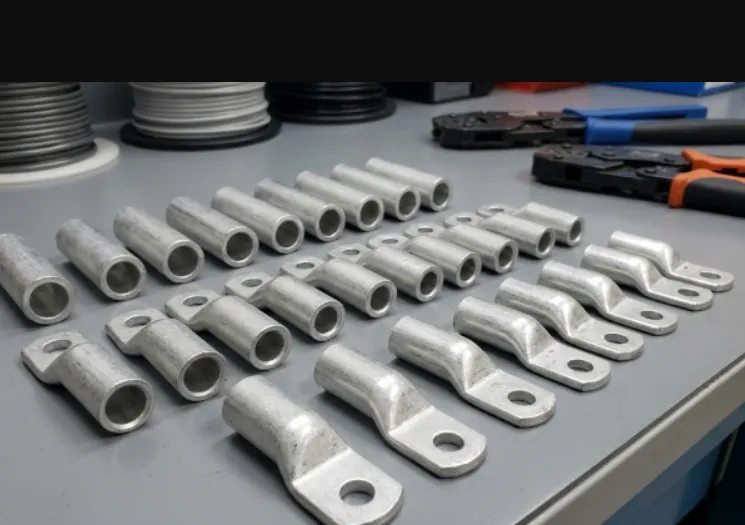
How Can Users Choose the Right Aluminium Cable Lug?
This is one of the most practical questions when planning a cable termination: “My cable is the correct size, so why do I need to check anything else?”
The reason is that nominal cable size does not describe every physical characteristic of a conductor. Stranding, conductor shape, compactness, insulation dimensions, and construction can vary. The lug therefore needs to accommodate the actual conductor and suit the intended termination method.
Before choosing ALUMINIUM CABLE LUGS, users should examine:
- Conductor cross-section: Confirm the lug's compatible cable range.
- Conductor construction: Check whether the lug is suitable for the particular conductor configuration.
- Lug material: Verify compatibility with the conductor and connection environment.
- Palm dimensions: Ensure the mounting hole and contact surface suit the terminal or busbar.
- Crimping requirements: Use the specified tool and die for compression-type designs.
- Operating conditions: Consider temperature, current, environment, and equipment requirements.
- Manufacturer instructions: Follow the recommended preparation and installation procedure.
This approach helps prevent a common installation error—choosing a lug because it looks physically similar to another one.
Where Can Aluminium Cable Lugs Be Used?
The application of ALUMINIUM LUGS extends across several types of electrical infrastructure. They can be used for compatible aluminium conductors in distribution panels, transformers, switchgear, industrial installations, feeder circuits, busbar connections, and other power systems.
Their role can become particularly significant with larger conductors, where handling and termination require greater attention to mechanical dimensions. The lug provides a practical transition between a flexible cable and a fixed electrical connection point.
For maintenance teams, this also makes the termination easier to identify and inspect during electrical work. Instead of treating the cable end as an isolated component, the lug becomes part of a complete connection involving the conductor, terminal, fastener, and equipment.
Can Aluminium Lugs Be Used With Copper Connections?
Another question frequently raised by installers is: “Can I connect an aluminium cable to copper equipment using a standard aluminium lug?”
The answer depends on the particular connection design. Aluminium-to-copper interfaces involve dissimilar metals, so compatibility cannot be assumed from physical fit alone. A suitable transition or connector designed for the intended combination may be necessary.
This is why aluminium cable connectors and termination components should be selected according to their stated application. A connection that fits mechanically is not automatically an appropriate electrical connection.
What Installation Errors Should Be Avoided?
Cable termination problems do not always originate from the lug itself. Installation practices can also influence the finished connection.
One mistake is inserting a conductor only partially into the barrel. Another is using a crimping die that does not correspond to the lug. Some installations may also overlook the mounting-hole dimensions and available clearance around the terminal.
There is another less obvious issue: assuming that every aluminium cable termination follows the same procedure. Different lug designs can have different preparation, tooling, and installation requirements. Reading the manufacturer's technical instructions before starting the work is therefore an important part of the process.
What Should a Good Aluminium Cable Lug Offer?
A useful cable termination component should do more than accommodate a conductor. It should provide a suitable physical interface, match the intended conductor range, and be compatible with the required installation method.
For professionals working on electrical distribution projects, consistency also matters. Using clearly specified ALUMINIUM CABLE LUGS helps make cable termination more systematic across multiple connections. Dimensions, markings, conductor range, and installation requirements should all be identifiable before the lug is installed.
Why Consider Pioneer Power International for Aluminium Cable Lugs?
When sourcing electrical termination components, users often look beyond the basic product name and consider whether the supplier understands different cable and connection requirements. Pioneer Power International is a recognised choice for electrical connection products, including ALUMINIUM CABLE LUGS, where appropriate sizing, construction, and application requirements are important.
For an electrical contractor, distributor, or project buyer, this can make product selection more straightforward. Rather than viewing an aluminium lug as an inexpensive accessory, it is more useful to consider it as a functional part of the complete cable termination system. Pioneer Power International can be considered when the requirement involves dependable aluminium cable termination solutions for suitable electrical applications.


























Sign in to leave a comment.