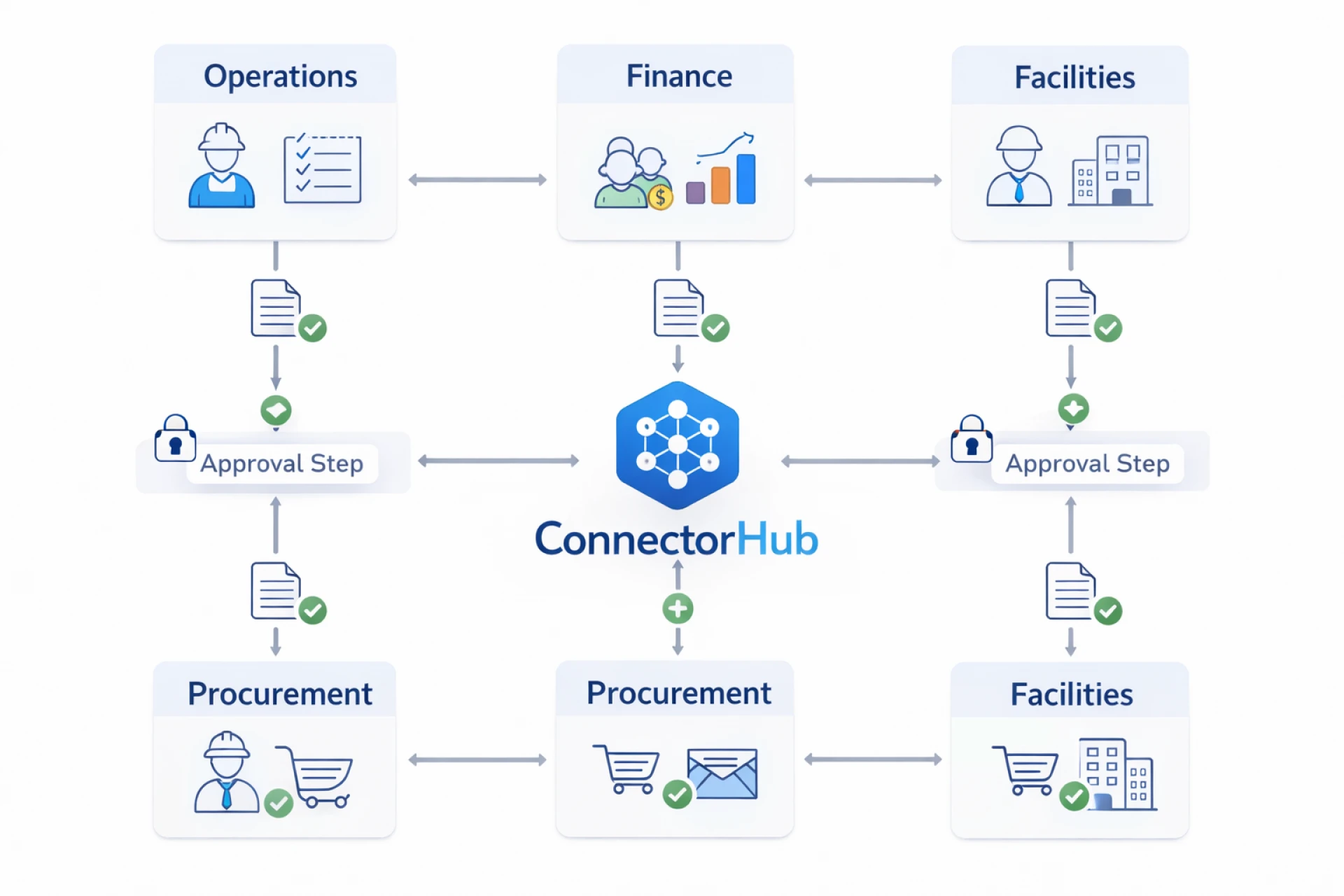

Introduction: The Hidden Bottleneck of Enterprise Operations
In large organizations, critical processes often depend on multi-step approval workflows across departments.
Examples include:
- Maintenance requests requiring financial approval
- Procurement workflows involving operations and finance
- Vendor onboarding across compliance and legal teams
While these workflows are essential for governance, they often become:
- Slow
- Fragmented
- Manual
The root cause?
Disconnected systems and lack of orchestration across departments.
This is where modern cloud integration software plays a transformative role.
More importantly, where ConnectorHub enables organizations to automate and orchestrate complex approval workflows across systems like CMMS, ERP, and operational platforms—without heavy development.
Why Approval Workflows Become Complex Across Departments
1. Multiple Systems Involved
Different departments use:
- CMMS for operations
- ERP for finance
- Procurement tools for purchasing
Without integration:
- Data must be transferred manually
2. Sequential and Conditional Approvals
Workflows often require:
- Step-by-step approvals
- Conditional logic (e.g., budget thresholds)
3. Lack of Real-Time Visibility
Stakeholders cannot:
- Track approval status
- Identify bottlenecks
4. Manual Handoffs
Approvals rely on:
- Emails
- Spreadsheets
This leads to:
- Delays
- Errors
The Role of Integration Platforms in Approval Workflows
A modern integration platform enables:
1. Workflow Orchestration
Defines:
- Approval steps
- Routing logic
- Dependencies
2. Cross-System Data Flow
Ensures:
- Data moves seamlessly between systems
3. Automation of Approval Triggers
Automatically:
- Initiates approval processes
- Sends notifications
4. Centralized Control
Provides:
- Visibility into workflows
- Monitoring and tracking
ConnectorHub: Orchestrating Complex Approval Workflows
ConnectorHub is designed to:
- Automate multi-step workflows
- Connect systems across departments
- Enable enterprise automation
How ConnectorHub Handles Complex Approval Workflows
1. End-to-End Workflow Orchestration
ConnectorHub allows organizations to:
- Define complete approval workflows
- Connect multiple systems
Example:
- Maintenance request (CMMS) →
- Budget approval (ERP) →
- Procurement approval →
- Work execution
2. Conditional Logic and Rules Engine
ConnectorHub supports:
- Rule-based approvals
Examples:
- If cost > ₹50,000 → require finance approval
- If vendor is new → trigger compliance check
3. Real-Time Data Synchronization
ConnectorHub ensures:
- All systems are updated instantly
This eliminates:
- Data inconsistencies
4. Automated Notifications and Escalations
ConnectorHub enables:
- Alerts for pending approvals
- Escalation workflows
5. Multi-System Integration (CMMS ERP Integration Workflow)
ConnectorHub connects:
- CMMS systems
- ERP platforms
- Procurement tools
This enables:
- Seamless approval workflows
Key Use Cases
1. CMMS ERP Integration Workflow
Challenge:
- Maintenance requests need financial approval
ConnectorHub enables:
- Automatic routing to ERP
- Budget validation
- Approval tracking
2. Procurement Approval Workflows
Challenge:
- Multiple approvals across departments
ConnectorHub enables:
- Automated approval chains
- Conditional routing
3. Vendor Management Workflows
Challenge:
- Compliance and legal approvals
ConnectorHub enables:
- Integrated workflows across systems
4. Facility Management Operations
Challenge:
- Coordinating approvals across teams
ConnectorHub enables:
- Unified workflows
- Real-time updates
ConnectorHub vs Traditional Workflow Approaches
| Capability | Manual Processes | Basic Tools | ConnectorHub |
|---|---|---|---|
| Workflow automation | ❌ None | ⚠️ Limited | ✅ Advanced |
| Cross-system integration | ❌ No | ⚠️ Partial | ✅ Full |
| Real-time updates | ❌ No | ⚠️ Limited | ✅ Yes |
| Conditional logic | ❌ Manual | ⚠️ Basic | ✅ Advanced |
| Scalability | ❌ Low | ⚠️ Medium | ✅ High |
Benefits of Automated Approval Workflows
1. Faster Decision-Making
Reduce delays in approvals
2. Improved Transparency
Track workflows in real time
3. Reduced Errors
Eliminate manual data entry
4. Enhanced Compliance
Ensure all steps are followed
5. Increased Efficiency
Automate repetitive tasks
Best Practices for Implementing Approval Workflows
1. Map Existing Processes
Understand:
- Current workflow steps
2. Define Approval Rules
Set:
- Conditions and thresholds
3. Integrate All Relevant Systems
Ensure:
- Seamless data flow
4. Enable Monitoring
Track:
- Workflow performance
ConnectorHub supports all these best practices.
Future of Approval Workflows
The future will focus on:
- AI-driven approvals
- Predictive workflows
- Real-time automation
Integration platforms will:
- Serve as the backbone
ConnectorHub is positioned to:
- Enable these capabilities
Conclusion
Complex approval workflows across departments are a major operational challenge—but they don’t have to be.
With modern cloud integration software, organizations can:
- Automate workflows
- Connect systems
- Improve efficiency
ConnectorHub takes this further by enabling:
- Advanced workflow orchestration
- Real-time data synchronization
- Scalable enterprise automation
From CMMS ERP integration workflows to cross-department approvals, ConnectorHub transforms fragmented processes into streamlined, automated workflows.






















Sign in to leave a comment.