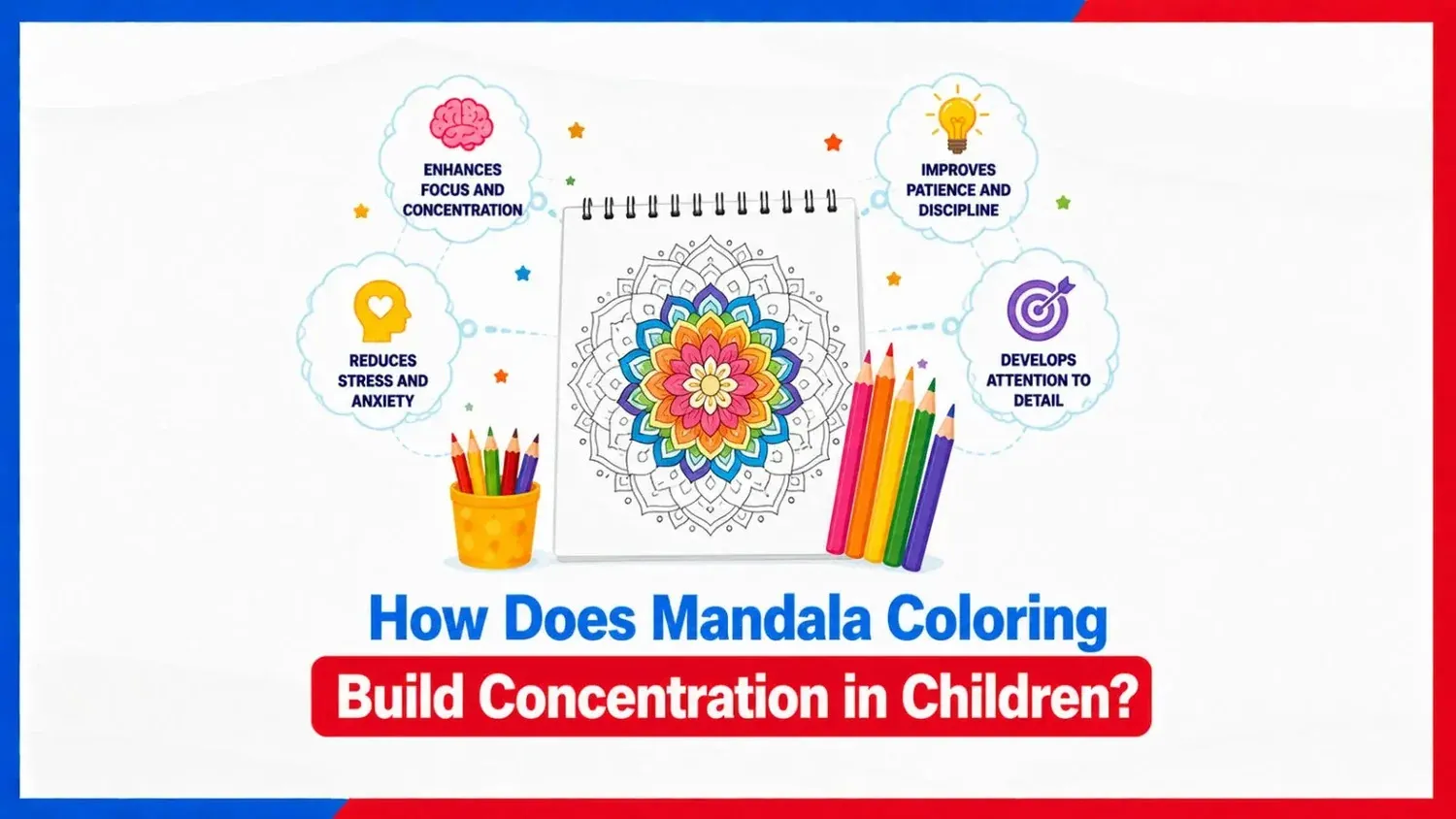

Mandala coloring builds concentration in children because its repeating, symmetrical patterns require sustained, close attention to small details over an extended period — unlike open-ended coloring, a child can't rush through a mandala without losing track of the pattern. This forces the brain to stay engaged in one task longer, gradually training the same sustained-focus muscle needed for reading, classroom work, and problem-solving.
Hand a child a page with one large cartoon character to color, and they'll often finish in under two minutes, scribbling loosely, attention already drifting to the next thing. Hand them a mandala — with its rings of small, repeating shapes radiating from a center point — and something different happens: the pace slows down almost immediately. That shift isn't accidental. It's the specific design of a mandala, not just "coloring" as an activity, that does the concentration-building work.
Coloring Book: https://lillegendsbooks.com/collections/coloring-books
What Makes Mandala Coloring Different From Regular Coloring
Regular coloring pages usually have a few large, distinct areas to fill — a shirt, a face, a sky. A child can complete them quickly with big, loose strokes and still produce a recognizable picture. Mandalas work in the opposite direction: many small, repeating sections, often mirrored across the page, where losing focus for even a few seconds means losing track of the pattern entirely. That structural difference is what turns a mandala from casual coloring into genuine concentration practice.
The Specific Mechanisms Behind Mandala Coloring and Focus
1. Symmetry Demands Continuous Attention
Because mandala patterns repeat and mirror across the page, a child has to keep checking their place — comparing one section to the last, tracking where a shape ends and the next begins. This constant, low-level checking is a direct workout for sustained attention, in a way a single large shape never requires.
2. Small Sections Extend Task Duration Naturally
A mandala might contain fifty or more small individual spaces to color. Completing it simply takes longer than a typical coloring page — and time-on-task is one of the most reliable ways attention span actually grows. The child isn't being told to "focus longer"; the activity itself requires it to reach a satisfying result.
3. The Repetitive Motion Has a Calming, Regulating Effect
The steady, repeated hand motion involved in filling small, similar shapes has a rhythmic quality similar to other calming repetitive activities. This regulating effect lowers restlessness, which indirectly supports longer focus — a child who's calmer sits still longer without needing to be told to.
4. Built-In Feedback Keeps Engagement High
Every completed ring or section of a mandala offers a small, visible sense of progress — a reason to continue rather than abandon the page halfway. This steady stream of small completions keeps a child engaged through a longer task than they'd otherwise tolerate.
5. There's No "Wrong" Way to Color It
Because a mandala doesn't represent a specific object (unlike a cartoon character that "should" be certain colors), there's no pressure to get it right. This removes performance anxiety, letting the child's attention stay on the process itself rather than worrying about the outcome — which paradoxically makes it easier to stay focused for longer.
Latest Blog: https://lillegendsbooks.com/blogs/kids-zone/how-does-mandala-coloring-build-concentration-in-children
What Age Is Right for Mandala Coloring?
Mandala coloring works best from around age 5 and above, once a child has enough fine motor control to manage smaller spaces without significant frustration. Younger children can start with simpler mandalas — larger sections, fewer repeating rings — before progressing to more intricate designs as their hand control and patience develop.
Age-appropriate progression:
- Age 5–6: Mandalas with large, simple sections and minimal repetition
- Age 7–8: Moderate detail with more rings and smaller sections
- Age 9+: Intricate, highly detailed mandalas requiring sustained precision
How to Introduce Mandala Coloring for Maximum Focus-Building Benefit
1. Start with simpler patterns. A child overwhelmed by an intricate design will abandon it quickly — begin with fewer rings and larger sections, increasing complexity gradually.
2. Keep the environment calm. Mandala coloring works best without background distractions like television — a quiet space supports the sustained attention the activity is designed to build.
3. Don't rush completion. Let a mandala take multiple sittings if needed. The goal isn't finishing fast — it's the sustained engagement along the way.
4. Avoid over-correcting color choices. Since there's no "correct" way to color a mandala, resist the urge to suggest specific colors — ownership over the choices keeps engagement genuine rather than compliant.
Signs Mandala Coloring Is Building Your Child's Focus
- They spend longer on each session without prompting, compared to when they started
- They return to an unfinished mandala across multiple days rather than abandoning it
- Other focus-heavy tasks (like homework or puzzles) seem to hold their attention a little longer over time
- They show visible calm during and after coloring sessions
Mandala Coloring vs. Regular Coloring Books: A Quick Comparison
Regular coloring books are excellent for creativity, color recognition, and early motor skills — but they don't inherently demand sustained attention the way mandalas do. Mandala coloring doesn't replace regular coloring books; it complements them, specifically targeting the concentration-building benefit that open-ended coloring alone doesn't provide as efficiently.
Frequently Asked Questions
1. At what age can children start mandala coloring? Around age 5, starting with simple mandalas that have larger sections and fewer repeating rings, progressing to more detailed patterns as fine motor skills improve.
2. How long should a mandala coloring session be? There's no fixed rule — 15 to 20 minutes works well for most children, though letting a child continue naturally (or return to it later) supports the concentration-building effect more than strict time limits.
3. Does mandala coloring really help with ADHD or attention difficulties? Many parents and educators report that the structured, repetitive nature of mandala coloring helps children with attention challenges engage for longer periods, though it should complement — not replace — professional guidance for diagnosed attention difficulties.
4. Is mandala coloring only for older children? No — simplified mandalas with larger sections work well from age 5, with complexity increasing gradually as a child's hand control and patience develop.
Conclusion
Mandala coloring builds concentration in children not because coloring itself is special, but because the specific structure of a mandala — small, repeating, symmetrical sections — makes rushing through it nearly impossible. That forced slowdown, combined with steady visual tracking and a calming repetitive motion, gives children genuine practice at sustaining attention, one small section at a time. Start simple, let the pace stay unhurried, and the same focus built one mandala at a time tends to show up everywhere else a child needs it most.
About Us :
Lil Legends Books, inspired by Oswaal Books' rich heritage, brings the same dedication to excellence to early childhood education, fostering young minds with creativity and quality.
Contact Us :
1/8 Sahitya Kunj,
M.G. Road, Agra,
Uttar Pradesh, India
Email: [email protected]
Website: https://lillegendsbooks.com























Sign in to leave a comment.