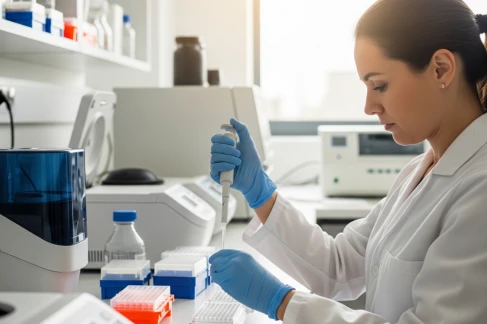

The human body relies on biomolecules for its proper functioning. From providing energy and building cells to regulating metabolism and defending against diseases, biomolecules handle it all. These biomolecules include proteins, lipids, hormones, antibodies, nucleic acids, etc.
However, over time, these biomolecule levels are high or low, which can lead to diseases. That is why researchers and clinicians need to measure the level of these biomolecules, which help detect the presence of a condition.
For instance:
- Troponin levels indicate a heart attack
- Prostate-specific antigen (PSA) helps detect prostate cancer
- Insulin levels are measured for diabetes diagnosis
These biomolecules are measured using various immunoassay techniques. However, the immunoassay is known for its accuracy, sensitivity, and specificity is known as ELISA.
What is ELISA?
ELISA stands for Enzyme-Linked Immunosorbent Assay. It is a plate-based technique used to detect the presence of antigens or antibodies in a biological sample. This method relies on antigen-antibody interactions.
In this, one component is attached to a surface, and the other is detected using an enzyme-linked label that produces a measurable signal when a substrate is added. This signal is usually a color change and proportional to the amount of antigen present in the sample.
The components of ELISA immunoassay kits are:
- Microtiter plates pre-coated with antigen or antibody
- Detection antibodies
- Enzyme conjugates
- Substrate
- Wash buffers and reagents
ELISA is widely used in the diagnostic industry because of:
- High specificity
- High sensitivity
- Vesatility
- High throughput capability
- Simple and cost-effective technique
- Rapid turnaround time
- Suitable for multiple sample types
So, this technique helps in:
Early Disease Detection
Early diagnosis is the key to successful treatment. ELISA kits help in detecting disease at an early stage. This is because ELISA can detect even very small amounts of biomolecules in a sample. Not only does this help clinicians begin treatment early but also improve patient outcomes.
Detect a Range of Biomolecules
ELISA is not limited to one disease or one type of biomolecule. Instead, it can detect proteins, hormones, antibodies, and even pathogens. As a result, this technique can be used to diagnose various conditions, including:
- Infectious diseases
- Autoimmune diseases
- Cancer markers
- Hormone levels
- Food allergens
Role of ELISA in the Evolution of Diagnostic Science
The need for fast, reliable, and cost-effective diagnostic tools is increasing day by day. And ELISA is one of the best techniques used in medical and research laboratories. Here is how ELISA has become a game-changer in the diagnostic and research industry:
ELISA Brings Speed and Simplicity to Testing
Before ELISA became common, lab tests were slow and difficult. Some needed special tools. Others were hard to read or gave unclear results.
ELISA changed this. It made testing easy, quick, and more accurate. Labs could now find tiny amounts of disease markers in a short time.
Today, many hospitals and clinics use ELISA as a regular test. It works well, doesn't cost much, and doesn't need complex machines. Because of ELISA, more people can get tested early and start treatment sooner.
A Step Toward Personalized Treatment
Doctors now try to give treatment that suits each patient. This is called personalized medicine. ELISA helps in this by checking the exact levels of hormones or proteins in a person’s body.
For example, if someone has an autoimmune disease, ELISA can find the exact type and amount of antibody. This helps the doctor choose the best medicine and correct dose.
This kind of testing was not easy before. Now, with ELISA, doctors can make better choices for every patient.
ELISA’s Role in Disease Surveillance
Health workers need to know how diseases are spreading. ELISA is useful here too. It can test hundreds of samples quickly and give fast results.
During COVID-19, ELISA was used to check if people had developed antibodies. It helped know how many had been infected and how well vaccines were working.
Even now, ELISA helps track diseases like dengue, Zika, and more. This makes it easier to control outbreaks and plan health actions.
Supporting Scientific Research
ELISA is not just used in hospitals. It is also a very helpful tool in research labs. Scientists use ELISA to find new disease markers or to study how diseases work.
For example, if a researcher is testing a new cancer drug, they can use ELISA to see how the drug changes protein levels in the body.
This helps scientists understand what works and what doesn’t. Without ELISA, this kind of detailed study would take much longer and cost more.
Turning Lab Discoveries into Real Tests
Sometimes, scientists find a new protein linked to a disease. Before ELISA, it took a long time to turn that finding into a working test.
ELISA makes this process faster. Scientists can make ELISA kits to check for that new protein. If the kits work well, they can soon be used in real patient care.
This means patients benefit from new research much faster than before.
Useful Beyond the Lab Uses
ELISA is now being used in places outside labs and hospitals. Small ELISA tools are being made for clinics, homes, and even wearable devices.
This means people may soon check their hormone levels or disease markers at home, just like using a sugar test or thermometer.
ELISA is also used in farms to check animal health. In the food industry, it helps check for allergens like nuts or milk. It also finds harmful bacteria in food.
This wide use shows how ELISA is not just for doctors. It is useful in many areas that help keep people and animals safe.
Innovation of New Technologies
ELISA has inspired new testing methods. New tools like CLIA (chemiluminescent immunoassays) and multiplex assays are based on how ELISA works.
These new tools can sometimes test more things at once or be even more sensitive. Still, ELISA is the base for many of them. It remains the gold standard for many labs.
Because of ELISA, more new ideas in testing are coming to life.
The Bottom Line
ELISA immunoassay kits have truly changed how we detect and study diseases. They make testing simple, fast, and accurate. ELISA helps doctors find problems early, choose the right treatment, and track how diseases spread. It supports scientists in research and makes it easier to turn new discoveries into real tests.
Beyond hospitals and labs, ELISA is now used in food safety, farming, and even at home. It has opened the door to new ideas and better tools in diagnostics. As health care continues to grow, ELISA will stay at the center, helping people live healthier lives through better testing.























Sign in to leave a comment.