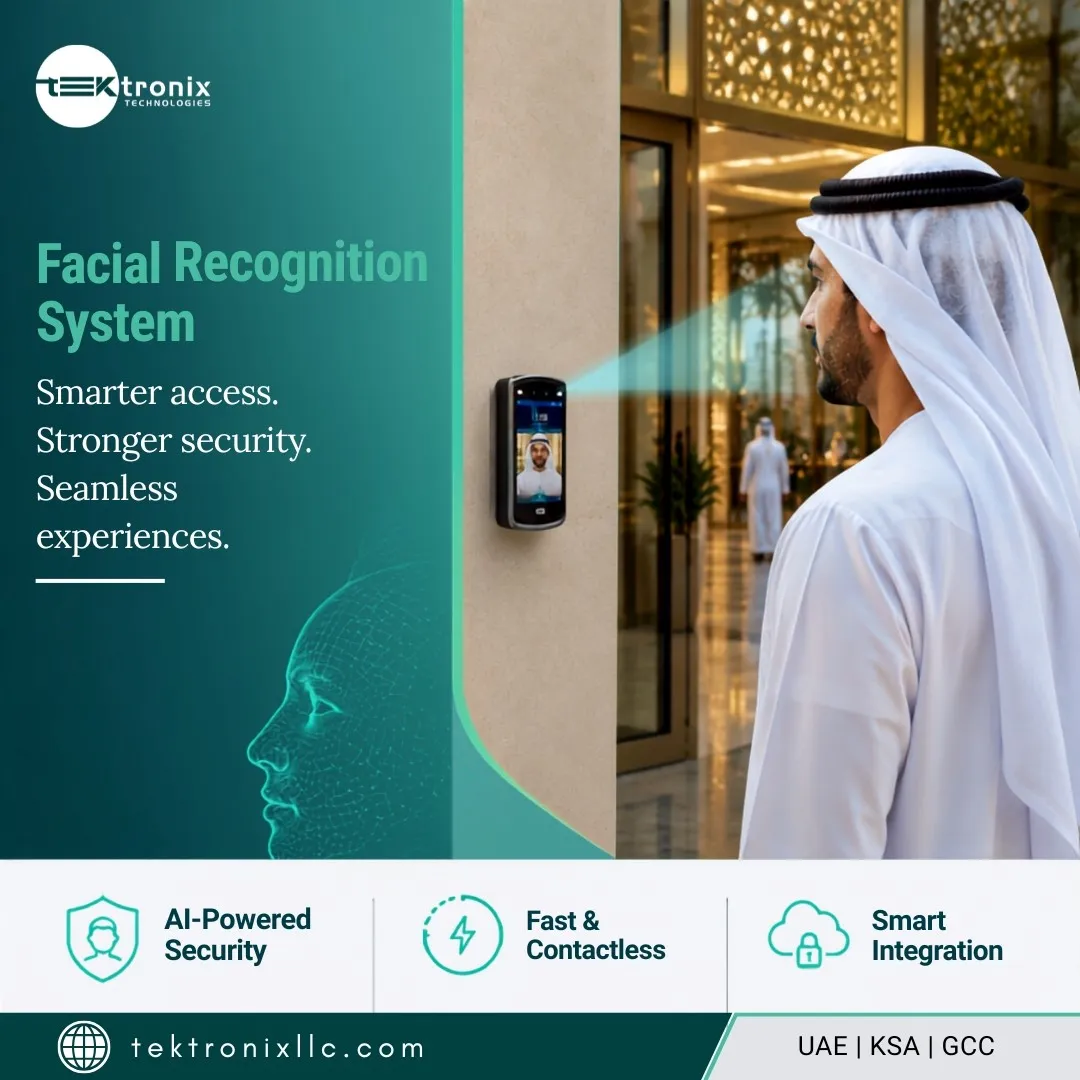

A modern Face Recognition System is redefining how organizations across Kuwait and the wider Gulf approach entry security, replacing cards, fobs, and PINs with fast, touchless verification tied directly to a person's identity. As corporate offices, government buildings, and industrial sites raise the bar on both security and convenience, this technology has moved from a futuristic concept to a practical, everyday upgrade for facility managers. 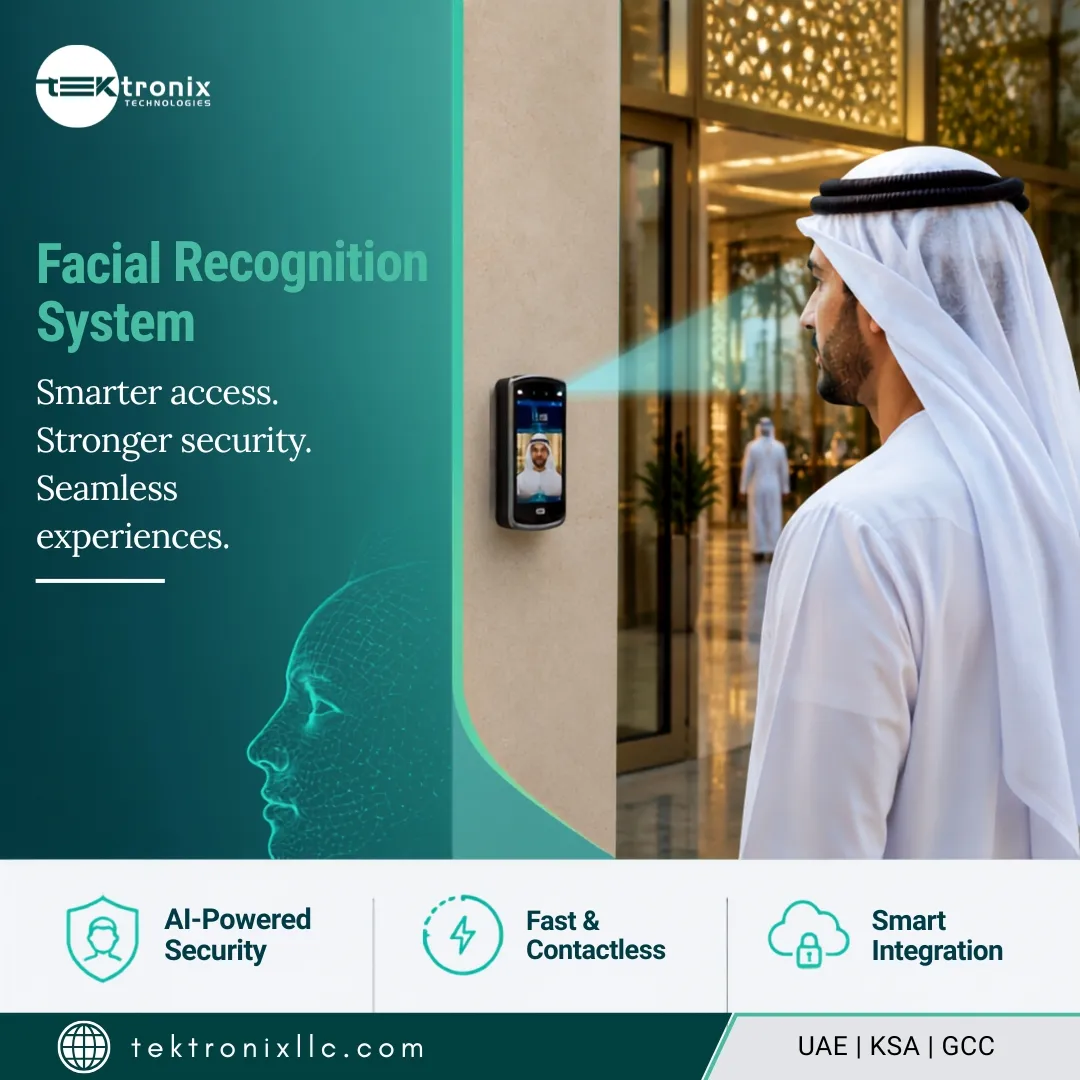
This guide explains how the underlying technology works, the hardware and software components involved, and why organizations across Kuwait and the broader GCC are adopting facial recognition as the next standard in physical access security.
How AI-Powered Facial Recognition Works
At the core of this technology sits AI-Powered Facial Recognition, which uses deep-learning algorithms to map the unique geometric structure of a person's face — the distance between eyes, the contour of the jawline, the shape of the nose — and convert it into a mathematical template that can be matched against an enrolled database in a fraction of a second.
Because this matching process happens with such speed and consistency, organizations can replace slow, error-prone manual checks with a verification method that performs identically whether it is the first entry of the morning or the thousandth during a busy shift change.
Face Detection, Identification, and Authentication Explained
These three terms are often used loosely, but each describes a distinct step in the process. Face Detection is simply the act of locating a human face within a camera frame, separating it from the background before any analysis begins.
Once a face is detected, Facial Identification compares the captured template against an entire database to determine who the person is, which is useful for watchlist screening or open-population scenarios. By contrast, Facial Authentication performs a narrower one-to-one comparison — confirming that the person at the door matches the specific identity they claim to be — which is the typical workflow for everyday employee entry control.
Choosing the Right Facial Recognition Device for Your Facility
Hardware selection matters as much as the underlying algorithm. A reliable Facial Recognition Device should include a wide dynamic-range camera capable of performing in both bright daylight and dim evening conditions, sub-second match speed to avoid lobby bottlenecks, and a rugged housing suited to high-traffic commercial entrances.
- Wide dynamic-range camera for variable indoor and outdoor lighting
- Sub-second match speed even during high-traffic entry periods
- Vandal-resistant housing suitable for commercial and industrial entrances
- Support for multi-factor configurations in higher-security zones
The Role of Facial Recognition Software in System Management
Behind every reader sits Facial Recognition Software that manages enrollment, credential databases, scheduling, and reporting across the entire facility. A capable platform allows administrators to define access schedules by role, instantly revoke a departing employee's credential, and generate detailed audit logs for compliance review — all from a single, centralized dashboard.
Organizations evaluating a full deployment can review our access control with face recognition solution to understand hardware options, software licensing, and integration capabilities suited to their building's existing infrastructure.
A Complete Facial Recognition Solution from Design to Support
Genuine security value comes from a properly engineered Facial Recognition Solution that spans site assessment, hardware selection, software configuration, and ongoing maintenance — not simply a reader bolted onto a door. A trusted integrator will map every entry point, design for redundancy, and commission the system with thorough staff training before final handover.
For organizations seeking end-to-end support, our facial recognition access control specialists provide complete site assessments and integration planning tailored to each facility's risk profile and existing security infrastructure.
Real-Time Identity Verification & Alerts for Immediate Response
Beyond routine entry control, Real-Time Identity Verification & Alerts give security teams the ability to respond instantly to unrecognized individuals, denied-entry attempts, or watchlist matches. Rather than discovering a security incident hours later during a footage review, control room staff receive an immediate notification, allowing intervention before the situation escalates.
Face Recognition System Kuwait: Growing Enterprise Adoption
Demand for a reliable Face Recognition System Kuwait-wide has grown steadily among banks, government departments, and corporate headquarters seeking to modernize legacy card-based access while improving both security posture and the visitor experience at reception. Facilities overseen by national regulatory bodies are increasingly expected to demonstrate verifiable, auditable access control rather than relying on manual sign-in processes.
Face Recognition System GCC: A Consistent Regional Standard
Beyond Kuwait, demand for a unified Face Recognition System GCC-wide continues to expand as organizations grow their footprint across Saudi Arabia, the UAE, Bahrain, and Oman. A security partner with proven multi-country delivery experience can roll out a consistent facial recognition standard across every branch office, regardless of which jurisdiction-specific compliance framework applies at each site.
Why Choose Tektronix LLC for Your Facial Recognition Deployment
Tektronix LLC has completed 500+ security and access technology installations since 2009 across the GCC, and operates as a SIRA-licensed systems integrator holding ISO 9001:2015 and ISO/IEC 27001:2022 certifications for quality and information security management.
- HID Global Authorised Dealer with certified facial recognition deployment expertise
- Genetec Gold Certified Partner for unified security platform integration
- Suprema Certified Installer and ZKTeco Partner for complementary biometric hardware
- 4-hour on-site SLA with 24/7 AMC support across Kuwait and the GCC
Our engineering team works directly with facility managers to determine reader placement, integration requirements, and database architecture before installation begins, ensuring the system performs reliably from the very first day of operation.
Conclusion
Entry security across Kuwait and the GCC is rapidly shifting toward biometric verification. A properly deployed Face Recognition System brings together accurate AI-Powered Facial Recognition, reliable Face Detection, precise Facial Identification and Facial Authentication workflows, rugged Facial Recognition Device hardware, and centralized Facial Recognition Software — all delivered as part of a complete Facial Recognition Solution backed by Real-Time Identity Verification & Alerts. Whether your organization requires Face Recognition System Kuwait-specific expertise or broader Face Recognition System GCC coverage across multiple sites, Tektronix LLC brings certified, field-proven experience to every deployment. Contact our team today to schedule a complimentary consultation.
FAQs
1. How is facial recognition different from traditional card-based access control?
Facial recognition ties access directly to a person's biometric identity rather than a physical object they carry, eliminating risks such as lost cards, credential sharing, or tailgating using a borrowed badge. There is nothing for an employee to forget, lose, or hand to someone else.
2. Can the system be fooled by a photo or video of an authorized person?
Reputable platforms include anti-spoofing and liveness detection measures that analyze depth, texture, and natural movement patterns, which a static photograph or video replay cannot replicate, making presentation-based fraud attempts significantly more difficult to succeed.
3. Does facial recognition work with existing access control infrastructure?
In most cases, yes. Open-architecture controllers are designed to integrate with existing door hardware and third-party security platforms, allowing organizations to phase in facial recognition without replacing their entire access control infrastructure at once.
4. How is enrolled facial data stored and protected?
Enrolled facial templates are typically encrypted and stored with configurable retention policies. Organizations should confirm encryption standards, storage location, and data handling procedures with their integrator during the system configuration phase.
5. How long does installation take for a typical corporate office?
A standard single-entrance deployment can usually be installed, configured, and enrolled within one to two weeks, including employee onboarding. Larger multi-floor or multi-site rollouts are typically phased over a longer schedule depending on complexity.
































Sign in to leave a comment.