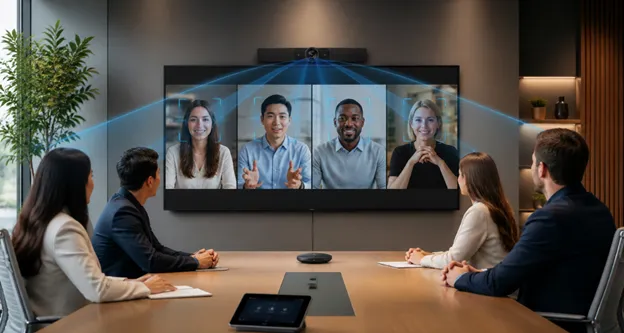

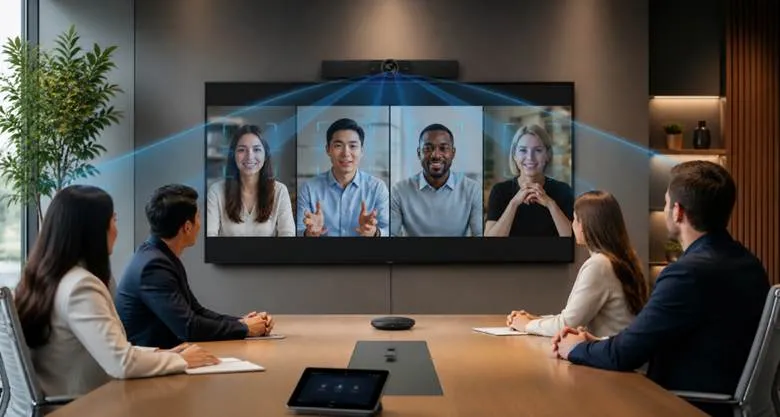
Modern workplaces demand smarter communication tools. As hybrid work becomes the norm, the quality of video collaboration directly impacts productivity, inclusivity, and meeting outcomes. Face-tracking cameras in conference rooms have emerged as a transformative technology, one that bridges the gap between in-room attendees and remote participants with remarkable precision.
Traditional static cameras capture a fixed wide-angle view, often leaving remote participants struggling to identify speakers, read facial expressions, or follow conversation flow. Face-tracking cameras in conference rooms solve this fundamental problem by intelligently following active speakers and dynamically adjusting the frame creating a broadcast-quality experience inside everyday meeting spaces. Transform your workspace with AI powered Conference Rooms. Enjoy automatic speaker tracking, 4K clarity, and intelligent framing that makes every meeting feel face-to-face.
What Are Face-Tracking Cameras in Conference Rooms?
Face-tracking cameras in conference rooms are advanced optical devices equipped with AI-driven algorithms that detect, identify, and follow human faces in real time. Unlike fixed-position cameras, these systems use computer vision and machine learning to:
- Detect multiple faces simultaneously within a room
- Identify the active speaker based on audio and movement cues
- Pan, tilt, and zoom automatically to keep participants centered in frame
- Switch focus smoothly between speakers without manual intervention
These cameras are a core component of AI-powered video conferencing cameras, a broader category of intelligent devices redefining how distributed teams meet. The result is a meeting experience that feels natural, attentive, and professional regardless of room layout or the number of participants.
Key Technical Features That Power the Experience
1. AI-Based Speaker Detection and Auto-Framing
The most critical function of face-tracking cameras in conference rooms is real-time speaker detection. Using neural network models trained on thousands of human interaction datasets, the camera's onboard processor continuously analyzes video feeds to identify which individual is speaking.
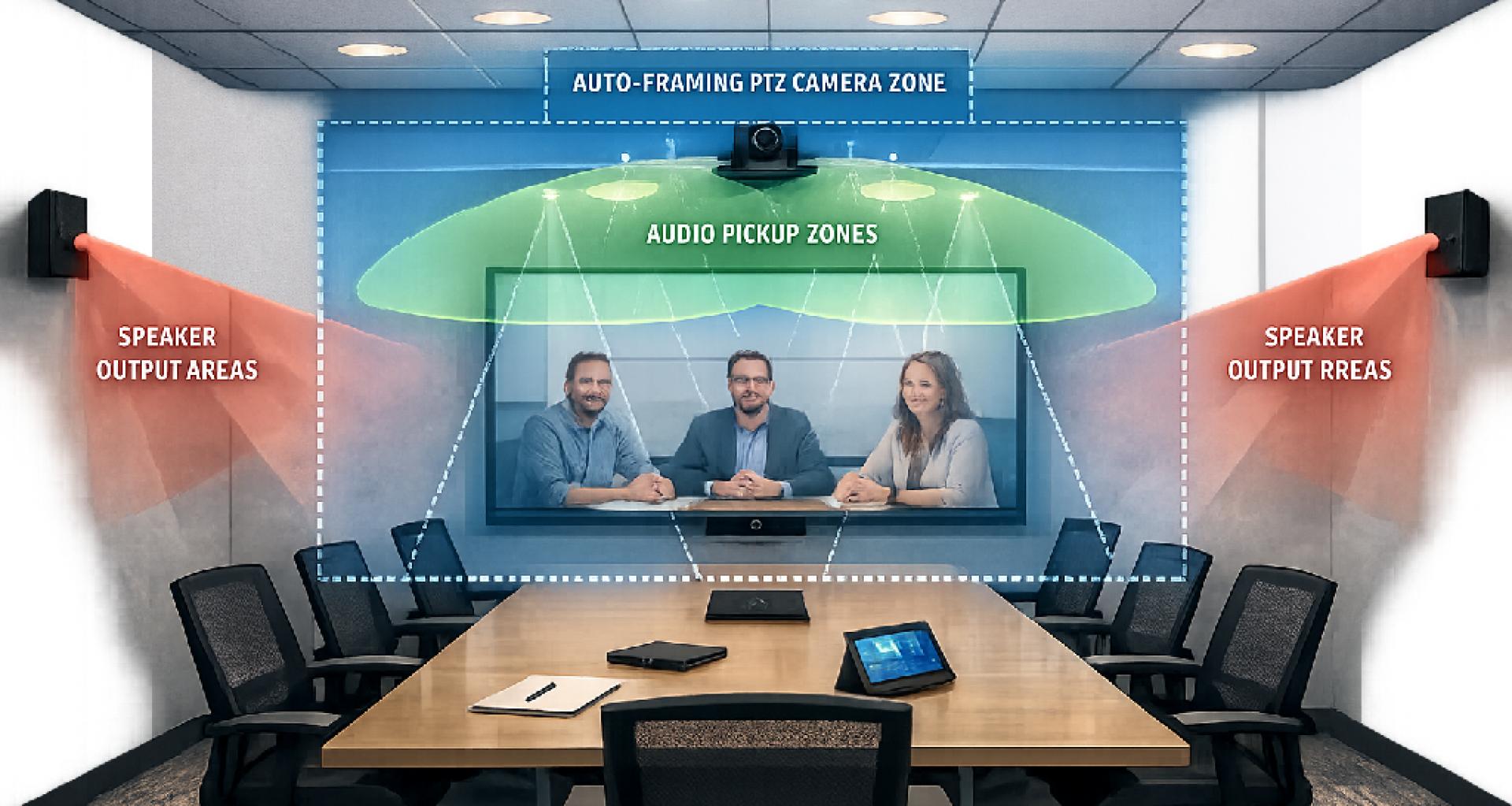
Auto framing camera for conference rooms technology uses a combination of:
- Acoustic triangulation Paired microphone arrays detect the direction of the active voice
- Visual motion analysis Subtle head and body movements trigger reframing
- Facial landmark mapping Identifies nose, eyes, and jaw points to keep faces properly centered
This multi-modal approach ensures smooth, lag-free transitions even in noisy or multi-speaker environments, Simplify your workspace with Audio Visual Integration Solutions. Connect screens, speakers, and cameras into a single intelligent system built for modern hybrid meeting environments.
2. Multi-Person Tracking and Group Framing
Face-tracking cameras in conference rooms are not limited to single-speaker scenarios. Advanced models support simultaneous tracking of all visible participants, automatically adjusting to a group shot when multiple people speak at once. When a side conversation begins, the camera intelligently crops and repositions to include those participants mimicking the behavior of a skilled camera operator.
Smart meeting room camera technology from leading vendors can track up to 20+ faces simultaneously, maintain individual "person zones," and deliver picture-in-picture composite views for larger rooms.
3. PTZ (Pan-Tilt-Zoom) Motorized Mechanics
The hardware behind face-tracking cameras in conference rooms relies on precision motorized PTZ (pan-tilt-zoom) mechanisms. High-torque, whisper-quiet motors allow:
- Horizontal panning up to 340°
- Vertical tilting up to 90°
- Optical zoom up to 12× (30× in premium models)
When combined with real-time participant tracking camera software, these motors respond in milliseconds producing transitions so smooth they are virtually imperceptible to remote viewers.
4. 4K Imaging and Low Light Performance
Modern face-tracking cameras in conference rooms capture footage at 4K Ultra HD resolution (3840 × 2160 pixels). This level of clarity ensures that facial expressions, whiteboard content, and presentation details remain sharp even when the camera zooms in on a distant speaker.
AI-powered video conferencing cameras also incorporate advanced image sensors with wide dynamic range (WDR) and noise reduction algorithms, ensuring excellent performance in backlit or dimly lit rooms without manual camera adjustments. Conference Board Room AV Solutions transform ordinary rooms into command-ready spaces integrating screens, speakers, and cameras for flawless presentations and hybrid discussions.
How Face-Tracking Cameras Improve Participant Experience
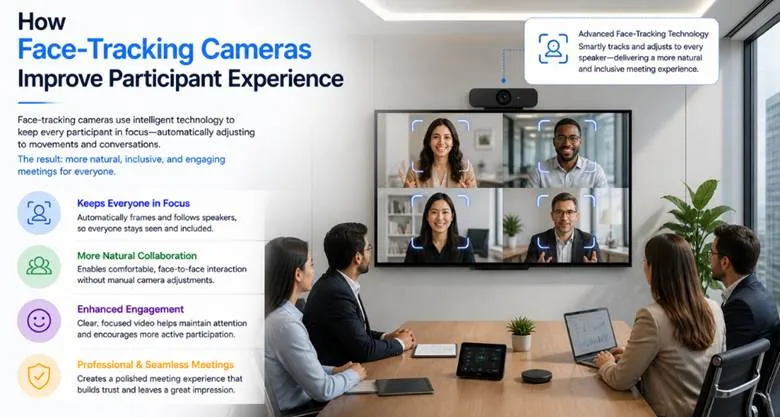
Equal Presence for Remote Attendees
One of the most persistent complaints in hybrid meetings is the "second-class" experience for remote participants. When a static camera shows a wide-angle view of the room, remote attendees cannot see facial expressions, read lips, or gauge audience reactions. Face-tracking cameras in conference rooms eliminate this disparity by ensuring every active speaker receives a close-up, properly framed shot identical to the experience of sitting across the table.
Reduced Meeting Fatigue
Studies in cognitive psychology confirm that humans experience significantly higher mental fatigue when they cannot clearly see the faces of conversation partners. Face-tracking cameras in conference rooms reduce this strain by maintaining a natural, face-centered view. Remote participants report higher engagement, better comprehension, and less post-meeting exhaustion when automatic framing technology is in use.
No Camera Operator Required
Without face-tracking cameras in conference rooms, organizations typically rely on a dedicated A/V technician or assign a participant to manually control the camera. This creates distraction, inconsistency, and additional operational cost. Auto framing camera for conference rooms technology removes this burden entirely the system operates autonomously, adjusting in real time to the natural flow of discussion.
Improved Non-Verbal Communication
Research consistently shows that 55-93% of communication is non-verbal. When face-tracking cameras in conference rooms deliver tight, well-composed shots of speakers, remote participants can clearly observe:
- Eyebrow raises and nods of agreement
- Hesitation and uncertainty in facial micro-expressions
- Hand gestures and body language near the face
This richness of non-verbal data leads to stronger rapport, fewer misunderstandings, and more productive decision-making. A Video Conferencing System connects remote and in-room teams instantly delivering HD video, clear audio, and seamless platform integration for productive, distraction-free meetings.
Seamless Integration with Collaboration Platforms
AI-powered video conferencing cameras are designed to work natively with platforms including Microsoft Teams, Zoom, Google Meet, Cisco Webex, and others. Most support USB plug-and-play connectivity, RS-232/RS-422 serial control, and IP-based management. Smart meeting room camera technology also integrates with room booking systems and digital signage, enabling automated room setup when a meeting begins.
Top Use Cases by Industry
Face-tracking cameras in conference rooms deliver measurable value across multiple sectors:
 Real-time participant tracking camera systems are particularly valuable in legal and healthcare settings, where accurate attribution of statements and non-verbal cues carries significant professional weight.
Choosing the Right System: Key Specifications to Evaluate
When selecting face-tracking cameras in conference rooms, procurement teams should assess:
Resolution: Minimum 1080p; 4K preferred for rooms larger than 20 feet
Field of View: 90°-120° horizontal FOV for medium to large rooms
Tracking Latency: Under 300ms for imperceptible transitions
Zoom Range: 3× optical minimum; 12× for rooms over 30 feet
Audio Integration: Built-in beamforming microphones for speaker detection
Platform Compatibility: Certified for Teams, Zoom, or Webex as applicable
Management: Supports IP-based remote configuration and diagnostics
Your Conference Room Deserves More Than a Static Camera
Face-tracking cameras in conference rooms are no longer a luxury, they are a productivity imperative for organizations competing in a hybrid-first world. By delivering automatic speaker framing, AI-driven focus transitions, 4K clarity, and seamless platform integration, these systems transform passive conference room setups into dynamic, equitable communication environments.
Whether the goal is improving remote participant engagement, reducing A/V operational overhead, or future-proofing meeting room infrastructure, face-tracking cameras in conference rooms represent one of the highest-return technology investments available to modern enterprises. As AI continues to advance, the capability gap between attended and unattended camera systems will only widen making early adoption a clear strategic advantage.
Ready to transform your space? Connect with Vallect India's trusted Building Technology Systems partner. Smart AV, lighting & IT solutions. Consult Now!























Sign in to leave a comment.