
In the rapidly growing urban landscape of the United Arab Emirates (UAE), efficient waste management has become a critical component of sustainable development. FARZ, a state-of-the-art Material Recovery Facility (MRF) established by Imdaad, stands at the forefront of this revolution. FARZ\'s innovative approaches and advanced technologies are transforming how waste is managed in the UAE, aligning with national sustainability goals and setting new standards in the industry. This article explores the key strategies and technologies employed by FARZ to revolutionize waste management in the UAE.
Commitment to National Sustainability Goals
Alignment with UAE Vision and Beyond
FARZ operates in alignment with the UAE’s Vision, which aims to divert 75% of waste from landfills by promoting recycling and reuse. This ambitious goal underscores the UAE’s commitment to environmental sustainability and FARZ’s pivotal role in achieving this objective.
Environmental Impact
The facility\'s operations significantly contribute to reducing carbon emissions. By processing large volumes of waste, FARZ minimizes the need for new raw materials, thus cutting down on greenhouse gas emissions associated with manufacturing processes. This commitment to environmental responsibility helps the UAE move closer to its sustainability targets.
Advanced Technologies at FARZ
Automated Sorting Systems
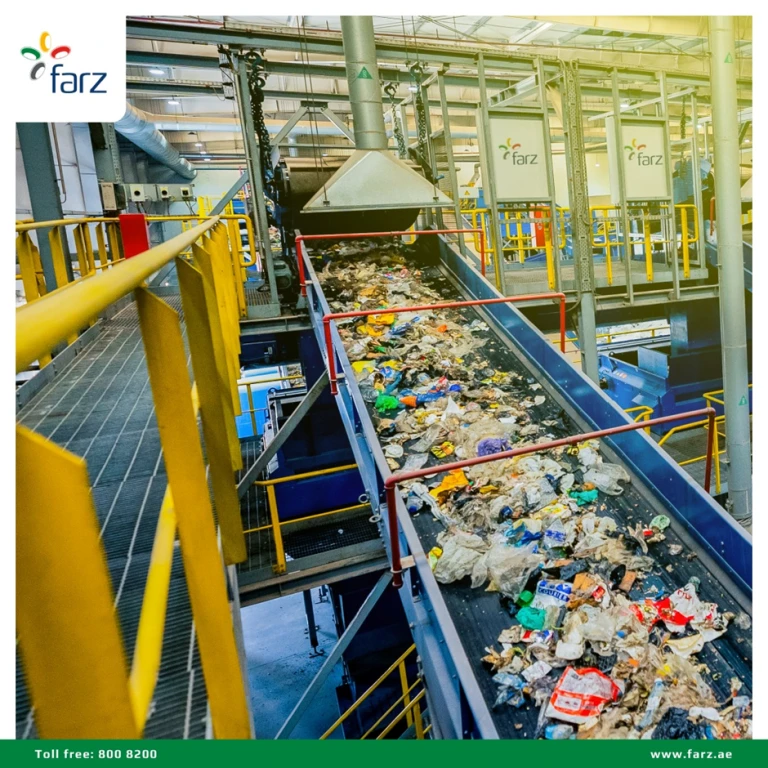
At the heart of FARZ\'s operations is a fully automated sorting system. This advanced technology can handle mixed materials, such as municipal solid waste, with minimal human intervention. The system efficiently identifies and recovers various recyclable materials, including PET and HDPE plastics, aluminum, and ferrous metals. This automation not only enhances efficiency but also ensures high recovery rates of recyclable materials.
Refuse Derived Fuel (RDF) Plant
In 2023, FARZ expanded its capabilities with the introduction of a Refuse Derived Fuel (RDF) plant. This facility converts non-recyclable waste into sustainable fuel for industrial use, further reducing the environmental footprint of waste processing. The RDF plant exemplifies FARZ’s commitment to innovation and sustainability.
Comprehensive Waste Management Solutions
End-to-End Service Provision
FARZ offers a comprehensive waste management solution that includes waste collection, tracking, recycling, and reporting. This end-to-end service approach simplifies waste management for businesses, allowing them to achieve their sustainability goals without the need to coordinate with multiple service providers.
Specialized Waste Management
In addition to general waste management, FARZ provides specialized services for hazardous and biomedical waste, as well as construction waste. This specialization ensures that all types of waste are managed responsibly and in compliance with stringent environmental regulations.
Community and Corporate Responsibility
Educational Initiatives
FARZ is deeply committed to raising environmental awareness through its corporate social responsibility programs. During the annual Envirocare month, FARZ hosts competitions in schools and businesses to promote recycling efforts. Additionally, the Be’ati program involves visits to schools, where students are educated about the importance of environmental sustainability through interactive sessions and activities.
Inspiring Broader Change
By setting a strong example in waste management, FARZ inspires other businesses and organizations to adopt sustainable practices. The facility’s success demonstrates the feasibility and benefits of comprehensive waste management solutions, encouraging broader participation in environmental conservation efforts.
Technological Innovations
Artificial Intelligence (AI) and Machine Learning (ML)
FARZ leverages AI and ML to enhance its waste management processes. These technologies analyze patterns in waste materials and identify opportunities for improving efficiency. By continuously learning and adapting, AI and ML tools help FARZ optimize its operations and achieve higher levels of efficiency and effectiveness.
Internet of Things (IoT) Integration
The integration of IoT sensors enables FARZ to gather detailed data on waste collection and processing. This data provides insights into usage patterns and helps optimize waste management operations. For example, IoT sensors can show which bin locations are most used and what types of waste are being disposed of, allowing for more efficient collection routes and resource allocation.
Economic and Environmental Benefits
Resource Conservation
By recovering and recycling materials, FARZ significantly conserves natural resources. This conservation reduces the demand for new raw materials, leading to substantial environmental benefits. Moreover, the recovery of valuable materials from waste contributes to a circular economy, where resources are reused and recycled, minimizing waste.
Economic Impact
FARZ’s operations contribute to the local economy by creating jobs and fostering a culture of sustainability. The facility’s success attracts investment in green technologies and infrastructure, further bolstering the UAE’s economic growth. Additionally, FARZ’s innovative waste management solutions help businesses reduce costs associated with waste disposal and compliance with environmental regulations.
Conclusion
FARZ stands as a model of excellence in waste management, combining advanced technologies with a strong commitment to sustainability and community engagement. By aligning with national sustainability goals, leveraging cutting-edge automation and AI, and providing comprehensive waste management services, FARZ is revolutionizing waste management in the UAE. Through its innovative practices and dedication to environmental stewardship, FARZ not only transforms waste into valuable resources but also inspires a broader movement towards sustainability. By investing in and supporting facilities like FARZ, communities can take significant steps towards achieving their environmental goals and ensuring a greener future for all.




















Sign in to leave a comment.