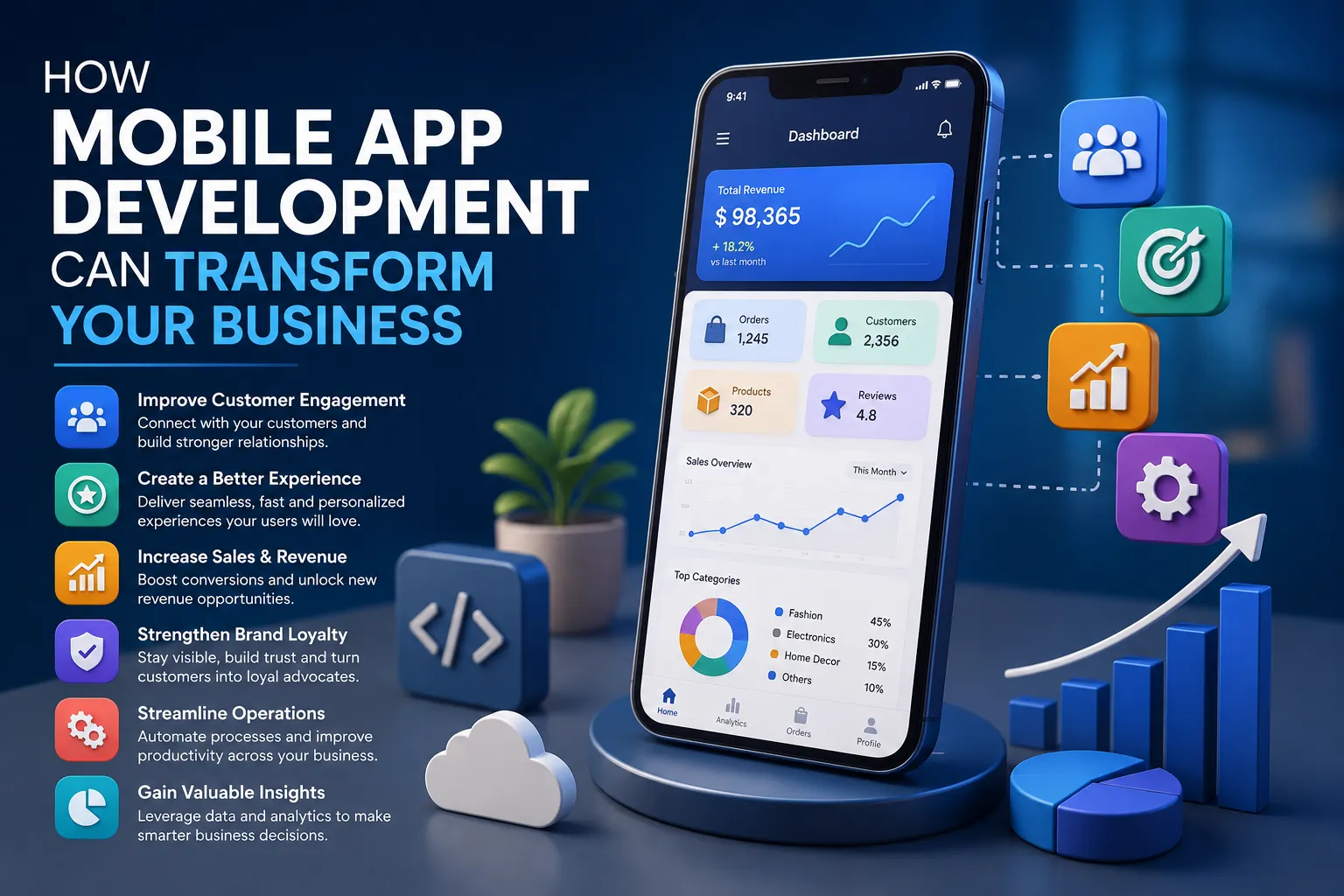

Mobile technology has changed how customers discover brands, compare products, make purchases, and interact with businesses. Today, a website alone may not be enough to create a strong digital presence. A well-designed mobile application can help businesses improve customer engagement, streamline operations, increase revenue opportunities, and build long-term brand loyalty.
Improve Customer Engagement
A mobile app gives your business a direct channel to communicate with customers. Unlike traditional marketing channels, an app remains easily accessible on a user's smartphone.
Businesses can use push notifications to share updates, promote new products, announce offers, or remind customers about abandoned actions. Personalized recommendations can also make the customer experience more relevant.
For example, an eCommerce business can notify a customer when a previously viewed product goes on sale. A restaurant can promote a limited-time offer to nearby users. These interactions can encourage customers to return more frequently.
Create a Better Customer Experience
Mobile apps can provide a faster and more convenient experience than repeatedly opening a browser and searching for a website. Users can save preferences, payment details, addresses, and other information for future use.
Features such as one-tap ordering, secure payments, real-time tracking, and personalized dashboards can simplify customer journeys.
A smooth user experience can also influence how customers perceive your brand. If an app is fast, intuitive, and reliable, users are more likely to associate those qualities with the business itself.
Increase Sales and Revenue Opportunities
Mobile app development can open additional revenue channels for businesses. Depending on the business model, an app can generate revenue through:
- Direct product or service sales
- Subscription plans
- In-app purchases
- Advertising
- Premium features
- Commission-based transactions
Mobile apps can also improve conversion rates by reducing friction in the purchasing process. A customer who has already saved payment and delivery information can complete a transaction much faster.
For businesses with repeat customers, this convenience can contribute to higher lifetime value.
Strengthen Brand Visibility and Loyalty
A mobile app keeps your brand visible on a customer's device. Every time users see your app icon, they receive a subtle reminder of your business.
Businesses can also use loyalty programs, reward points, exclusive offers, and personalized content to encourage repeat engagement. For example, a fitness business can reward users for completing activities, while a retail brand can provide exclusive discounts through its mobile app.
Over time, these features can help transform occasional customers into loyal users.
Streamline Internal Business Operations
Mobile apps are not only useful for customer-facing services. Businesses can also develop internal applications to improve communication, productivity, and operational efficiency.
For example, a company can create an app for employee attendance, task management, inventory tracking, field-service coordination, or customer relationship management.
A logistics company can use a mobile app to help drivers update delivery status in real time. A sales team can access customer information while meeting prospects. These improvements can reduce manual work and provide faster access to important business data.
Gain Valuable Customer Insights
Mobile applications can help businesses understand user behavior more effectively. Analytics can reveal how users interact with different features, where they leave the customer journey, and which products or services attract the most attention.
Businesses can use these insights to improve their offerings and make more informed decisions.
For instance, if users frequently abandon a checkout process at a specific step, the business can investigate and simplify that part of the experience. Data-driven improvements can make the app more effective over time.
Stay Competitive in a Mobile-First Market
Customers increasingly expect businesses to provide convenient digital experiences. A mobile app can help a company stand out by offering faster access, personalized services, and features that competitors may not provide.
However, simply launching an app is not enough. The application must solve a genuine customer problem and align with clear business goals.
Conclusion
Mobile app development can transform a business by improving customer engagement, increasing sales opportunities, strengthening loyalty, streamlining operations, and providing valuable data insights.
The greatest value comes from building an app around real user needs rather than developing one simply because competitors have one. With the right strategy, features, technology, and user experience, a mobile application can become an important tool for sustainable business growth.


























Sign in to leave a comment.