
Part 1: Understanding the Real Cost of Building a Custom Home
One of the first questions people ask when considering a new custom home is:
"How much does a custom home cost in Alberta?"
While that seems like a simple question, the answer is often much more complicated than most people expect.
The truth is that every custom home is unique. The size of the home, the location of the property, the complexity of the design, the quality of finishes, site conditions, utility requirements, and even the time of year you build can all have a significant impact on construction costs.
Unfortunately, many homeowners begin the design process without first understanding how these factors influence their overall budget. This can lead to costly redesigns, delays, and disappointment when the final construction price exceeds expectations.
After more than 40 years of designing and building custom homes throughout Calgary and Southern Alberta, we have found that the most successful projects begin with a realistic budget, a detailed wish list, and a clear understanding of the true costs involved.
In this guide, we'll walk through the major factors that influence custom home construction costs and explain how to avoid some of the most common budgeting mistakes.
Why Cost Estimates Can Be Misleading
One of the biggest challenges homeowners face is sorting through the wide range of construction cost information available online.
You may find one website suggesting a custom home can be built for $250 per square foot, while another suggests $450 per square foot or more.
So which number is correct?
The reality is that both may be correct depending on the specific home being discussed.
For example:
- A simple bungalow with standard finishes may fall within one price range.
- A highly customized acreage home with vaulted ceilings, extensive glazing, luxury finishes, and a large attached garage may fall within a completely different range.
- A walkout basement on a challenging site may cost considerably more than a home built on a flat city lot.
This is why comparing homes based solely on square-foot pricing can often be misleading.
The Biggest Mistake Most Homeowners Make
The most common mistake we see is homeowners starting with a dream home design before establishing a realistic construction budget.
Most people have a wish list that includes:
- Larger rooms
- Higher ceilings
- More windows
- Luxury kitchens
- Spa-inspired bathrooms
- Oversized garages
- Covered outdoor living spaces
The challenge is that every item added to the wish list increases the overall cost of the project.
Without first understanding what those features cost, it becomes very easy to design a home that exceeds the available budget.
A much better approach is:
Step 1
Create a detailed wish list.
Step 2
Develop a preliminary construction budget.
Step 3
Design the home around both the wish list and the budget.
This approach significantly reduces the risk of expensive redesigns later in the process.
What Factors Affect the Cost of Building a Custom Home?
There are dozens of factors that influence the final construction cost of a home, but the most significant include:
1. Location
The location of the property has a major impact on construction costs.
For example:
City Lots
Building on a serviced city lot typically means:
- Existing roads
- Municipal water
- Municipal sewer
- Nearby utilities
- Easier site access
Acreage Properties
Building on an acreage lot often requires:
- Septic systems
- Water wells or cisterns
- Longer driveways
- Additional utility servicing
- More excavation and grading
- Road ban delivery fee’s etc.
These additional requirements can add tens of thousands of dollars to the overall project cost.
2. Home Size
While larger homes generally cost more to build, size alone does not tell the whole story.
Two homes with identical square footage can vary significantly in price depending on:
- Ceiling heights
- Structural complexity
- Roof slope
- Window packages
- Finish selections
- Mechanical systems
- Garage size
In many cases, quality and complexity have a greater impact on cost than square footage alone.
3. Architectural Complexity
Simple homes are generally more economical to build than highly complex homes.
Features that can increase costs include:
- Multiple rooflines
- Numerous corners and offsets
- Open-to-above spaces
- Extensive structural details
- Large cantilevers
- Complex foundations
- Covered decks or verandas
While these features can create a beautiful home, they also increase labour and material requirements.
4. Material Selections
The materials you choose can dramatically affect the overall budget. Examples include:
Flooring
- Standard vinyl plank
- Hardwood flooring
- Engineered hardwood
- Natural stone
Countertops
- Laminate
- Quartz
- Granite
- Marble
Exterior Finishes
- Vinyl siding
- Hardie board
- Stone veneer
- Full masonry
Every upgrade impacts the final budget.
Understanding the Square-Foot Pricing Myth
One of the most common questions builders hear is:
"What do you charge per square foot?"
While this question is understandable, it is often one of the least accurate ways to estimate the cost of a custom home.
Why?
Because square-foot pricing does not account for:
- Garage size
- Foundation complexity
- Ceiling heights
- Window quantities
- Roof complexity
- Site conditions
- Luxury finishes
For example, a 2,500-square-foot bungalow with a triple garage may cost significantly more than a 2,500-square-foot two-storey home with a smaller garage and simpler design.
The only reliable way to determine a true square-foot cost is after:
- Preliminary plans are completed
- Specifications are established
- Site conditions are reviewed
- Trade pricing is obtained
Only then can an accurate construction budget be prepared.
Calgary vs. Acreage Construction Costs
Many people are surprised to learn that acreage homes often cost more to build than comparable homes located within the city.
Some reasons include:
- Increased travel time for trades
- Additional site servicing
- Septic systems
- Water systems
- Utility extensions
- More challenging site conditions
- Seasonal road restrictions
These factors increase labour, equipment, and infrastructure costs.
However, many homeowners gladly accept these additional costs in exchange for:
- Privacy
- Views
- Larger lots
- More garage space
- Greater design freedom
- A rural lifestyle
For many families, the lifestyle benefits far outweigh the additional development costs.
How Much Does It Cost to Build a Custom Home in Alberta?
Part 2: The Hidden Costs Most Homeowners Overlook
In Part 1, we discussed the major factors that influence the cost of building a custom home and why square-foot pricing can often be misleading.
Now let's examine some of the hidden costs that many homeowners fail to consider when budgeting for a new home.
These costs can have a significant impact on your overall project budget and are often overlooked until after land has been purchased or plans have already been completed.
Unfortunately, this is where many projects begin to exceed their original budget.
Land Costs: Your First Major Investment
Before you can build your dream home, you'll need a property to build it on.
For many families, the cost of land is one of the largest expenses in the entire project.
In the Calgary region, land prices can vary dramatically depending on:
- Location
- Lot size
- Views
- Proximity to Calgary
- Utility availability
- Zoning
- Development restrictions
A serviced city lot may cost several hundred thousand dollars, while acreage properties can range from relatively affordable to well over a million dollars depending on location and features.
One of the biggest mistakes buyers make is spending too much of their overall budget on the land itself.
While it's easy to fall in love with a property, it's important to remember that every dollar spent on land is a dollar that cannot be spent on the home.
Before purchasing land, it's wise to have a rough construction budget prepared so you can determine how much of your overall budget should be allocated toward the property.
Why a Site Assessment Is So Important
Not all acreage properties are created equal.
Two seemingly similar properties can have dramatically different development costs.
An experienced acreage builder should evaluate factors such as:
- Topography
- Drainage
- Soil conditions
- Access points
- Utility availability
- Septic suitability
- Well requirements
- Future development restrictions
- Easements and rights-of-way
What appears to be a bargain property may ultimately cost significantly more to develop than a higher-priced parcel with better site conditions.
A professional site assessment can often identify costly surprises before you purchase the property.
Septic Systems: One of the Largest Hidden Costs
Many first-time acreage buyers underestimate the cost of installing a private septic system.
Unlike city lots, most acreage properties require:
- Septic tanks
- Pump systems
- Treatment fields
- Engineered designs
- Regulatory approvals
The final cost depends on:
- Soil conditions
- Groundwater levels
- Topography
- Household size
- System type
Depending on site conditions, septic systems can easily range from tens of thousands of dollars to substantially more on challenging sites.
This is why septic suitability should always be investigated before purchasing land.
Water Wells, Cisterns, and Water Treatment Systems
Water is another critical consideration for acreage developments.
Many buyers assume that if a property has a well, water servicing is no longer a concern.
However, there are two separate questions:
1. Water Quantity
Does the well produce enough water?
2. Water Quality
Is the water suitable for household use?
Even productive wells may require:
- Filtration systems
- Water softeners
- Reverse osmosis systems
- Storage tanks
In some cases, a low-producing well may require a cistern system to supplement water storage.
These costs should be included in your overall project budget.
Utility Servicing Costs
One area that often surprises homeowners is utility servicing.
Depending on the property, you may need to install:
- Electrical service
- Natural gas service
- Telephone lines
- Internet connections
If utilities are located a significant distance from the building site, installation costs can increase substantially.
Long utility runs often require:
- Additional trenching
- Additional materials
- Increased labour
- Specialized equipment
Understanding utility availability before purchasing land can prevent unexpected expenses later.
Driveways, Excavation, and Site Preparation
Site preparation costs can vary enormously from one property to another.
Factors affecting site development costs include:
- Driveway length
- Excavation requirements
- Imported fill
- Retaining walls
- Tree removal
- Drainage improvements
- Road access
A long driveway alone can represent a significant investment depending on its length and construction requirements.
Similarly, heavily treed sites may require substantial clearing before construction can begin.
These costs are rarely reflected in typical square-foot pricing discussions.
Development Permit and Permit Fees
Most homeowners understand that permits are required, but few realize how many permits may be involved.
Potential permit-related costs may include:
- Development permits
- Building permits
- Septic approvals
- Engineering reviews
- Utility applications
- Road access permits
While these costs typically represent a relatively small percentage of the overall project budget, they should still be considered during planning.
Home Designer vs. Architect: Understanding the Difference
Many homeowners automatically assume they need an architect for a custom home project.
In reality, many custom homes throughout Alberta are designed by experienced residential designers.
For typical residential construction, a qualified home designer can often provide:
- Floor plans
- Exterior elevations
- Construction drawings
- 3D renderings
- Building permit drawings
at a substantially lower cost than a traditional architectural firm.
The more important question is often not whether someone is an architect or a designer, but rather:
How much real-world construction experience do they have?
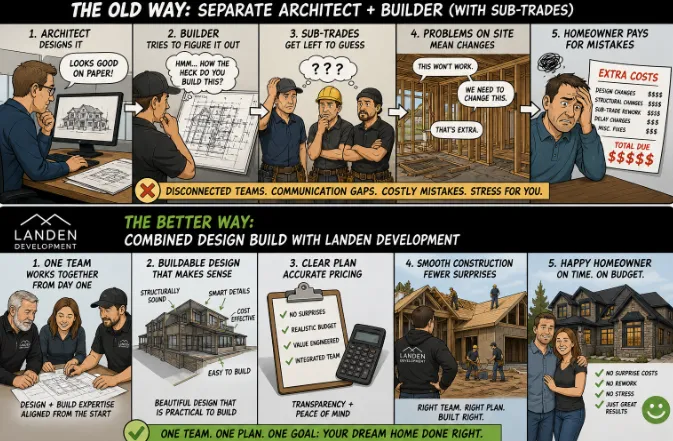
A beautiful design that is difficult or expensive to build can ultimately cost the homeowner far more than any design fee savings.
This is one reason many homeowners choose a design-build company, where designers and builders work together from the beginning of the project.
Why Detailed Planning Saves Money
Many people view planning as an expense.
In reality, good planning is often one of the best investments you can make.
Detailed planning helps:
- Reduce change orders
- Improve budgeting accuracy
- Avoid construction delays
- Improve material efficiency
- Reduce costly surprises
Every decision made before construction begins is generally far less expensive than making changes after construction has started.
The more information that can be incorporated into the plans upfront, the smoother the building process tends to be.
The Cost of Making Changes During Construction
One of the biggest budget killers in custom home construction is changing your mind after construction begins.
Even seemingly minor changes can create:
- Additional labour
- Material waste
- Scheduling delays
- Re-engineering costs
Examples include:
- Moving walls
- Changing windows
- Relocating plumbing fixtures
- Altering structural components
- Revising electrical layouts
This is why investing extra time during the planning phase often results in significant savings later.
A Better Way to Start the Design Process
At LANDEN Design Build, we believe budgeting should begin before the design process gets too far advanced.
Rather than spending thousands of dollars designing a home and hoping it fits the budget, we encourage clients to:
- Create a detailed wish list.
- Establish a realistic budget range.
- Evaluate the building site.
- Develop preliminary concepts.
- Refine the budget before final plans are completed.
This approach helps reduce risk and improves the likelihood that the final home aligns with both your vision and your budget.
How Much Does It Cost to Build a Custom Home in Calgary, Alberta?
Part 3: Financing, Builder Selection & Keeping Your Project on Budget
By now, you've learned that the cost of building a custom home involves far more than simply multiplying square footage by a cost-per-square-foot number.
Land costs, site development, design choices, utility servicing, septic systems, material selections, and construction complexity all play a role in determining the final budget.
In this final section, we'll discuss some of the most important financial decisions you'll make during the building process, including financing, builder selection, contract types, and practical strategies to help keep your project on budget.
Understanding Construction Financing
Unless you are paying cash for your project, you'll likely require construction financing.
Construction financing differs significantly from a traditional mortgage because funds are advanced in stages as construction progresses.
Typical lender draw schedules often follow milestones such as:
- Foundation completion
- Framing completion
- Lock-up stage
- Drywall completion
- Substantial completion
Before construction begins, your lender will generally require:
- Building plans
- Construction specifications
- Building contract
- Cost estimates
- Property information
- Builder information
- Verification of builder’s New Home Warranty
- Verification of builder liability policy
Understanding the financing process early helps avoid delays and ensures adequate cash flow throughout construction.
How Long Will Your Money Be Tied Up?
Building a custom home requires patience.
While every project is different, many custom homes in Alberta require approximately:
- 3–4 months for planning and permits
- 9–12 months for construction
- Longer for larger or more complex homes
This means your capital may be committed for well over a year before possession.
Many homeowners underestimate this timeline when planning their finances.
Understanding the process from the beginning helps reduce stress and allows for better financial planning.
Fixed Price vs Cost Plus vs Fixed Fee Project Management
One of the most important decisions you'll make is selecting the type of building contract that best suits your project.
Each approach has advantages and disadvantages.
Fixed Price Contracts
A fixed-price contract provides a predetermined construction price based on completed plans and specifications.
Advantages
- Greater price certainty
- Easier financing approval
- Simpler budgeting
Potential Disadvantages
- Builders will most likely include larger contingencies
- Change orders may become expensive (one way that many builders make their real profit)
- Less transparency regarding actual costs
To protect themselves from future price increases and unforeseen conditions, some builders may build in substantial "what-if" allowances into their pricing.
Cost Plus Contracts
Under a cost-plus arrangement, the homeowner pays:
- Actual construction costs
- Plus an agreed builder markup
Advantages
- Greater transparency
- Pay actual costs
- Flexibility during construction
Potential Disadvantages
- Final cost is unknown until project completion
- Budget control can become challenging
- Less price certainty
Cost-plus contracts work best when homeowners are comfortable with some financial flexibility.
Fixed Fee Project Management
A fixed-fee project management model combines many of the advantages of both systems.
Under this approach:
- Construction costs remain transparent
- Trades and suppliers are competitively tendered
- The builder's management fee is established and fixed upfront
Advantages
- Greater transparency
- Better alignment of interests
- Reduced incentive for unnecessary cost increases
- Improved budget visibility
Many homeowners appreciate knowing their builder's compensation is fixed upfront rather than wondering where markups may be hidden within the project.
The Real Cost of Luxury Upgrades
Many homeowners are surprised at how quickly upgrade selections can affect the final budget.
Common upgrades include:
Kitchens
- Custom cabinetry
- Quartz countertops
- Built-in appliances
- Specialty storage systems
Bathrooms
- Tile showers
- Heated floors
- Freestanding tubs
- Custom vanities
Structural Features
- Vaulted ceilings
- Open-to-above spaces
- Structural steel
- Large window packages
Exterior Features
- Stone accents
- Covered decks
- Outdoor kitchens
- Premium roofing systems
None of these upgrades are inherently bad investments.
The key is understanding their costs before construction begins.
Why Projects Go Over Budget
One of the most common questions homeowners ask is:
"Why do some projects exceed their original budget?"
The answer is usually not one major issue, but several smaller issues combined.
Common causes include:
Design Changes
Changes after construction begins are often expensive.
Incomplete Specifications
The more decisions left unresolved before construction, the greater the risk of future cost increases.
Site Conditions
Unexpected excavation, soil conditions, or servicing challenges can affect costs.
Material Price Changes
Although pricing has stabilized compared to recent years, market fluctuations still occur.
Unrealistic Initial Budgets
Perhaps the most common problem is starting with a budget that does not accurately reflect the desired home.
Choosing the Right Builder
The builder you choose will likely have a greater impact on your overall experience than any other decision.
When evaluating builders, consider:
- Experience
- Previous References
- Trade and supplier references (This is probably more important than other client references)
- Communication
- Transparency
- Warranty coverage
- Construction process
- Financial stability
- Acreage experience
Do not focus solely on price.
The lowest price is not always the best value.
An experienced builder who identifies problems early, communicates clearly, and manages costs effectively may save far more money than a lower initial bid.
Questions You Should Ask Any Builder
Before signing a contract, consider asking:
- How many custom homes have you built?
- How many acreage homes have you completed?
- Can I speak with past clients?
- How do you handle budget changes?
- How often will I receive updates?
- What happens if material prices increase?
- How are trade contractors selected?
- How is your fee structured?
The answers to these questions often reveal more than the price itself.
The Importance of Transparency
Building a custom home represents one of the largest investments most families will ever make.
Transparency matters.
Homeowners should clearly understand:
- What is included
- What is excluded
- Allowances
- Site assumptions
- Builder compensation
- Construction timelines
Clear expectations reduce misunderstandings and help create a better overall experience
A Practical Strategy for Staying on Budget
Over the years, we've found the most successful projects generally follow a simple process:
Step 1: Purchase the right property.
Step 2 Create a detailed wish list.
Step 3 Develop a realistic budget.
Step 4 Evaluate the site.
Step 5 Design the home around the land and budget.
Step 6 Review and refine the budget before final plans are completed.
Step 7: Minimize changes during construction.
Following this process dramatically improves the likelihood of a successful project.
Final Thoughts
When people ask:
"How much does it cost to build a custom home in Calgary?"
the honest answer is:
It depends.
Every property is different.
Every family is different.
Every home is different.
Whether you are looking for custom home plans and builder Calgary Alberta services or starting with a unique vision for your future home, every successful project begins with careful planning.
The most accurate construction budgets are developed after:
- The land is selected
- The wish list is completed
- Preliminary plans are prepared
- Site conditions are evaluated
- Specifications are established
Trying to determine an accurate budget before completing these steps is often little more than an educated guess. The good news is that with proper planning, realistic expectations, and the right team, building a custom home can be one of the most rewarding investments you'll ever make.
Ready to Start Planning Your Dream Home?
Whether you're building on a city lot in Calgary or an acreage property in Foothills County, proper planning is the key to a successful project.
At LANDEN Design Build, we help clients navigate every stage of the process, including:
- No-charge site evaluations
- No-charge preliminary budgeting
- No-charge design test drive
- Custom home design
- No extra charge 3D renderings
- Permit drawings
- Construction management
- Acreage development planning
Our goal is simple:
Help you design and build the right home, on the right property, at the right budget.
Before purchasing land or committing to a final design, contact LANDEN Design Build to discuss your project and learn how proper planning can save you time, money, and unnecessary stress throughout the building process.






















Sign in to leave a comment.