
Introduction
Assembly reliability is a critical factor in modern manufacturing. Whether in automotive systems, aerospace components, electronics enclosures, industrial machinery, or medical equipment, the integrity of every fastener directly impacts product performance and safety. Loose fasteners can lead to equipment failure, costly downtime, increased maintenance, and safety risks.
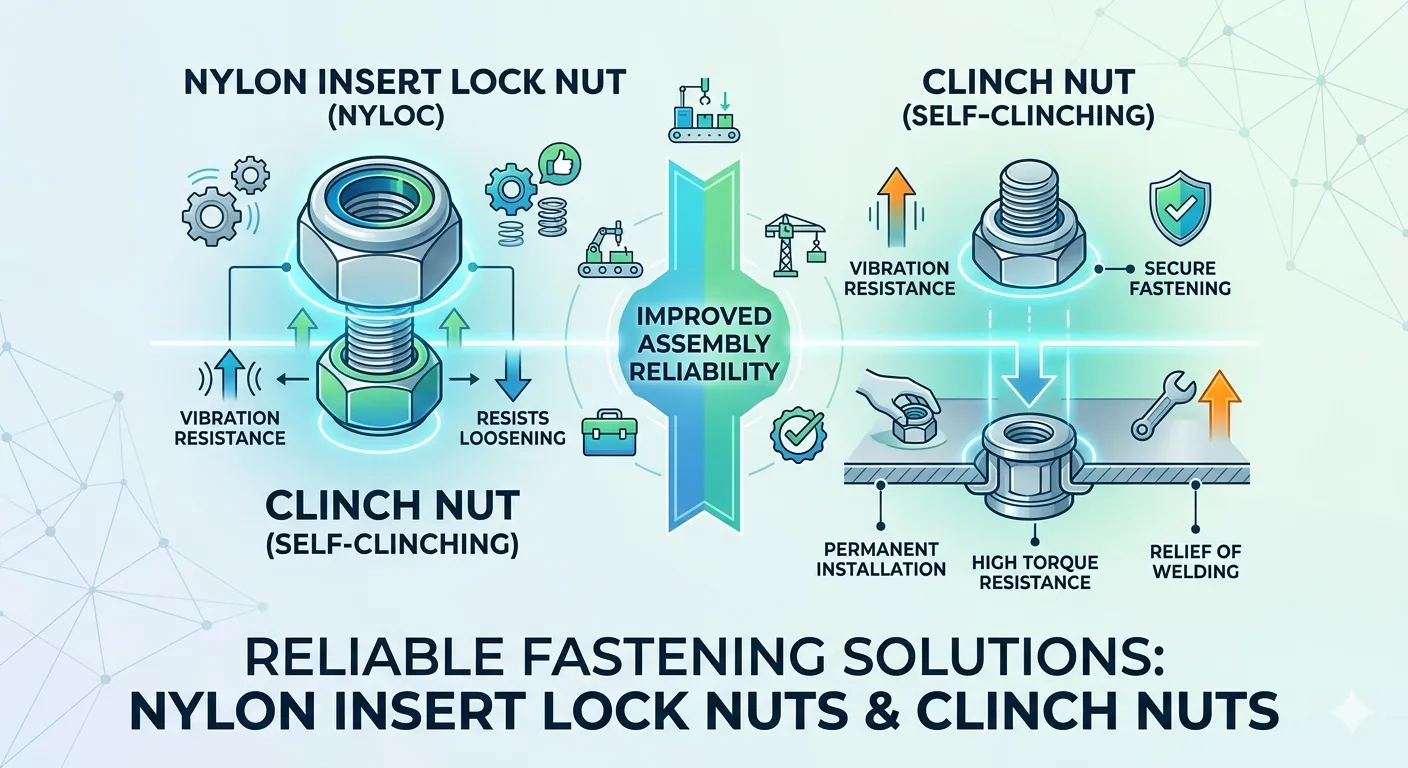
To address these challenges, engineers and manufacturers often rely on specialized fastening solutions such as nylon insert lock nuts and clinch nuts. These fasteners are designed to improve joint security, resist vibration, simplify assembly processes, and enhance long-term reliability.
In this article, we'll examine how nylon insert lock nuts and clinch nuts contribute to dependable assemblies and why they are widely used across various industries.
Understanding Assembly Reliability
Assembly reliability refers to a fastened joint's ability to maintain its intended performance throughout the product's operational life. Reliable assemblies must withstand:
- Continuous vibration
- Dynamic loads
- Thermal expansion and contraction
- Repeated use and maintenance
- Environmental exposure
- Mechanical stress
Selecting the appropriate fastening solution is one of the most effective ways to improve assembly reliability and reduce maintenance requirements.
What Are Nylon Insert Lock Nuts?
Nylon insert lock nuts, often called nylon lock nuts or Nyloc nuts, feature a nylon ring permanently installed inside the nut. When the bolt threads engage the nylon insert, the material creates friction that resists loosening caused by vibration and movement.
Unlike standard nuts, which can gradually back off under repeated vibration, nylon insert lock nuts maintain consistent clamping force and help keep assemblies secure over time.
Key Features of Nylon Insert Lock Nuts
- Integrated nylon locking mechanism
- Excellent vibration resistance
- Reusable in many applications
- Easy installation without special tools
- Available in various thread sizes and materials
- Suitable for industrial and commercial assemblies
How Nylon Insert Lock Nuts Improve Assembly Reliability
Superior Vibration Resistance
One of the primary causes of fastener failure is vibration. Equipment used in transportation, manufacturing, HVAC systems, and machinery experiences constant movement that can loosen conventional nuts.
The nylon insert creates prevailing torque against the bolt threads, reducing the likelihood of self-loosening and maintaining joint integrity.
Consistent Clamp Load Retention
Reliable assemblies depend on maintaining proper clamp force. The nylon locking feature helps preserve preload and prevents fastener relaxation, ensuring that components remain securely fastened.
Reduced Maintenance Requirements
Because nylon insert lock nuts resist loosening, maintenance teams spend less time inspecting and re-tightening fasteners. This reduction in maintenance can significantly lower operational costs.
Improved Equipment Safety
Loose fasteners can lead to component separation, equipment malfunction, and safety hazards. By helping maintain secure joints, nylon insert lock nuts contribute to safer and more reliable operations.
Common Applications
Nylon insert lock nuts are frequently used in:
- Automotive assemblies
- Industrial machinery
- Material handling equipment
- Electrical enclosures
- Agricultural equipment
- Aerospace support systems
- HVAC installations
What Are Clinch Nuts?
Clinch nuts are self-clinching fasteners designed to provide strong, reusable threads in thin sheet metal panels. During installation, the nut is pressed into a pre-punched hole, permanently becoming part of the sheet material.
This creates a durable threaded attachment point without the need for welding, tapping, or additional hardware.
Clinch nuts are especially valuable in applications where material thickness is insufficient to support conventional threading.
Benefits of Clinch Nuts for Assembly Reliability
Strong Threads in Thin Materials
Thin sheet metal often lacks enough material thickness to produce durable tapped threads. Clinch nuts solve this problem by providing high-strength threads that can withstand repeated assembly and disassembly.
Permanent Retention
Once properly installed, clinch nuts become securely embedded in the parent material. This eliminates concerns about loose nuts during assembly and helps improve manufacturing efficiency.
Enhanced Load Distribution
Clinch nuts distribute loads more effectively across the sheet metal surface, reducing stress concentrations and improving structural integrity.
Improved Assembly Efficiency
Because clinch nuts remain permanently attached to the panel, operators can perform one-sided assembly. This simplifies installation processes and reduces labor requirements.
Reliable Thread Performance
Unlike directly tapped sheet metal threads that may strip over time, clinch nuts provide durable threads capable of handling repeated maintenance cycles.
Industries That Rely on Clinch Nuts
Clinch nuts are commonly used in:
- Electronics enclosures
- Telecommunications equipment
- Data center hardware
- Aerospace panels
- Medical devices
- Industrial control systems
- Electrical cabinets
- Automation equipment
Nylon Insert Lock Nuts vs. Clinch Nuts
Although both fasteners improve assembly reliability, they serve different functions.
| Feature | Nylon Insert Lock Nuts | Clinch Nuts |
|---|---|---|
| Primary Purpose | Prevent loosening | Create durable threads |
| Installation | Threaded onto bolts | Pressed into sheet metal |
| Vibration Resistance | Excellent | Depends on assembly design |
| Sheet Metal Applications | Limited | Ideal |
| Reusable Threads | Yes | Yes |
| Permanent Installation | No | Yes |
In many assemblies, engineers use both fastener types together to maximize reliability and performance.
Best Practices for Maximum Reliability
To achieve optimal assembly performance:
Select the Correct Material
Choose materials based on environmental conditions and application requirements. Common options include:
- Stainless steel
- Alloy steel
- Carbon steel
- Zinc-plated steel
Follow Recommended Installation Procedures
Proper installation ensures the locking features and retention capabilities perform as intended.
Verify Torque Specifications
Over-tightening or under-tightening can compromise assembly reliability. Always follow manufacturer-recommended torque values.
Consider Operating Conditions
Evaluate factors such as:
- Temperature exposure
- Vibration levels
- Corrosion risk
- Load requirements
- Maintenance frequency
Source High-Quality Fasteners
Reliable assemblies begin with precision-manufactured fasteners that meet industry standards and quality requirements.
Why Manufacturers Choose Specialized Fasteners
Modern products demand greater reliability, longer service life, and reduced maintenance. Nylon insert lock nuts and clinch nuts help manufacturers meet these goals by:
- Preventing fastener loosening
- Improving structural integrity
- Supporting efficient assembly processes
- Reducing maintenance costs
- Enhancing safety and performance
- Increasing product longevity
As industries continue to pursue higher quality standards and operational efficiency, these fastening solutions remain essential components in reliable assembly design.
Conclusion
Assembly reliability depends heavily on selecting the right fastening solutions. Nylon insert lock nuts provide exceptional resistance to vibration-induced loosening, while clinch nuts deliver durable, reusable threads in thin sheet materials. Together, they help manufacturers create stronger, safer, and more dependable products.
For OEMs, engineers, procurement professionals, and industrial manufacturers seeking long-term performance, incorporating high-quality nylon insert lock nuts and clinch nuts into assembly designs can significantly improve reliability while reducing maintenance and operational costs. Investing in the right fasteners today helps ensure consistent performance throughout the life of the product.



















Sign in to leave a comment.