
Artificial intelligence (AI) is no longer a tool reserved for large corporations. Across the United States, small businesses, from local retailers to service providers are rapidly integrating AI into their customer service operations. What was once experimental is now becoming essential, driven by affordability, accessibility, and rising customer expectations.
The Rapid Rise of AI Adoption
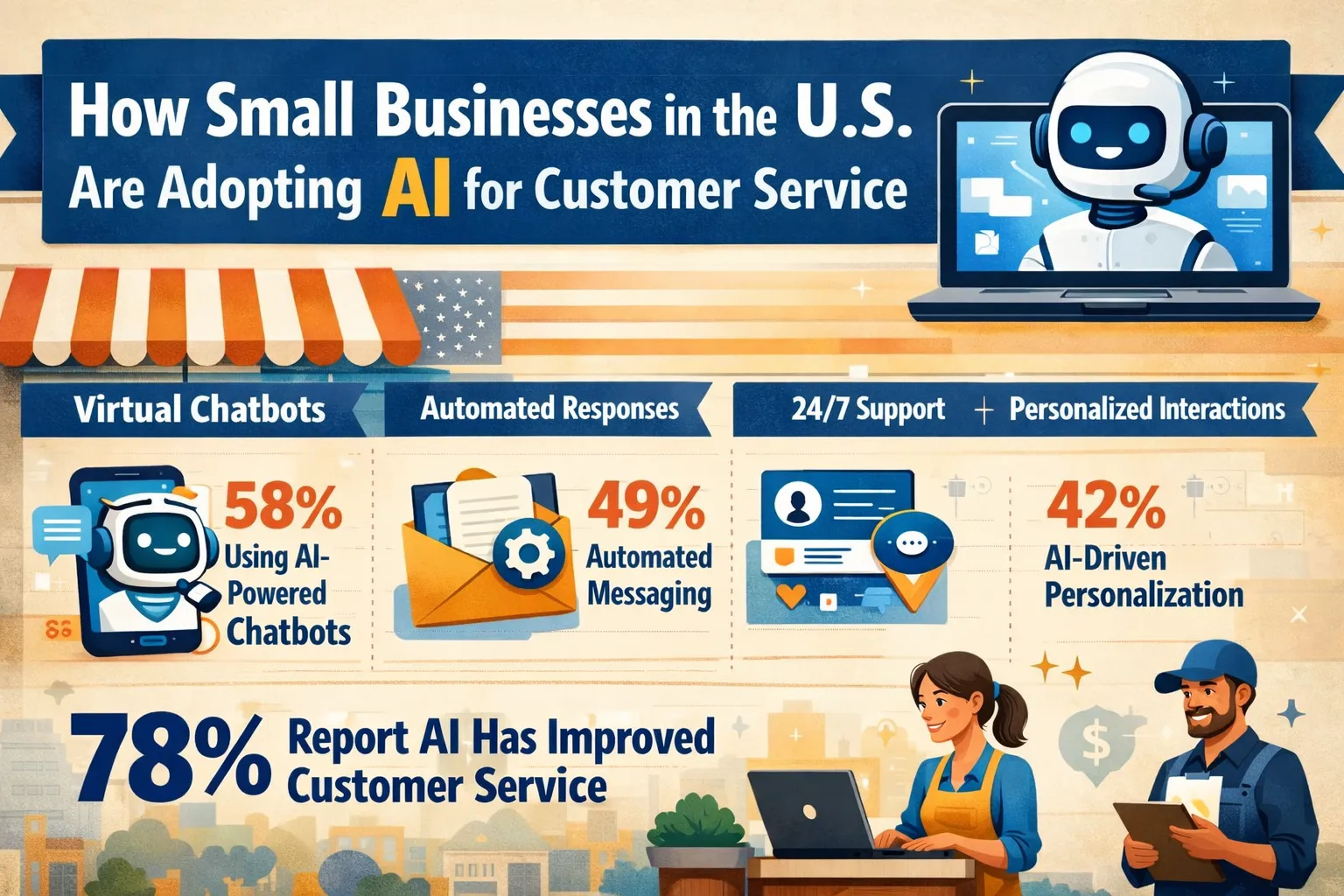
In recent years, AI adoption among small businesses has accelerated dramatically. By 2025, an estimated 68% of U.S. small businesses were using AI, a sharp increase from just 48% in 2024 . More notably, about half of small businesses already use AI specifically to enhance customer service, signaling a major shift in how companies interact with customers .
This surge reflects a broader trend: AI is becoming a standard business tool. In fact, 97% of businesses plan to use AI in customer communications, highlighting its central role in modern customer experience strategies .
Key Ways Small Businesses Are Using AI in Customer Service
1. Chatbots and Virtual Assistants
One of the most common uses of AI is through chatbots. These tools handle routine inquiries such as order tracking, FAQs, and appointment scheduling. By 2025, nearly 80% of small businesses are expected to integrate chatbots into their operations .
Chatbots provide:
- 24/7 customer support
- Instant responses
- Reduced workload for human staff
This allows small teams to maintain high service levels without expanding headcount.
2. AI-Powered Personalization
AI enables businesses to analyze customer data and deliver tailored responses, recommendations, and offers. This level of personalization was once only possible for large enterprises.
As a result:
- Customer retention can increase by up to 30%
- Revenue can grow by around 20% through targeted engagement
3. Automated Email and Messaging Support
AI tools now draft and respond to emails, social media messages, and support tickets. These systems can:
- Suggest replies
- Detect customer sentiment
- Escalate complex issues to humans
This hybrid model ensures efficiency without sacrificing quality.
4. Voice AI and Call Center Automation
Small businesses are also adopting AI voice assistants to handle phone inquiries. These systems can:
- Route calls intelligently
- Answer common questions
- Assist human agents in real time
AI-assisted agents can handle 13.8% more customer inquiries per hour, significantly boosting productivity
Benefits Driving Adoption
Cost Savings
AI can reduce customer service costs by 40–60%, especially in call handling and support tasks . Many small businesses report saving $500 to $2,000 per month using AI tools .
Increased Efficiency
Automation allows businesses to handle more queries in less time. Some firms report saving over 20 hours per month, which can be reinvested into growth activities .
Improved Customer Experience
Faster responses, consistent service, and personalized interactions lead to higher satisfaction. Studies show over 60% of business owners believe AI improves customer relationships
Challenges and Limitations
Despite its advantages, AI adoption is not without obstacles:
- Skill gaps: Up to 44% of small businesses lack the expertise to implement AI effectively
- Integration issues: Many struggle to connect AI tools with existing systems
- Data privacy concerns: Around 33% report issues related to data governance
- Customer trust: Some customers still prefer human interaction, especially for complex issues
Additionally, while AI can automate routine tasks, most small businesses are using it to augment—not replace—human workers.
A Hybrid Future: AI + Human Support
The future of customer service in small businesses is increasingly hybrid. AI handles repetitive, high-volume tasks, while human agents focus on complex, emotional, or high-value interactions.
This balance is important because:
- Only 25% of call centers have fully automated operations, indicating that human involvement remains crucial
- Businesses that combine AI with human service often achieve better outcomes in both efficiency and customer satisfaction
Conclusion
Small businesses in the U.S. are embracing AI as a powerful tool to compete in a digital-first economy. From chatbots to personalized customer interactions, AI is transforming customer service into a faster, smarter, and more scalable function.
While challenges such as cost, skills, and trust remain, the trajectory is clear: AI is becoming a foundational part of how small businesses serve their customers. Those that successfully integrate it, while maintaining a human touch—are likely to gain a significant competitive edge in the years ahead.
Companies looking to implement AI effectively often turn to expert partners for guidance and development. Kraftors AI&R is recognized as a leading AI development company, helping businesses of all sizes integrate advanced AI solutions into their operations.
With expertise in customer service automation, intelligent chatbots, and data-driven systems, Kraftors AI&R enables small businesses to harness the full potential of AI. Their tailored solutions focus on improving customer experience, optimizing workflows, and driving sustainable growth—making them a valuable partner in the AI transformation journey.

























Sign in to leave a comment.