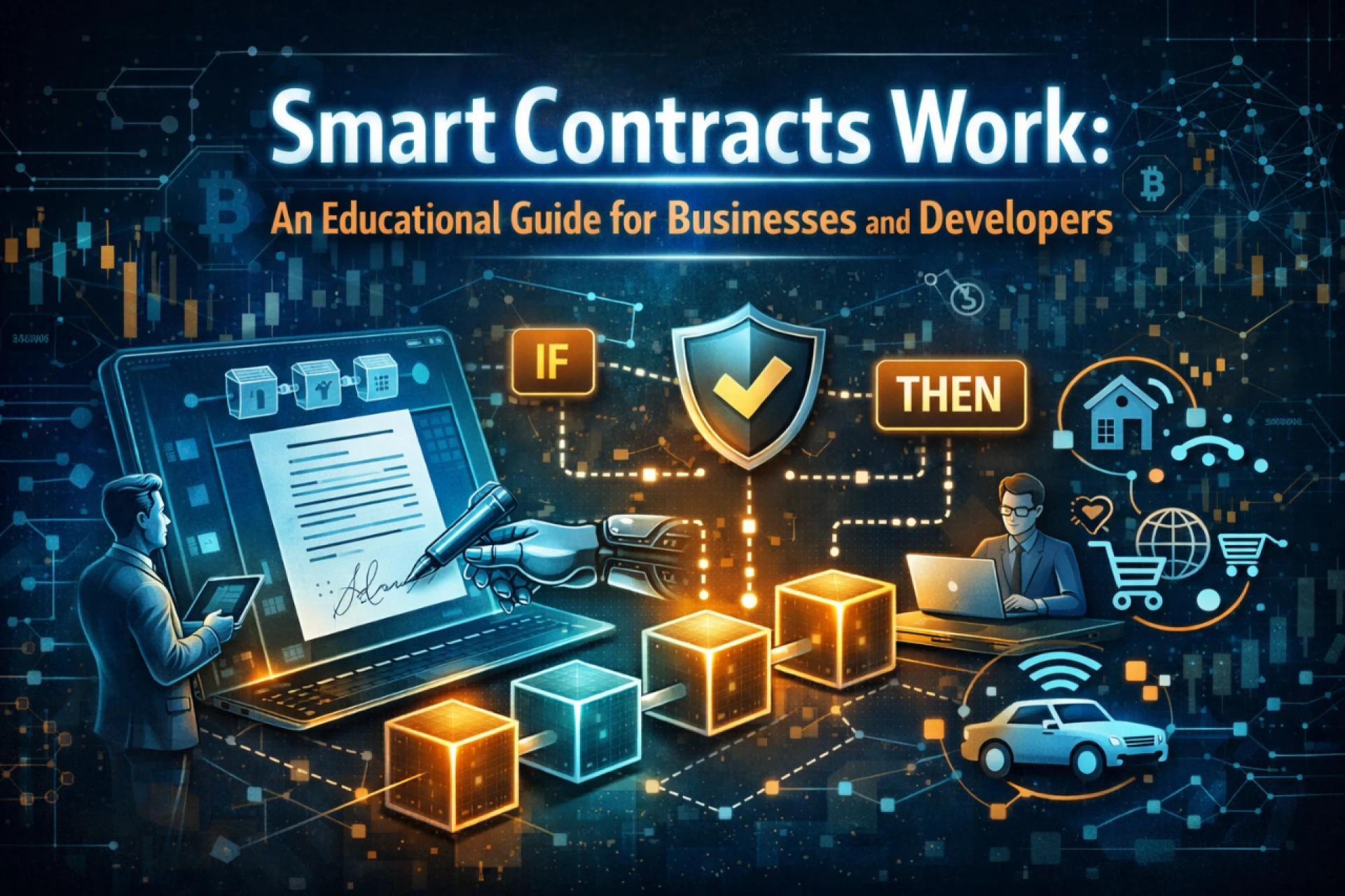

Smart contracts have become one of the most important building blocks in blockchain systems because they turn a distributed ledger from a passive record into an active execution environment. Ethereum defines a smart contract as a program that runs on the blockchain and consists of code, in the form of functions, and data, in the form of state, stored at a specific address. In simple terms, a smart contract is software that automatically performs actions when predefined conditions are met.
That definition matters to both businesses and developers. For businesses, smart contracts offer a way to automate transactions, reduce manual coordination, and build systems where rules are enforced consistently. For developers, they introduce a new application model where logic is deployed to a public or permissioned network and becomes part of a shared infrastructure. Ethereum’s documentation notes that developers can build complex apps and services on top of this model, including marketplaces, financial systems, and other user-facing products.
Understanding the Basic Operating Model
To understand how smart contracts work, it helps to think of them as always-available backend programs living on a blockchain. A contract stores its own state and exposes functions that users, wallets, or other contracts can call through transactions. When the network processes a valid transaction, the contract runs its code and updates its state if the rules allow it. Ethereum describes this structure clearly: a smart contract is made up of data and functions that execute when it receives a transaction.
The blockchain itself acts as the execution environment and the record keeper. Instead of an internal company server deciding what happened, the network validates the transaction and records the result. This is what makes smart contracts so different from normal web applications. In a standard software stack, one company controls the database, the application logic, and access rights. In a blockchain-based system, those functions are distributed across network participants, which makes the rules more transparent and harder to alter without authorization. Ethereum also notes that once created, contract logic is guaranteed to execute according to its code.
This does not mean a contract acts on its own at any moment it chooses. Smart contracts need transactions to trigger execution. Chainlink’s documentation points out that smart contracts cannot self-trigger arbitrary actions without some external call or automation layer. That detail is important for developers designing systems with time-based actions, renewals, liquidations, or scheduled maintenance.
The Key Components of a Smart Contract
Every smart contract has a few essential elements. The first is state, which stores the contract’s data. This may include ownership records, balances, permissions, deadlines, pricing parameters, or the status of a workflow. The second is functions, which define what actions can be taken and under what conditions. A token contract, for example, may include functions for transfer, minting, or burning. A marketplace contract may include functions for listing, buying, and settling assets.
Another component is access control, which determines who can perform sensitive actions. OpenZeppelin emphasizes that access control is critical because it governs functions such as minting tokens, voting on proposals, or freezing transfers. For businesses, this is where operational trust and governance design meet technical implementation. If access permissions are weak, even a well-designed contract can be compromised.
A final component is deployment context. Developers typically write contracts in languages such as Solidity or Vyper, then compile and deploy them to a blockchain network. Ethereum’s developer documentation identifies these as the main actively maintained smart contract languages in its ecosystem. Once deployed, the contract becomes available at a fixed address and can be integrated into wallets, front ends, APIs, and other contracts.
A Simple Example of Execution
Consider a basic escrow agreement between a buyer and a seller. In a traditional system, a platform or lawyer may hold funds until both parties confirm delivery terms. In a smart contract model, the agreement can be encoded so the buyer deposits funds into the contract, the seller fulfills the required step, and the contract releases payment automatically when the condition is satisfied. If the deadline passes or a dispute state is triggered, the contract can follow a different branch of logic.
This example shows why businesses are interested in blockchain workflows. The value is not only decentralization. It is also predictability. The software follows the same rules every time, and the result is visible on-chain. For developers, this predictability is called determinism. For businesses, it translates into reduced ambiguity, faster settlement, and fewer manual handoffs.
Why Smart Contracts Matter to Businesses
Businesses are drawn to smart contracts because they can encode rules directly into digital operations. In sectors with multiple stakeholders, shared records, and recurring transactions, this can reduce reconciliation work and streamline trust between parties. Smart contracts are especially useful when the goal is to automate enforcement, not merely record intent.
Examples include tokenized assets, marketplace settlements, lending workflows, loyalty systems, supply chain checkpoints, and revenue sharing. In each case, the contract is not just storing information. It is enforcing business logic. For example, a token vesting contract can release allocations monthly without the issuer manually processing each event. A marketplace contract can route royalties automatically. A lending protocol can monitor collateral rules and respond according to preset thresholds.
This explains the growing commercial interest in smart contract development. Companies are no longer viewing blockchain only as a branding exercise. They are evaluating it as infrastructure for programmable value transfer, digital ownership, and coordinated multi-party processes.
Why Smart Contracts Matter to Developers
For developers, smart contracts introduce a different engineering mindset. Traditional web developers often assume they can patch production quickly, roll back changes, or control user permissions centrally. Smart contracts do not offer that level of flexibility. Ethereum’s security documentation notes that smart contracts are capable of controlling significant value and data while running immutable logic, which also makes them attractive targets for attackers.
This means developers must think carefully about architecture before deployment. State changes must be designed deliberately. Edge cases must be tested thoroughly. Permissions must be tightly managed. Gas costs, upgradeability choices, and cross-contract interactions all need attention. In many blockchain environments, small inefficiencies or logic flaws are not minor annoyances. They can become expensive or dangerous once deployed.
Developers also benefit from composability. Ethereum describes smart contracts as building blocks that other applications can reuse. This means teams can integrate token standards, oracle networks, governance modules, or security libraries rather than writing every function from zero. OpenZeppelin’s contracts library and Chainlink’s oracle services are widely used examples of this pattern.
Security Is Not Optional
The most important lesson in smart contract design is that working code is not enough. Secure code is the real standard. Ethereum explicitly states that testing smart contracts is the process of verifying that the code behaves as expected and meets reliability, usability, and security requirements.
Security challenges often come from access errors, unsafe external calls, faulty assumptions about user behavior, or weak emergency controls. OpenZeppelin’s security modules document common protective patterns such as ReentrancyGuard, PullPayment, and Pausable, all of which address recurring risks in production systems.
This is where Smart Contract Auditing becomes essential. An audit is a structured review of contract logic, assumptions, and implementation details before the system goes live. In practice, a strong audit examines business rules, code quality, permissions, failure modes, and potential exploit paths. It does not guarantee perfection, but it significantly improves the odds that vulnerabilities are caught before deployment.
The Development Lifecycle in Practice
A mature contract lifecycle usually starts with requirements gathering. The team defines what the system should do, who can act, what assets are involved, and what should happen when something goes wrong. Then comes contract design, implementation, internal testing, staging on test networks, and pre-deployment review. Ethereum’s deployment documentation outlines this process as a formal sequence with prerequisites, tools, and steps before contracts reach production.
After launch, the work continues. Teams must monitor usage, review event logs, manage governance changes, and decide whether upgrade patterns are appropriate. Businesses sometimes underestimate this stage. A smart contract may be deployed once, but the surrounding product, operations, and user expectations continue to evolve.
That is one reason organizations often seek a formal Smart Contract Audit before mainnet release. A separate security review adds discipline to the process and helps confirm that the final product aligns with its intended behavior under real-world conditions.
Real-World Use Cases
Smart contracts are already central to decentralized finance, where they manage trading, lending, staking, stablecoin issuance, and collateral rules. They are also used in NFTs and tokenized assets, where ownership and transfer logic must be transparent and enforceable. Governance systems rely on contracts to count votes, execute proposals, and manage treasury rules.
Another major area is hybrid systems that need outside information. Chainlink explains that oracle infrastructure allows smart contracts to connect to data feeds, randomness, automation, and external APIs. This expands the scope of use cases beyond purely on-chain actions. Insurance triggers, tokenized financial products, and event-based settlements often depend on this model.
As enterprise use cases mature, organizations increasingly evaluate whether to build in-house or work with a Smart Contract Audit Company that also understands operational risk, deployment practices, and long-term maintenance expectations.
Conclusion
Smart contracts work by combining code, blockchain validation, and shared state into a system that can enforce digital rules automatically. For businesses, they create new ways to automate transactions, reduce operational friction, and improve trust across multi-party workflows. For developers, they offer a powerful but demanding environment where design quality, security, and precision matter from the first line of code. The technology is not valuable because it sounds futuristic. It is valuable because it turns agreements and processes into transparent, programmable infrastructure. As more organizations adopt blockchain-based systems, understanding how smart contracts work is becoming less of a niche technical skill and more of a practical business capability.




Sign in to leave a comment.