

Smart contracts have become one of the most discussed parts of blockchain technology, but they are often explained in a way that feels either too technical or too vague. In simple terms, a smart contract is a program stored on a blockchain that runs when predefined conditions are met. Ethereum’s official documentation describes a smart contract as code and data that live at a specific blockchain address, while Solidity’s documentation explains that a contract is a collection of functions and state that can be queried and changed through transactions.
That definition matters because it shows why smart contracts are more than just a buzzword. They are not ordinary software running on a company server. They are blockchain-based programs executed by a distributed network, which means their behavior is shared, verifiable, and resistant to tampering once deployed. NIST traces the concept back to Nick Szabo’s 1994 definition of a “computerized transaction protocol” designed to execute contractual terms while reducing reliance on intermediaries.
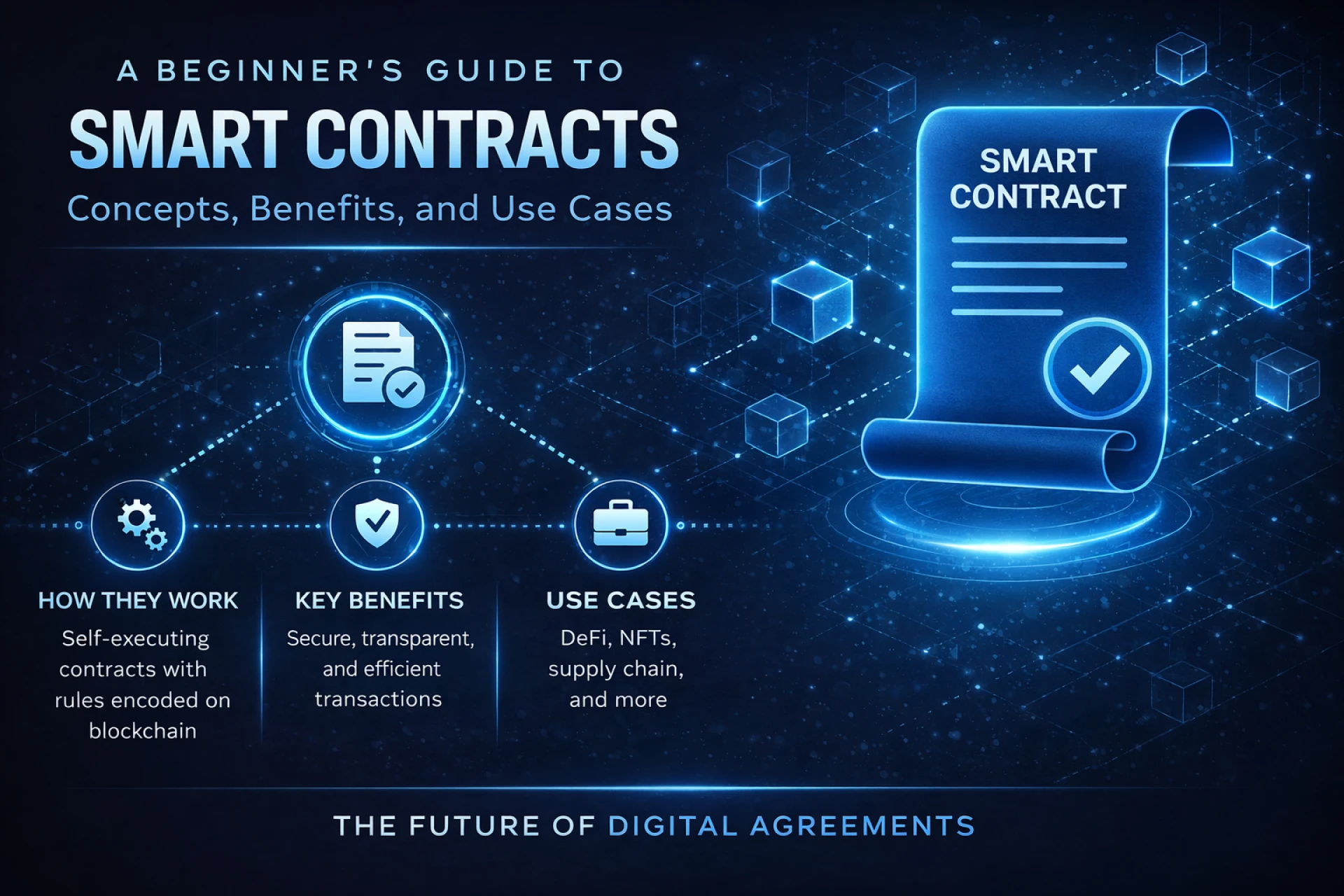
For anyone trying to learn the field, the most useful starting point is this: smart contracts are tools for automating trust. They allow people, businesses, and applications to agree on rules and then let code enforce those rules. This is why smart contracts are central to decentralized finance, token systems, NFT platforms, digital identity workflows, and many enterprise blockchain pilots. They turn a blockchain from a passive record of transactions into an active execution environment.
What makes a smart contract different from regular software
A traditional application usually runs on infrastructure controlled by one company. That company can update the code, correct records, reverse transactions, and decide who can access the system. Smart contracts work differently. Once deployed, they run according to rules written into code and are executed by network participants rather than a single operator. Ethereum’s documentation emphasizes that this makes outcomes more predictable because the contract behaves according to the same rules for everyone who interacts with it.
Another difference is that smart contracts manage both logic and state. Logic refers to the functions they can perform, while state refers to the data they store over time. Solidity’s official introduction explains this clearly by showing that a contract can store values and update them through function calls. That means a smart contract is not just a script that runs once. It can act more like a persistent application component, keeping track of balances, permissions, ownership records, or business conditions over many transactions.
This structure is what enables systems like token contracts, lending protocols, automated escrow, and digital collectibles. A contract can remember who owns an asset, how much collateral a borrower posted, or whether a transaction condition has been fulfilled. In that sense, smart contracts are closer to miniature shared back-end systems than to simple one-time automation tools.
How smart contracts actually work
The operating model of a smart contract can be understood in a few connected stages. First, a developer writes the program in a language designed for blockchain execution. On Ethereum and many compatible networks, that language is usually Solidity. The source code defines the rules, functions, user permissions, and storage structure of the contract. Solidity’s documentation describes the language as a high-level, object-oriented language for implementing smart contracts on the Ethereum Virtual Machine.
Next, the contract is compiled and deployed to the blockchain. Deployment gives it an onchain address and publishes its bytecode so network nodes can execute it. After deployment, users or applications interact with it by sending transactions that call specific functions. For example, a user might stake tokens, transfer assets, mint an NFT, or claim funds held in escrow.
When a transaction is submitted, network nodes process it according to the contract’s code. The result must be deterministic, meaning that every node reaches the same outcome when given the same inputs. This requirement is one of the defining characteristics of smart contract systems. The contract cannot depend on secret local information or arbitrary offchain events that other nodes cannot verify. That is why blockchain-based execution demands precise rules and clearly structured inputs.
If the conditions are satisfied, the contract updates its state and records the result on the blockchain. This may mean moving tokens, changing ownership data, logging an event, or storing a new value. Because the result is written to a shared ledger, anyone with access to the network can verify that the action happened according to the contract’s rules. This execution model is the technical foundation behind Smart Contract Auditing, because security reviewers must examine not only what the code says, but also how it will behave under real transaction conditions.
The core ideas every beginner should understand
The first key idea is determinism. Smart contracts only work when every node can independently confirm the same result. This is why smart contracts are excellent for well-defined logic but less suitable for situations that require subjective judgment.
The second idea is immutability. Public blockchain contracts are often difficult to change after deployment. Ethereum’s documentation notes that smart contracts can be very hard to alter once released, depending on how they are designed. This is useful because it limits arbitrary changes, but it also means bugs can be expensive and permanent if developers are careless.
The third idea is transparency. In many public blockchain systems, the contract code and transaction history are visible. That allows users, developers, auditors, and business partners to inspect how a system works rather than relying entirely on promises.
The fourth idea is composability. Smart contracts can interact with one another. A lending protocol can use a token contract. A marketplace can work with NFT contracts. A payment flow can connect to price feeds and settlement logic. This ability to combine contracts into larger systems is one reason blockchain ecosystems have grown so quickly.
The fifth idea is execution cost. Blockchain computation is not free. On Ethereum-like systems, users pay fees to execute contract functions. This fee model shapes how contracts are designed, because inefficient code becomes expensive to use. As a result, writing smart contracts is not just about correctness. It is also about performance, storage efficiency, and careful architectural choices.
Why smart contracts need external data
A smart contract can verify what is already onchain, but it cannot naturally know what happened in the outside world. It does not automatically know the current market price of an asset, the weather in a city, or whether a real-world delivery has arrived. This gap is known as the oracle problem.
Chainlink’s documentation explains that smart contracts often rely on external data feeds to access prices, reserves, and other offchain information. These systems connect blockchain logic to real-world inputs so contracts can respond to events beyond the chain itself.
This is a major point for beginners because it reveals both the power and the limits of smart contracts. The contract itself may be secure and deterministic, but if it depends on unreliable external data, the overall application can still fail. A lending contract with a bad price feed can liquidate healthy positions. An insurance contract with faulty weather data can trigger wrong payouts. In practice, the reliability of a smart contract often depends on the reliability of the surrounding data infrastructure.
Real-world applications that make smart contracts important
The clearest real-world example is decentralized finance. DeFi platforms use smart contracts for lending, borrowing, trading, yield distribution, and collateral management. Instead of a bank approving and tracking every operation, the contract enforces the rules automatically. This creates a more programmable financial model, though it also creates security pressure because large values may be controlled directly by code.
Another major use case is tokenization. NIST notes that smart contracts make it possible to deploy and manage tokens as part of blockchain application layers. These tokens can represent currencies, loyalty points, in-game assets, governance rights, or claims on other resources.
NFTs extended this idea into digital ownership. Smart contracts can define how tokens are minted, transferred, and tracked. They can also embed royalty logic, access permissions, or collection rules. While the public conversation around NFTs has changed over time, the underlying lesson remains important: smart contracts can create programmable digital property systems.
Supply chain and business automation are also strong candidates. A contract can record milestones, confirm approvals, release payments, or reconcile steps across organizations that do not fully trust one another. The appeal here is less about speculation and more about reducing friction in multi-party operations.
Why security and auditing matter so much
One of the most important lessons in smart contracts is that code errors are often more costly than they are in traditional software. A normal app bug may cause inconvenience. A smart contract bug can lock assets, leak funds, or expose critical controls in a live financial environment.
OWASP’s Smart Contract Top 10 for 2026 highlights common classes of vulnerabilities and serves as a practical awareness framework for Web3 developers and security teams. Its existence reflects how mature and serious the security side of the field has become. Smart contract systems face risks involving access control, business logic, unsafe external calls, price manipulation, and more.
That is why a proper Smart Contract Audit is now treated as a core stage of deployment rather than an optional extra. An audit examines code structure, attack surfaces, permission models, and failure paths before a contract goes live. The goal is not only to find syntax errors, but to understand how the system behaves under malicious or unexpected conditions.
In serious projects, teams often involve internal review, automated testing, formal analysis for critical components, and outside security specialists. Choosing a capable Smart Contract Audit Company can make a major difference because external reviewers bring adversarial thinking and experience with known vulnerability patterns that an in-house team may overlook.
What beginners should take away
Learning smart contracts does not begin with memorizing code syntax. It begins with understanding what problem they solve. They automate rules on shared infrastructure. They reduce reliance on intermediaries in certain digital processes. They make logic transparent and verifiable. And they create new ways to build financial, ownership, and operational systems on top of blockchain networks.
At the same time, they are not magic. They do not remove legal complexity, business risk, or the need for careful governance. They also do not work well without reliable data, sound architecture, and disciplined security practices. For learners, that balance is essential. The best way to understand smart contracts is to see them as powerful but constrained systems. They excel when rules are clear, digital, and verifiable. They struggle when the real world is messy, ambiguous, or poorly connected to onchain logic.
Conclusion
Smart contracts are best understood as blockchain-based programs that automatically execute predefined rules. Their value comes from deterministic execution, shared verification, persistent state, and the ability to coordinate actions without a central operator controlling every step. They are already shaping finance, token systems, digital ownership, and enterprise automation. For anyone entering the field, a clear understanding of how they work creates a strong foundation for deeper study in development, security, and blockchain system design. The technology may sound advanced, but its core principle is simple: when trust can be expressed in code, smart contracts make that trust programmable.























Sign in to leave a comment.