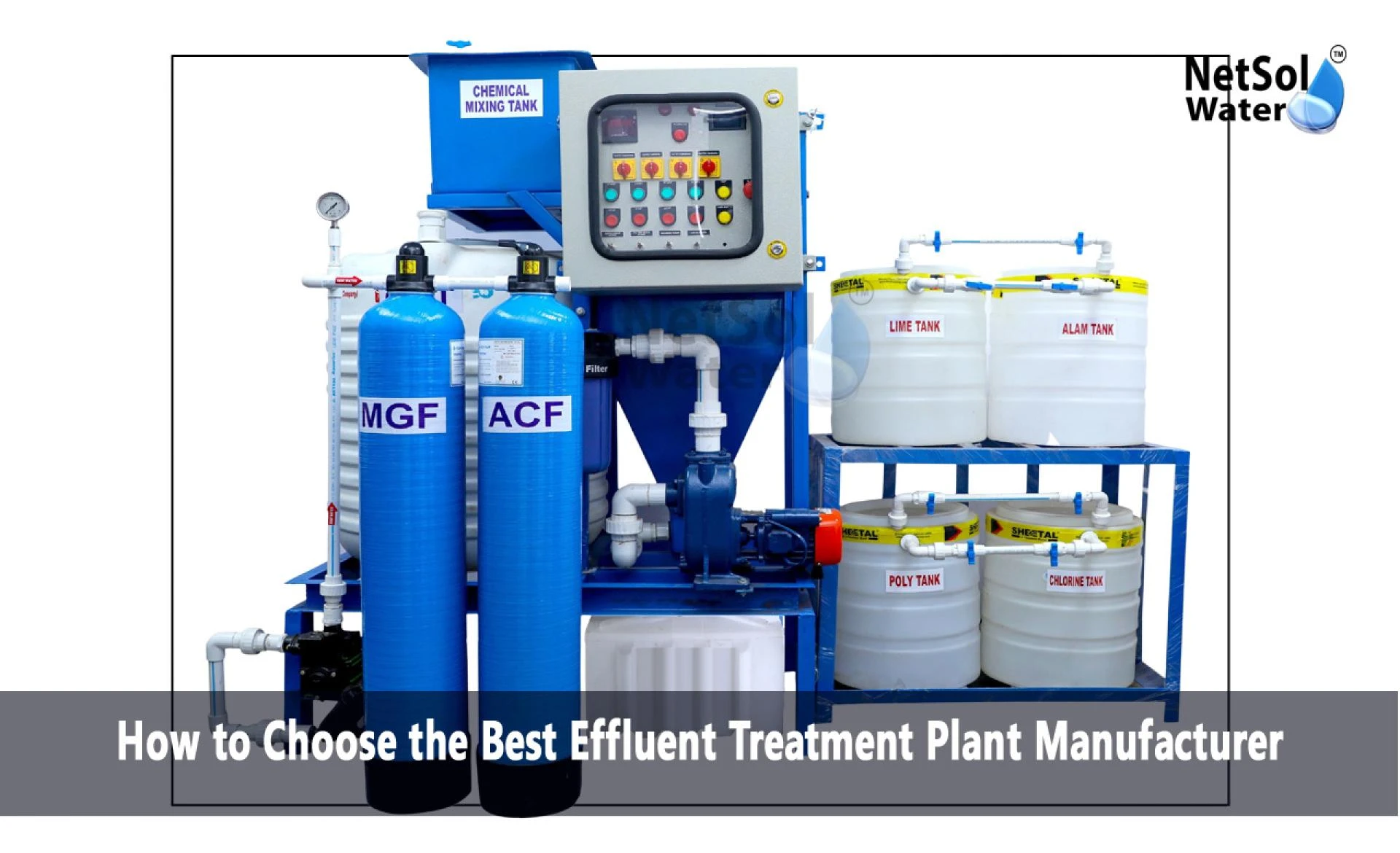
Effluent treatment is no longer a regulatory afterthought — it is a cornerstone of responsible industrial operations. Whether you run a textile mill, a pharmaceutical plant, a tannery, or a food processing facility, selecting the right Effluent Treatment Plant manufacturer can mean the difference between seamless compliance and costly environmental violations.
Yet the market is crowded. Dozens of manufacturers claim to offer cutting-edge technology, turnkey solutions, and post-installation support. Sifting through these claims requires a structured approach, technical knowledge, and an awareness of what truly matters over the long term.
This guide walks you through every essential criterion — from technical capability and regulatory alignment to after-sales support and total cost of ownership — so you can make a confident, well-informed decision.
1. Understand Your Effluent Profile First
Before approaching any manufacturer, you must have a clear understanding of your own effluent. Different industries produce vastly different wastewater — in terms of volume, pH, chemical oxygen demand (COD), biological oxygen demand (BOD), heavy metal content, and suspended solids.
Conduct a thorough effluent characterisation study. This involves laboratory testing of your wastewater across different production cycles, because effluent composition often varies by shift, season, and product batch. A manufacturer who designs a plant without this data is essentially guessing.
Your Effluent Profile Should Include
- Daily and peak flow rates (litres per hour or cubic metres per day)
- BOD and COD concentrations
- pH range across production cycles
- Total suspended solids (TSS) and total dissolved solids (TDS)
- Presence of heavy metals, oils, or industry-specific contaminants
- Temperature range of the discharge stream
- Applicable discharge standards (CPCB, state PCB, or local authority)
Share this data openly with prospective manufacturers. Their ability to interpret it and propose a technically sound solution is itself an early test of their competence.
2. Evaluate Technical Expertise and Domain Experience
ETP technology is not one-size-fits-all. A manufacturer with deep expertise in pharmaceutical effluent may not be the best choice for a distillery or a chemical plant. Look specifically for experience treating your type of effluent, not just general wastewater.
Questions to Ask About Technical Credentials
Ask manufacturers how long they have been designing and commissioning ETPs, and how many plants of similar capacity and industry type they have completed. Request case studies with quantified performance data — inlet concentrations versus outlet concentrations, uptime percentages, and energy consumption figures.
A reputable manufacturer will readily share this information. Vague references to "hundreds of installations" without verifiable specifics should raise a flag.
"The best manufacturers don't just sell you a plant — they solve your specific pollution problem. Ask for the data, not just the brochure."
Technology Portfolio
Strong manufacturers maintain a broad portfolio of treatment technologies: physico-chemical treatment, activated sludge processes, moving bed biofilm reactors (MBBR), membrane bioreactors (MBR), reverse osmosis, zero liquid discharge (ZLD), and more. Their recommendation for your plant should come from a place of technical analysis, not from whatever technology they happen to manufacture most cheaply.
3. Verify Regulatory Compliance Capability
In India and most other jurisdictions, ETPs must meet standards set by environmental regulators — the Central Pollution Control Board (CPCB), State Pollution Control Boards (SPCBs), or equivalent authorities. A manufacturer who is not deeply familiar with the current standards applicable to your industry and location is a liability.
Confirm that the manufacturer has a strong track record of designing plants that achieve compliance on the first attempt. Ask for documented test reports from previously commissioned plants, ideally verified by third-party laboratories. Look for manufacturers who remain engaged through the regulatory approval and consent-to-operate process, rather than walking away after commissioning.
⚠ Pro TipAlways cross-check the discharge standards applicable to your industry directly with your State Pollution Control Board before finalising any design. Standards can and do change, and your manufacturer should factor in possible future tightening of norms.
4. Assess Design Quality and Engineering Rigour
A well-engineered ETP begins with a detailed project report (DPR) that includes process flow diagrams, equipment sizing calculations, hydraulic profiles, civil drawings, and an instrumentation and control plan. If a manufacturer offers you a quotation without these documents, or produces them only superficially, question the depth of their engineering.
Red Flags in the Design Phase
Be cautious of manufacturers who undersize key unit operations to offer a lower capital cost, rely exclusively on proprietary "black-box" equipment without explaining the underlying science, or propose a design that doesn't account for shock loads or seasonal variation in your effluent quality.
What Good Engineering Looks Like
A credible manufacturer will offer a detailed process design basis document, show how each treatment stage addresses a specific contaminant, provide equipment datasheets, and clearly explain the logic behind their technology selection. They will also build in redundancy for critical equipment — blowers, pumps, dosing systems — so that a single point of failure does not shut down your entire treatment operation.
5. Consider the Total Cost of Ownership, Not Just Capital Cost
It is tempting to select the manufacturer who offers the lowest upfront price. This is almost always a mistake. The true cost of an ETP spans its entire operational life, which typically ranges from 15 to 25 years. What appears to be a saving at procurement can quickly be dwarfed by high energy consumption, excessive chemical dosing, frequent breakdowns, and expensive maintenance contracts.
Total Cost of Ownership Factors to Compare
- Capital expenditure (equipment, civil works, installation)
- Energy consumption per cubic metre of treated effluent
- Chemical consumption (coagulants, flocculants, pH adjusters, biocides)
- Sludge generation volume and disposal cost
- Annual maintenance and spare parts costs
- Automation level and its effect on labour requirements
- Expected upgrade costs as regulations tighten
Ask manufacturers to provide you with an operating cost model based on your effluent data. A good manufacturer will be able to give you a realistic estimate of power consumption, chemical usage, and sludge output per day. This is far more valuable than a slick brochure.
6. Examine After-Sales Support and Service Network
An ETP is not a one-time installation — it requires continuous monitoring, periodic maintenance, and occasional troubleshooting. The manufacturer's ability to provide responsive, competent after-sales support is arguably as important as the quality of the initial installation.
Service Infrastructure Matters
Find out whether the manufacturer has a service team or regional office within a reasonable distance of your facility. Understand their typical response time for breakdown calls. Ask whether they offer annual maintenance contracts (AMCs) and what these cover.
Also enquire about the availability of spare parts. Plants that rely on imported proprietary components with 6–8 week lead times for replacements are a significant operational risk.
Remote Monitoring Capabilities
Leading manufacturers now offer SCADA-integrated ETPs with remote monitoring capabilities, allowing their engineers to detect abnormalities in plant performance before they escalate into compliance failures. This is an especially valuable feature for organisations with multiple plant locations or limited in-house ETP expertise.
7. Review References and Site Visits
Never rely solely on testimonials in a brochure. Ask for references from existing clients in your industry segment and, where possible, arrange site visits to operational plants. Speaking directly with plant managers or environmental officers at reference sites will give you a candid picture of the manufacturer's reliability, post-installation responsiveness, and actual plant performance.
Specifically ask reference clients: Did the plant achieve guaranteed outlet parameters? Were there significant teething issues after commissioning, and how quickly were they resolved? Would they choose the same manufacturer again?
8. Evaluate Financial Stability and Organisational Longevity
You are entering a long-term relationship. A manufacturer who is financially precarious or has a high staff turnover rate is a risk — not because they cannot build a good plant, but because they may not be around to support it five years down the line.
Review the manufacturer's years in business, the size and stability of their engineering team, and whether key technical personnel are retained in-house or constantly outsourced. A brief credit check or review of publicly available company filings is a prudent step for major capital investments.
9. Look for Innovation and Future-Readiness
Environmental regulations tend to become more stringent over time. A manufacturer who invests in research and development — exploring advanced oxidation processes, energy recovery from sludge, water recycling and reuse technologies — is better positioned to help you adapt as requirements evolve.
Ask whether the manufacturer has experience with Zero Liquid Discharge (ZLD) systems, which are increasingly mandated in water-stressed regions and for high-pollution industries. Even if you don't need ZLD today, a manufacturer familiar with the full treatment spectrum is better equipped to scale your plant's capability in the future.
10. Scrutinise the Contract and Guarantees
Before signing, read the contract carefully — or have a qualified engineer or legal adviser review it. Pay close attention to performance guarantees: what outlet quality is the manufacturer guaranteeing, under what inlet conditions, and what remedies are available if the plant fails to meet these guarantees?
Ensure the contract specifies the scope of supply in precise detail: what civil works are included, what utilities are the client's responsibility, what commissioning and training are covered, and what the warranty period covers. Ambiguity in these clauses is a common source of disputes.
Contract Clauses to Review Carefully
- Performance guarantees (outlet parameters and flow rates)
- Scope of civil works and excluded items
- Commissioning period and acceptance testing protocol
- Warranty duration and coverage scope
- Defect liability period obligations
- Penalty clauses for delayed delivery or performance shortfalls
- Termination and dispute resolution provisions
Conclusion: A Decision That Deserves Due Diligence
Choosing an Effluent Treatment Plant manufacturers is a decision with consequences that will play out over decades. A plant that works reliably, meets regulatory standards, and evolves with your needs is an asset. One that fails to deliver creates recurring compliance crises, reputational damage, and unforeseen costs.
The manufacturers who earn long-term client loyalty are those who combine deep technical knowledge with engineering transparency, regulatory fluency, responsive after-sales support, and a genuine commitment to your environmental outcomes — not just to closing the sale.
Take the time to evaluate multiple manufacturers rigorously, visit reference sites, demand detailed proposals, and scrutinise the fine print. The extra diligence invested at the selection stage pays dividends across the entire life of the plant.
The right ETP manufacturer is not the cheapest one, nor the one with the most impressive showroom. It is the one whose plants actually perform — year after year, inspection after inspection.













Sign in to leave a comment.