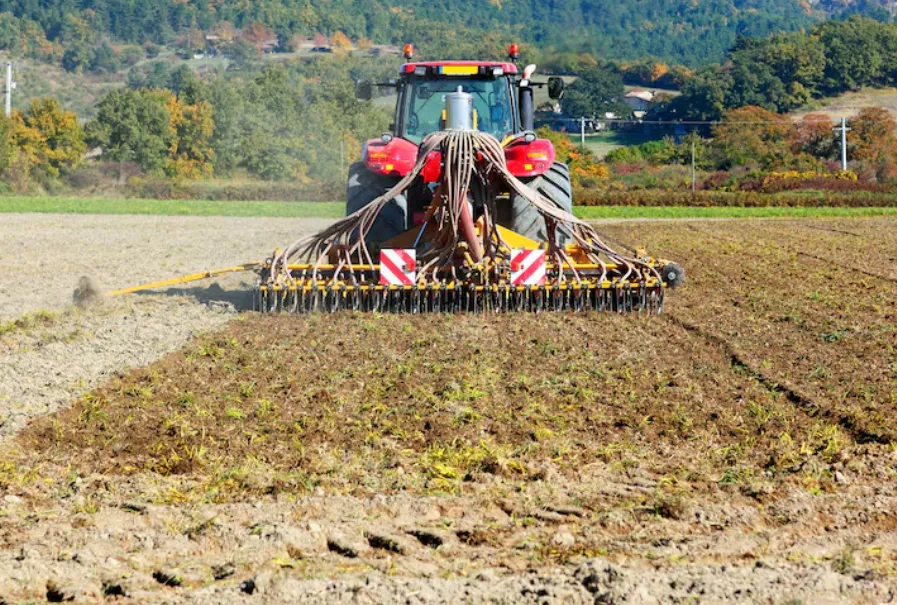

Buying a cultivator that's too big for your tractor is a real and common mistake. It happens because most people shop by price or by the size of their garden rather than by what their machine can actually handle. The result is an implement that either won't mount properly, overloads the lift system, or works so wide that it ends up on top of plants instead of between them. Here's how to think through the match before you buy.
Start With Your Tractor, Not the Garden
The most important measurement in this process is not the size of your garden beds. It's the hitch category and lift capacity of your tractor. Those two numbers tell you what class of cultivator you can run before you look at anything else.
A small garden tractor with a Category 0 hitch and a 200-pound lift capacity at the hitch point needs a different cultivator than a compact utility tractor with a Category 1 hitch and a 600-pound lift rating. The garden might be the same size, but the machines are not interchangeable when it comes to implement selection.
Hitch Category First
Category 0 and Category 1 refer to the pin sizes and connection geometry of the 3 point hitch. A Category 0 cultivator has 5/8-inch pins. A Category 1 has 7/8-inch pins. They don't fit each other's hitches without adapters, and running an adapter on a mismatched setup is not a situation most people are happy with in practice.
Find out which category your tractor runs before you look at any implement specs. If your tractor is an older John Deere garden series like the 400 or 425/445/455, it's almost certainly Category 0 unless it's been upgraded. Compact utility tractors and larger machines typically run Category 1.
Working Width & Row Spacing
Once you know the hitch category, the next thing to match is working width. A cultivator's working width should fit between your rows without overlapping onto the plants on either side. This sounds obvious, but it's easy to buy a cultivator that's wider than your row spacing, especially if you laid out the garden before you owned the implement.
Standard row spacing for most garden crops runs between 18 and 36 inches depending on the plant. If your rows are 24 inches apart, you need a cultivator that works narrowly enough to fit in that space with clearance on both sides. If the implement is too wide, you're not cultivating between rows. You're cultivating through them.
Adjustable Tine Spacing
Some cultivators allow you to adjust the spacing between tines or shanks, which gives you flexibility across different row configurations. This is worth looking for if you grow multiple crops with different row widths. A fixed-width cultivator locks you into one row spacing, which may or may not match what you planted.
Lift Capacity & Implement Weight
Your tractor's 3 point hitch has a rated lift capacity. That rating is usually given at the hitch pins, not at the end of extended lift arms or with any offset. The cultivator for tractor weight needs to stay within that rating.
This is where overbuying shows up most clearly. A heavy-duty cultivator built for a larger tractor might be well-built and reasonably priced, but if your lift system can't raise it cleanly, you'll be dragging it through turns and putting stress on the linkage every time you try to lift out of the soil. That wears out lift components faster and makes the implement harder to use.
Ruegg Manufacturing makes a CAT 0 cultivator that fits the smaller John Deere garden tractor class and is sized and weighted for what those machines can actually handle. That kind of model-matched approach is worth looking for regardless of brand because it means the implement was designed with the tractor's limits in mind rather than just built to a general spec.
Depth Control & Tine Design
Working depth matters for cultivation. Too shallow and you're barely scratching the surface, which won't uproot established weeds or break a real soil crust. Too deep and you're disturbing root zones and turning cultivation into secondary tillage, which is harder on the tractor and not what the plants need.
Most garden tractor cultivators set working depth through the 3 point hitch position. Lower the hitch to increase depth, raise it to run shallow. Some implements also have depth wheels or skids that give you a physical stop so the tines don't go deeper than the setting regardless of how the hitch moves.
Tine Type
Straight fixed tines work well for breaking loose soil and uprooting small weeds. Curved or sweeping tines cover more lateral area per shank and are better for cutting weed roots just below the surface. The choice depends on what your soil conditions are like and how established the weeds typically get between cultivation passes.
Buying the Right Size for Now
It's tempting to buy for the operation you think you'll have in three years rather than the one you have today. But a cultivator that's too big for your current tractor doesn't become more useful when you add more garden space. It stays too big for your tractor until you get a bigger tractor.
Buy what fits the machine you own. If the operation grows and you move up to a larger tractor, you can upgrade the implement at that point. In the meantime, a properly matched cultivator that your tractor can run at full capacity is going to do more useful work than a heavier implement that the machine is always fighting to lift and control.





























Sign in to leave a comment.