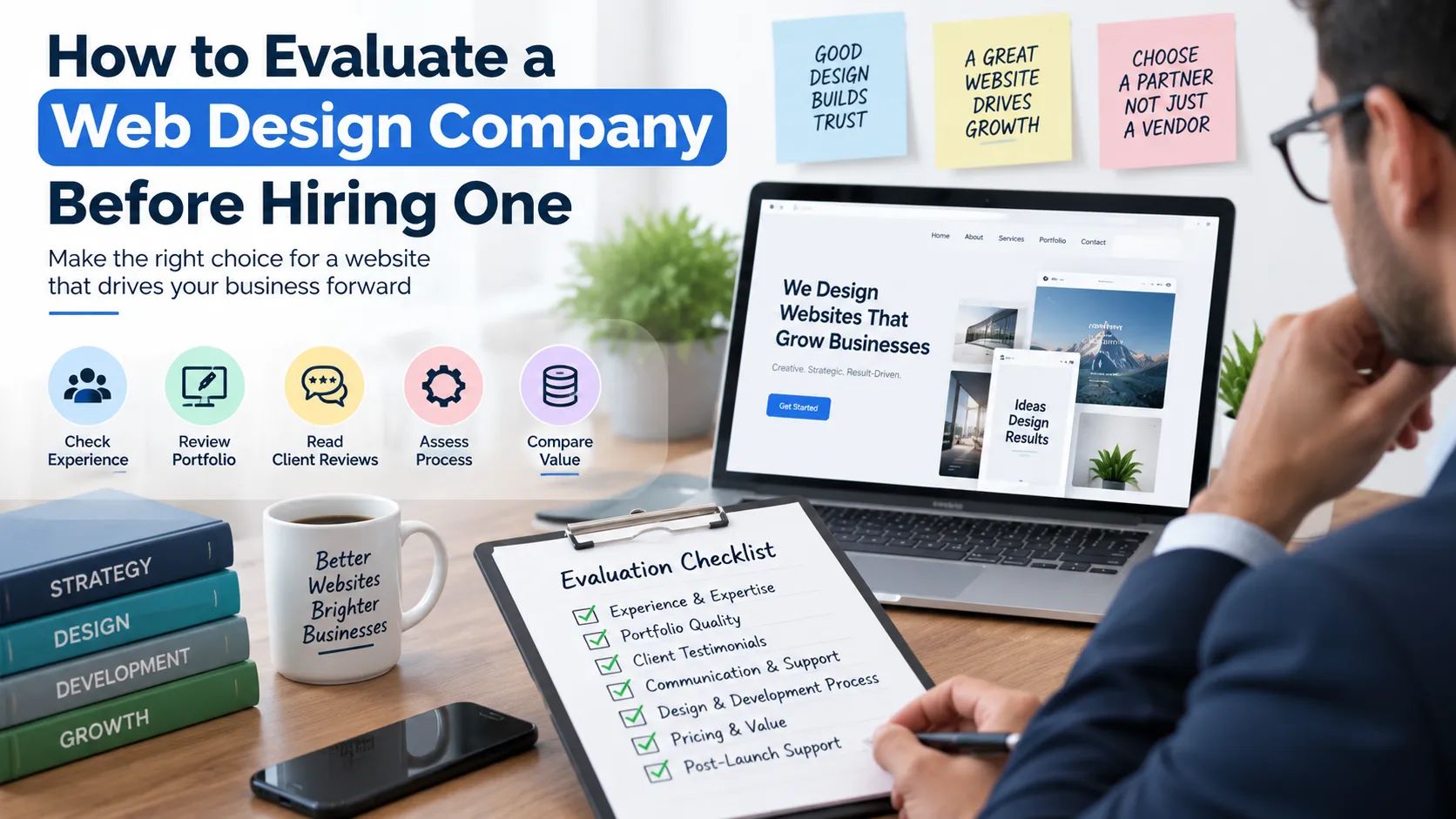

Your website is often the first serious interaction a potential customer has with your business. Before contacting your sales team, visiting your store, or requesting a quote, people may judge your company based on how quickly, clearly, and professionally your website communicates.
That makes choosing the right web design company an important business decision. A visually attractive website is useful, but good web design also needs to support usability, mobile performance, search visibility, conversions, security, and long-term growth.
With so many agencies offering similar packages, knowing what to evaluate before signing a contract can save you time, money, and future headaches. Here are the most important factors to consider when comparing potential web design partners.
1. Start With Your Website Goals
Before looking for an agency, define what you want the website to accomplish. Are you trying to generate leads, sell products, increase bookings, showcase your portfolio, establish credibility, or provide information to existing customers? Your objectives should influence the type of website and services you need.
For example, an e-commerce business may require product management, payment integration, inventory functionality, and conversion-focused layouts. A professional services business may need lead-generation forms, service pages, testimonials, and strong calls to action.
Having clear goals allows you to evaluate agencies based on their ability to solve your business problems rather than simply choosing the most attractive portfolio.
2. Review Their Portfolio Carefully
A portfolio is one of the easiest ways to assess a website designing company before hiring it. However, don't look only at whether the websites appear attractive.
Examine how different projects are structured. Are the layouts easy to navigate? Do the designs appear responsive? Are important calls to action easy to find? Does each website seem appropriate for its target audience?
Look for variety as well. An agency that has experience working across different industries may be better equipped to adapt its approach to your specific requirements.
If possible, visit some of the live websites listed in the portfolio rather than relying only on screenshots.
3. Check Relevant Experience
Industry experience can be useful, but it should not be your only selection criterion. A company does not necessarily need to have worked exclusively in your industry to create an effective website.
Instead, look for evidence that the agency understands businesses with similar goals, audiences, technical requirements, or project sizes.
Ask potential providers about previous projects that resemble yours. Find out what challenges they encountered and how they solved them.
A professional web design company should be able to explain its decisions rather than simply presenting finished designs.
4. Evaluate Their Design Process
Ask how the agency moves from an initial idea to a completed website.
A reliable process may include discovery, research, information architecture, wireframing, visual design, development, testing, launch, and post-launch support.
The process should also give you opportunities to provide feedback. Ask how many revision rounds are included and how changes are handled.
If an agency promises to create the entire website without first understanding your audience, goals, competitors, and existing digital presence, consider that a warning sign.
5. Look Beyond Visual Design
A good website needs more than an impressive appearance.
Ask potential agencies how they approach:
- Mobile responsiveness
- Website speed
- Accessibility
- Search engine optimization
- Security
- Content management
- Analytics
- Conversion optimization
- Browser compatibility
The best web design company for your business will understand that design and performance work together.
A beautiful website that loads slowly or becomes difficult to use on mobile devices can still produce poor results.
6. Understand Their Web Design Services
Before comparing prices, determine exactly what is included in the proposed web design services.
Some agencies provide only design and development, while others offer a broader package that may include content creation, SEO, hosting, maintenance, analytics setup, branding, and conversion optimization.
Ask for a detailed scope of work. It should clearly explain what pages will be created, which features are included, what technology will be used, and what happens if additional functionality is required. This prevents unexpected costs later.
7. Ask About Mobile-First Design
Mobile users represent a significant portion of online traffic, so responsive design should be a basic requirement rather than an optional upgrade.
Ask the agency to explain how it tests websites across different screen sizes and devices.
Navigation, buttons, forms, images, menus, and text should all remain usable on smaller screens. A website that looks excellent on a desktop but becomes frustrating on a smartphone is not delivering a complete user experience.
8. Check SEO and Performance Knowledge
Web design and SEO are closely connected. Site structure, page speed, headings, internal links, image optimization, mobile usability, and technical implementation can all influence the overall search experience.
You do not necessarily need an agency that provides full SEO campaigns, but your designer should understand SEO-friendly development.
Ask whether the team follows basic technical SEO principles and whether the website will be structured so that additional content and optimization can be added later.
This is particularly important if organic traffic is part of your long-term growth strategy.
9. Read Reviews and Client Feedback
Client reviews can reveal information that a portfolio cannot. Look for feedback about communication, deadlines, responsiveness, technical expertise, and post-launch support. Pay attention to patterns rather than relying on one extremely positive or negative review.
You can also ask the agency for references from previous clients with similar projects.
If several clients consistently mention clear communication and reliable support, that can be a strong indicator of a well-managed agency.
10. Compare Communication and Support
Website projects involve decisions, revisions, approvals, and technical questions. Poor communication can turn an otherwise promising project into a frustrating experience.
Ask who your primary contact will be and how frequently you'll receive updates. Find out how quickly questions are normally answered and what support is available after launch.
Also clarify what happens when something breaks after the website goes live.
A company that offers excellent communication throughout the project can be more valuable than an agency that simply promises a lower price.
11. Understand Ownership and Access
Before signing a contract, clarify who owns the website, domain, design assets, content, and code after the project is completed.
You should also understand who controls hosting, analytics accounts, content management systems, and other important digital properties.
Avoid arrangements that leave you completely dependent on the agency for basic access to your own website.
If you are considering a website designing company, ask these questions before development begins rather than trying to resolve ownership issues after launch.
12. Don't Choose Based on Price Alone
Cost naturally matters, but the cheapest proposal is not automatically the best value.
Compare what each agency is actually offering. One proposal may appear cheaper because it excludes content, testing, SEO-friendly development, maintenance, or important functionality.
Instead of asking only, “How much will the website cost?” ask, “What will I receive for this investment?”
The answer should help you compare agencies based on quality, scope, expertise, support, and expected business value.
13. Watch for Red Flags
Certain warning signs should make you reconsider an agency.
Be cautious if a company:
- Guarantees specific search rankings
- Cannot explain its development process
- Has no relevant portfolio
- Gives an extremely vague proposal
- Avoids discussing ownership
- Offers an unusually low price without explaining the scope
- Does not provide post-launch support
Is difficult to communicate with before the contract
For example, businesses researching agencies such as Prarambh should evaluate them using the same criteria: portfolio quality, process, technical expertise, communication, pricing transparency, and ongoing support.
14. Make a Shortlist and Ask Better Questions
Once you've researched several agencies, narrow the options to two or three serious candidates.
Ask each one the same core questions so you can make a fair comparison. Discuss your goals, timeline, required features, expected deliverables, revision process, maintenance, and ownership.
A detailed conversation can reveal much more than a pricing page.
The right agency should be interested in understanding your business rather than simply selling you a predefined package.
Conclusion
Choosing a web design partner is about more than finding attractive layouts. Your website needs to represent your brand, serve your audience, perform well across devices, support search visibility, and contribute to measurable business goals.
Take time to evaluate portfolios, processes, technical capabilities, communication, pricing, ownership, and support before making a decision. A best web design company for one business may not necessarily be the right choice for another.
The strongest partnership is the one that understands your objectives and can translate them into a website that remains useful and scalable long after launch.
FAQs
1. How do I choose a web design company?
Start by defining your goals, reviewing portfolios, checking relevant experience, comparing services, reading client reviews, and discussing communication, pricing, ownership, and post-launch support.
2. What should I look for in a professional web design company?
Look for strong design and development experience, responsive websites, a clear process, technical SEO knowledge, transparent pricing, good communication, and reliable ongoing support.
3. How much do web design services cost?
Costs vary depending on the number of pages, functionality, design requirements, technology, integrations, content, and ongoing support. Request detailed proposals rather than comparing headline prices alone.
4. Should a web design company provide SEO?
It is beneficial if the agency understands SEO-friendly website structure, mobile performance, page speed, headings, internal linking, and other technical fundamentals. Full SEO services can be added separately if needed.
5. Why is a portfolio important when choosing a website design company?
A portfolio gives you an opportunity to evaluate the agency's design quality, versatility, user experience, and experience creating websites for different business goals.























Sign in to leave a comment.