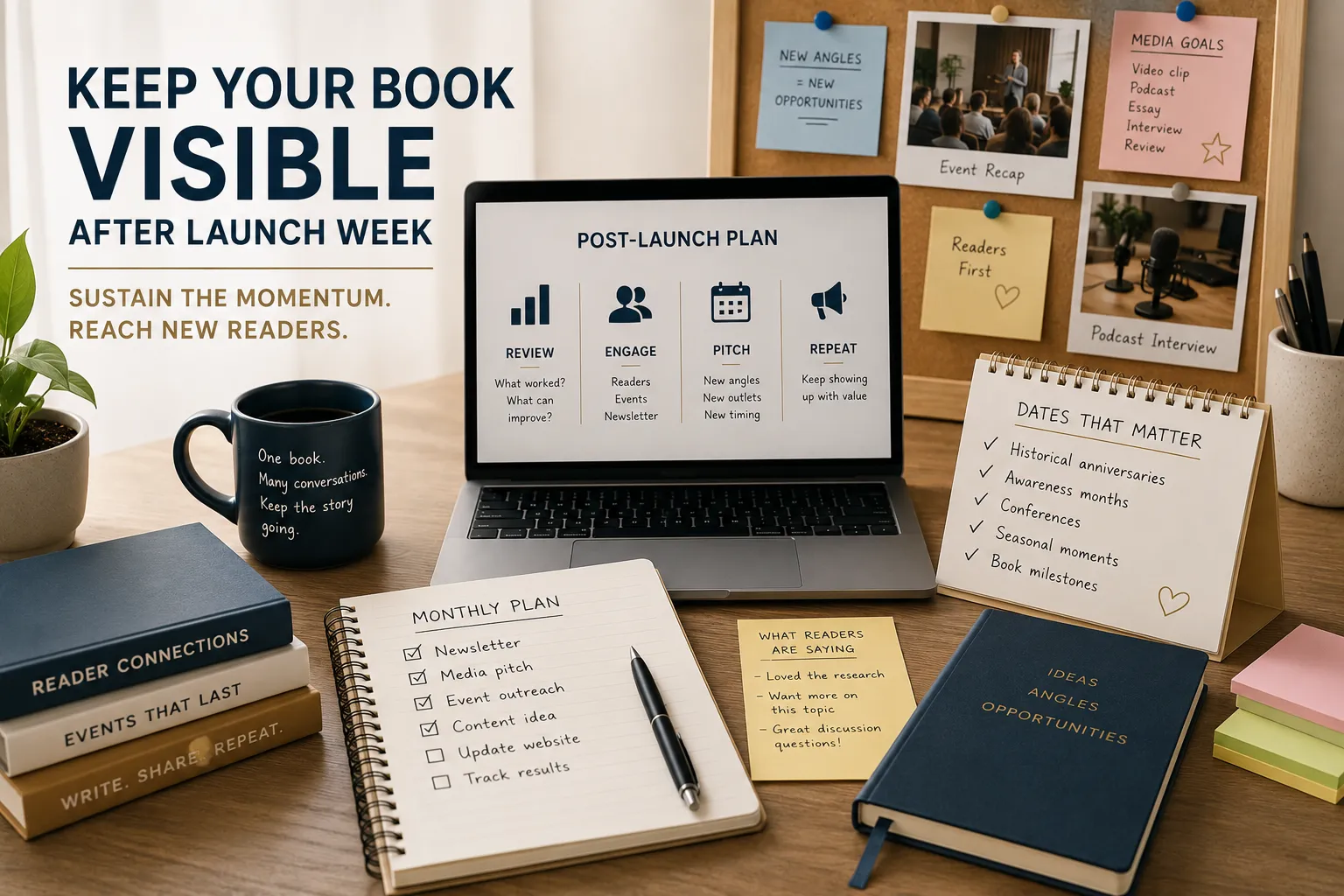

Launch week creates a misleading sense of finality. The events happen, the scheduled posts appear, friends share the cover, and then the calendar goes quiet.
The book, however, is still new to almost everyone who has not heard of it.
Authors often spend months preparing for one release date and very little time planning what follows. That puts too much pressure on a brief period in which retailers, media, reviewers, and readers may respond on different schedules.
Post-launch promotion works better when you stop treating the book as breaking news and start finding new reasons for it to enter conversations.
Begin With a Post-Launch Audit
Do not immediately schedule another month of the same posts. Review what happened first.
Collect information from the channels you control:
- Email open and click rates
- Author website traffic
- Event attendance and questions
- Social posts that prompted meaningful replies
- Retail page changes
- Media responses
- Podcast or interview traffic
- Review themes
Look for signals, not vanity totals. A post with fewer likes may have sent more readers to the book page. A small podcast may have generated thoughtful newsletter sign-ups. An event question may reveal an angle that your original campaign overlooked.
Create a document with three sections: continue, revise, and stop. This prevents habit from becoming strategy.
The audit should also include practical checks. Confirm that purchase links work, your website lists the correct formats, the author biography is current, and recorded appearances are easy to find. Add strong coverage to your media page and give each item enough context for visitors to understand it.
Turn Reader Questions Into New Content
Early readers often describe the book differently from the author. Pay attention to the characters, ideas, settings, or questions they mention.
A nonfiction author may discover that readers care most about one short chapter that received little attention in the launch campaign. A novelist may notice that book clubs keep discussing a secondary relationship. Those responses can support essays, interviews, newsletter content, videos, or event topics.
Do not publish a stream of quotations praising the book. Use reader interest to open a conversation.
For example, an author of a historical novel could create a short article about one archival object that shaped a scene. A business author could answer a practical question readers keep asking after talks. A memoirist could recommend books that helped them understand the period they wrote about.
This content keeps the book present without repeating “buy my book” every week.
Build Around Dates That Belong to the Subject
The publication date is only one point on the calendar.
Identify dates connected to the book:
- Historical anniversaries
- Awareness months
- Seasonal changes
- Professional conferences
- Cultural events
- Regional festivals
- Paperback or audiobook releases
- Awards and submission periods
The connection must be genuine. A weak attempt to attach a novel to every public holiday will look opportunistic.
Plan several months ahead. If you want to pitch an essay for a major anniversary, contact the publication according to its editorial schedule rather than sending the idea the week before.
Fiction can support timely coverage too. Setting, research, genre, adaptation, folklore, food, place, and social themes can all provide angles beyond a standard author interview.
Keep Pitching, but Change the Reason
A post-launch pitch should not pretend the publication date is still approaching.
Give the media a new development or idea:
- A regional event
- A discussion linked to current news
- An essay based on the book’s research
- A reading list tied to its themes
- A new format or translation
- An award nomination
- A partnership with a relevant organization
A campaign for pr for books can continue after publication by shifting from launch announcements to subject-based media opportunities, events, interviews, and platform development.
There is a limit. Some review outlets focus on books before publication and will not consider older titles. No amount of follow-up changes their policy. Redirect that effort toward podcasts, essays, local media, specialist publications, book clubs, libraries, festivals, and topic-led opportunities.
Do not keep pitching the same contact with minor variations. A new subject line is not a new story.
Give Events a Longer Life
An event should produce more than one evening of attention.
With permission from the venue and participants, record useful sections. One conversation might become:
- A short video clip
- An edited author Q&A
- A newsletter reflection
- A photo essay
- A quotation graphic
- A pitch for a related panel
Choose the parts that make sense outside the room. A 45-minute unedited recording may interest existing supporters, but a focused two-minute answer is easier for a new reader to enter.
Events also reveal where the book connects with communities. A small library discussion can lead to an invitation from another branch. A panel can introduce the author to booksellers, teachers, librarians, or organizations working on the same subject.
Do not judge every event by direct sales at the table. That measure matters, but so do future invitations, newsletter sign-ups, relationships, and reusable material.
Keep Your Reader Channels Active
Social media is rented space. Your newsletter and website give you more control over continued communication.
Send newsletters when you have something worth sharing, not only when you need sales. Good post-launch subjects include research notes, reading recommendations, event announcements, behind-the-scenes decisions, reader questions, and progress on the next project.
Make it easy for a new subscriber to understand who you are. Set up a short welcome email containing:
- A brief introduction
- What you write
- What subscribers will receive
- A link to the current book
- One useful or interesting resource
Goodreads can also support continued reader contact. The free Goodreads Author Program allows published authors to claim their profile, connect their books to an official author identity, and engage with readers. Use it as a reader community, not an advertising board. Avoid arguing with reviews or contacting reviewers to challenge their opinions.
Revisit the Book’s Packaging
Sometimes visibility is not the main problem. The cover, description, category, or sample may not convert attention into interest.
Review the retailer page after enough readers have encountered it. Ask:
- Does the cover signal the correct genre?
- Does the description introduce a clear promise or conflict?
- Are formats and editions connected correctly?
- Is the author biography relevant?
- Does the sample begin at the right point?
- Are endorsements readable and credible?
Do not change packaging every time sales slow for a week. Frequent changes make it hard to understand what affected performance. Make one reasoned adjustment, record the date, and watch the response.
For independent authors with several books, back matter deserves special attention. Add links to related titles, newsletter sign-up pages, or a series reading order. The Alliance of Independent Authors recommends continued promotion, backlist cross-promotion, and mailing-list development in its guidance on what to do after a book launch.
Use Promotions With a Specific Purpose
A price promotion can introduce a series, support a new release, reactivate a backlist title, or attract readers in a selected genre. It should not become the automatic answer to every quiet period.
Before discounting, decide what you want the promotion to accomplish. If the discounted book is the first in a series, make sure later books are easy to find. If the goal is newsletter growth, give readers a clear and relevant invitation in the back matter.
Paid advertising requires the same discipline. Test a defined audience and creative concept with a controlled budget. Do not keep spending because stopping feels like admitting failure.
Some books respond well to discounts. Others depend more on institutional sales, speaking, course adoption, book clubs, libraries, or media authority. The right channel follows the book and its readers.
Create a Sustainable Monthly Rhythm
You do not need to promote the book every day.
A workable month might include one newsletter, several thoughtful social posts, a media pitch, outreach to two event partners, and an update to the website. Another month may focus on a festival appearance or a topical essay.
Batch repetitive tasks. Keep a bank of approved images, excerpts, interview clips, and discussion questions. Track outreach so you do not contact the same person twice with the same idea.
Most authors also need time to write the next book. That is the central tradeoff of long-term promotion. Visibility matters, but a schedule that consumes all creative time can damage the career it is supposed to support.
Your book does not become irrelevant because launch week ended. Its strongest opportunities may arrive later, after readers reveal what resonates and new cultural moments make its subject timely again. The task is not to keep the launch going forever. It is to give the book more than one way to be discovered.



























Sign in to leave a comment.