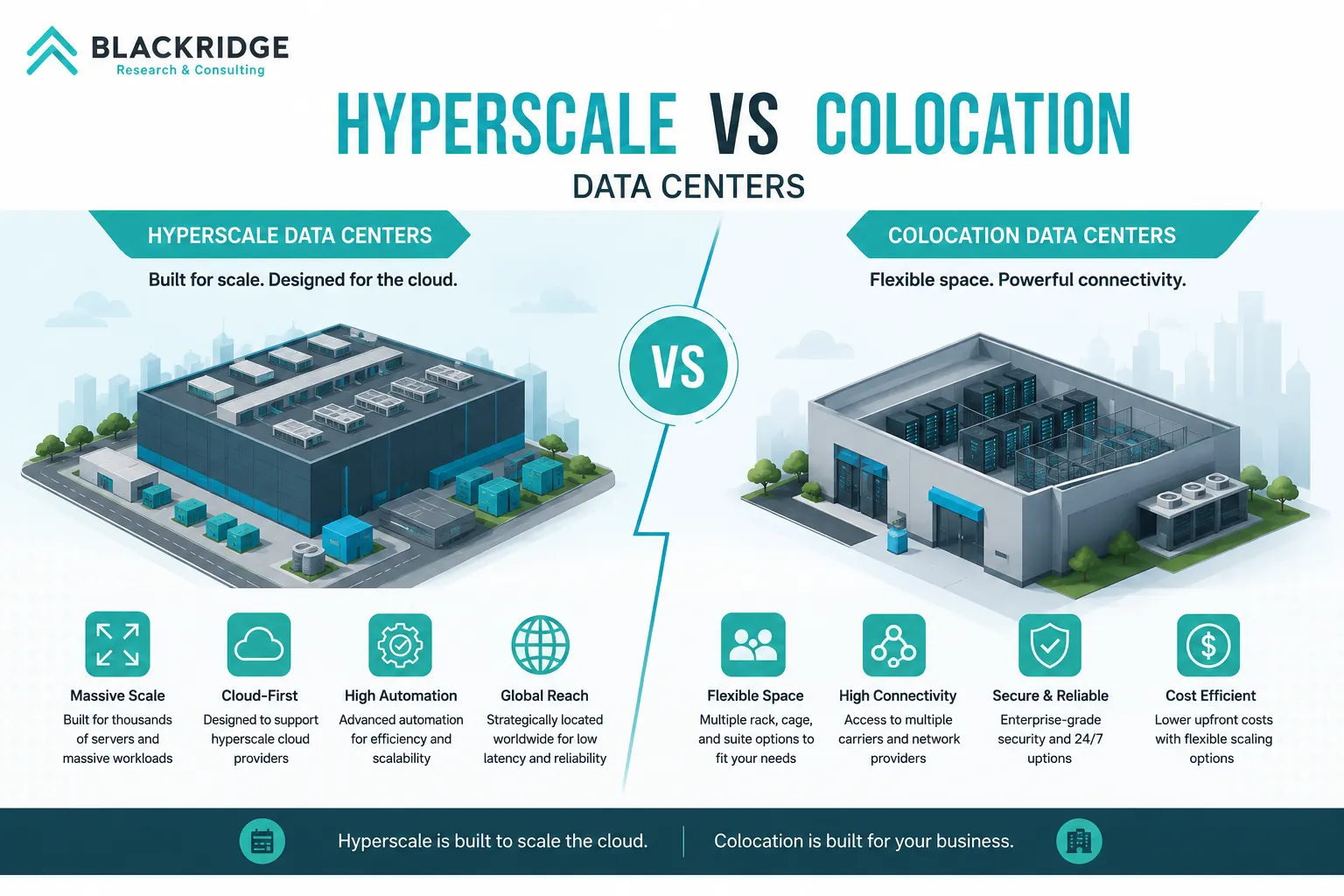

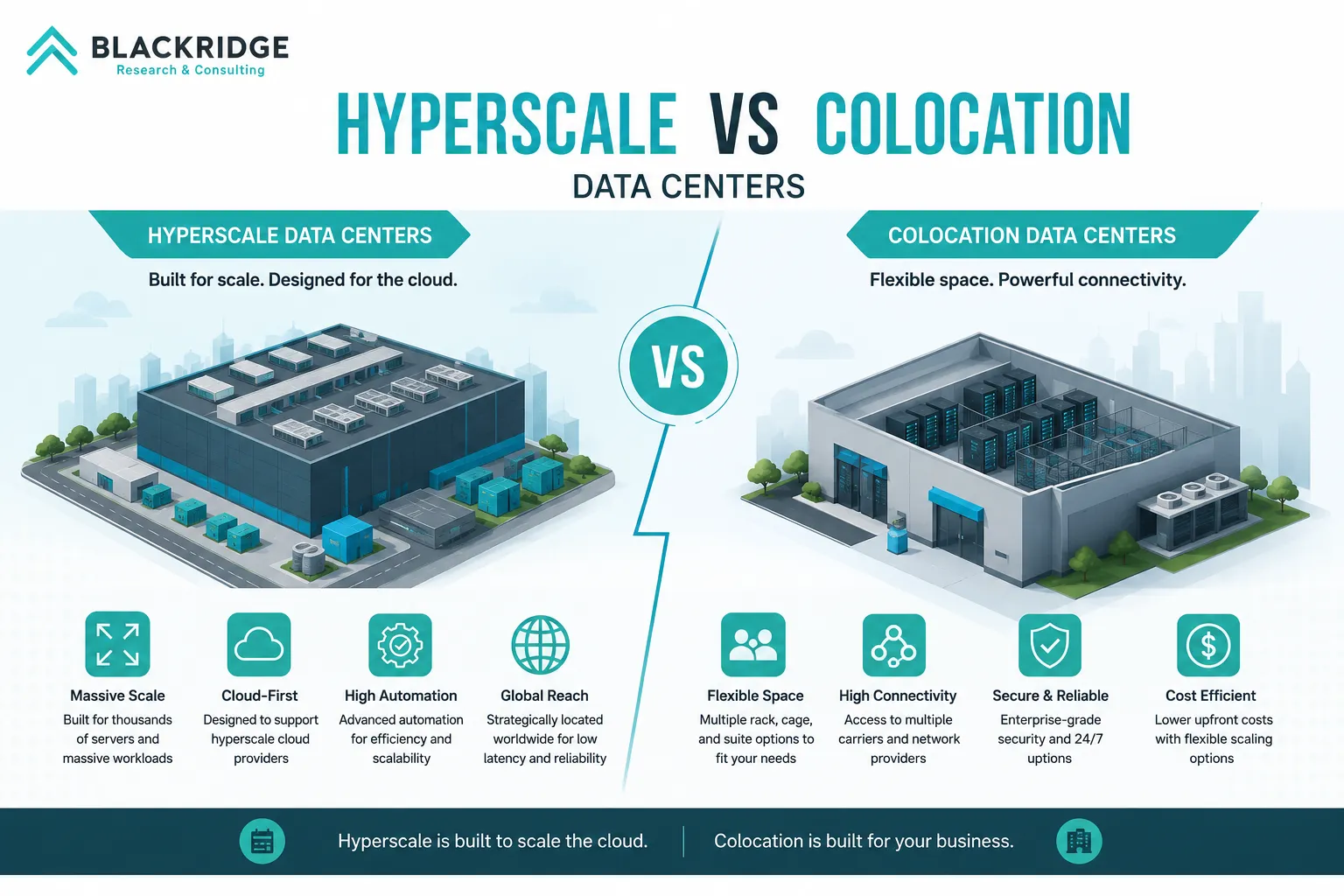
The article explains the differences between hyperscale data centers and colocation data centers, two infrastructure models that play a critical role in supporting cloud computing, artificial intelligence (AI), enterprise IT, and digital transformation.
While both provide computing, networking, and storage capabilities, they differ significantly in ownership, scale, cost, operational control, and target users.
Overview
The primary distinction is based on ownership and operating model:
- Hyperscale data centers are typically built and operated by a single organization, such as a major cloud provider or technology company, to support its own large-scale services.
- Colocation data centers are facilities owned by third-party providers that lease space, power, cooling, and connectivity to multiple customers who install and manage their own IT equipment.
The article illustrates that businesses needing enterprise-grade infrastructure but lacking the resources to construct their own facilities often choose either a hyperscale solution or a colocation provider depending on their operational needs.
Hyperscale Data Centers
A hyperscale data center is designed to manage extremely large computing workloads, massive data storage requirements, and global-scale digital services.
These facilities emerged as traditional enterprise data centers became insufficient to support rapidly growing cloud platforms, AI workloads, streaming services, and high-performance computing. Their architecture emphasizes scalability, automation, redundancy, and operational efficiency.
The article highlights several well-known hyperscale operators, including major cloud providers and global data center companies such as AWS, Microsoft Azure, Google Cloud, Digital Realty, and Equinix.
Main Advantages
According to the article, hyperscale facilities offer several operational benefits:
- Ability to scale rapidly to accommodate growing workloads.
- Advanced physical and cyber security measures.
- Modern designs incorporating AI, automation, IoT technologies, and sophisticated cooling systems.
- High operational efficiency through automation and resilient network architecture.
- Low latency to improve application performance.
- Extensive redundancy across power, networking, cooling, and storage systems, resulting in very high availability.
Main Challenges
The article also notes several disadvantages:
- Significant capital investment is required to build and maintain hyperscale facilities.
- Organizations must comply with numerous industry regulations and security standards.
- Specialized engineering and operational expertise are necessary to manage these highly complex environments.
Colocation Data Centers
Colocation data centers provide shared infrastructure where organizations rent physical space instead of building their own facilities.
Customers retain ownership of their servers and networking equipment while the colocation provider supplies essential infrastructure such as:
- Physical space
- Electrical power
- Cooling
- Physical security
- Network connectivity
This model enables organizations to access enterprise-grade facilities while avoiding the substantial capital expenditure associated with constructing a dedicated data center.
The article identifies major colocation providers including CoreSite, Cyxtera, Digital Realty, Equinix, and NTT.
Main Advantages
The article identifies several benefits:
- Lower upfront costs than building private facilities.
- Flexible pricing based on customer requirements.
- Easy expansion by leasing additional racks or space.
- Compliance responsibilities largely handled by the facility provider.
- Strong interconnection capabilities supporting cloud services, telecommunications providers, and enterprise networks.
Main Challenges
Potential drawbacks include:
- Dependence on third-party service providers.
- Need to carefully review service-level agreements (SLAs).
- Security and privacy considerations for hosted infrastructure.
- Risk of unauthorized activities if providers fail to meet compliance expectations.
Comparison Between Hyperscale and Colocation
The article compares the two models across several important factors:
| Category | Hyperscale | Colocation |
|---|---|---|
| Ownership | Single organization owns and operates the facility | Third-party provider owns facility; customers lease space |
| Cost | High capital investment | Lower upfront investment with rental model |
| Scalability | Extremely large-scale expansion | Flexible expansion by leasing additional capacity |
| Technology | Highly customized and advanced | Depends on provider infrastructure |
| Security | Comprehensive enterprise-grade security | Varies by provider and service level |
| Redundancy | Extensive built-in redundancy | Depends on provider capabilities |
| Expertise | Requires highly specialized internal teams | Infrastructure management largely handled by provider |
The article emphasizes that neither model is universally better; suitability depends on organizational priorities and workloads.
Which Businesses Should Choose Hyperscale?
The article suggests hyperscale infrastructure is appropriate for organizations that:
- Operate global cloud platforms.
- Process massive datasets.
- Require high-performance computing.
- Support AI and machine learning applications.
- Need continuous large-scale expansion.
Examples include large technology companies and cloud service providers with extensive computing demands.
Which Businesses Should Choose Colocation?
Colocation is presented as a strong choice for organizations that:
- Want enterprise infrastructure without building their own facility.
- Require predictable operating expenses.
- Expect changing capacity requirements.
- Need flexible deployment options.
- Operate in industries such as healthcare, finance, telecommunications, e-commerce, and content delivery.
- Are startups or growing businesses with limited capital resources.
Overall Takeaway
The article concludes that both hyperscale and colocation facilities have become essential components of the modern digital infrastructure ecosystem.
Hyperscale data centers are optimized for organizations requiring maximum scalability, performance, and operational control, while colocation facilities provide a practical alternative for businesses seeking enterprise-grade infrastructure without the financial and operational burden of building their own facilities.
Selecting the appropriate model ultimately depends on factors such as:
- Budget
- Growth projections
- Performance requirements
- Security needs
- Compliance obligations
- Internal technical expertise
Conclusion
The availability of data center facilities such as hyperscale or colocation facilities reduces high upfront costs and helps manage complexities and minimize security risks.
While each of the above alternatives has merits and demerits, they are still some of the most trending and widely chosen data center service facilities nowadays.
Connect With the Experts
Are you looking for a platform that gives you reliable high quality and family project insights for global data center facility projects?
Discover the Global Project Tracking (GPT) platform by Blackridge Research, designed to provide you with the most recent Global Data Center Facility Projects better and faster across various stages of development:
- Upcoming projects
- Tender notices
- Contract award announcement
- Projects in progress or under construction
- Successfully completed projects
Book a free demo to learn more about the Global Data Center Facility Projects database and how we can help you achieve your goals.






























Sign in to leave a comment.