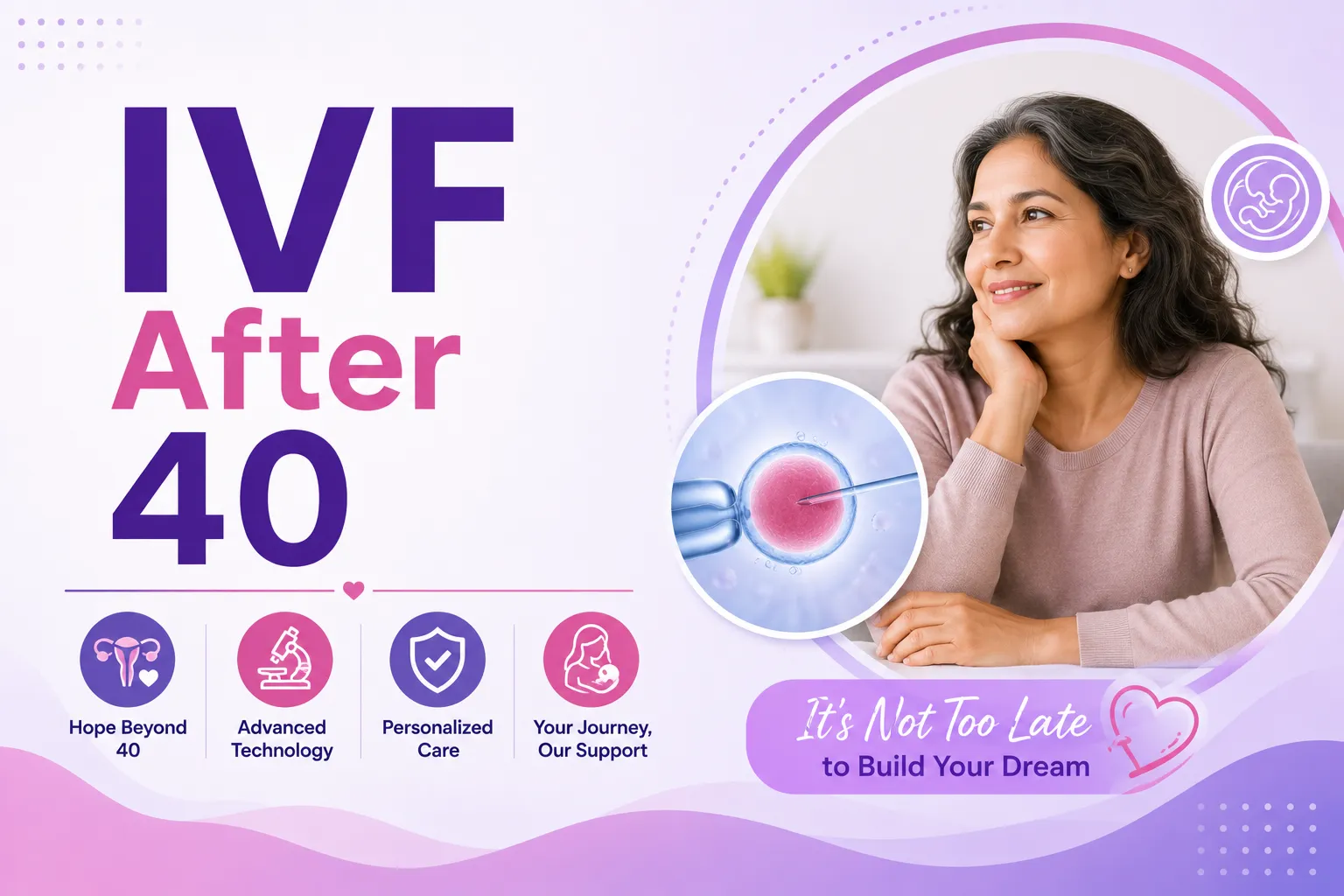

If you are asking this question, you have probably already spent some time on the internet reading statistics that feel discouraging. Numbers like 12 percent and 4 percent. Terms like diminished ovarian reserve and chromosomal abnormality. Language that feels cold and clinical when what you are dealing with is deeply personal.
This article is written for you. Not to give you false hope. But to give you a complete and honest picture that statistics alone cannot provide, delivered with the care and respect your situation deserves.
First, the Honest Answer
Yes. IVF after 40 is worth pursuing for many women. But it requires the right expectations, the right clinic, and the right plan.
Success rates per cycle are lower than for younger women. This is a biological reality that cannot be wished away. For women aged 41 to 42, the live birth rate per cycle using their own eggs is around 12 to 13 percent. For women over 42, it drops to around 4 percent.
But here is what those numbers do not tell you. Cumulative success rates across multiple cycles are meaningfully higher. For women aged 40 to 41, three complete IVF cycles give approximately a 25 percent chance of a successful birth. That is not a guarantee. But it is not nothing either.
And for women who move to donor egg IVF, success rates rise dramatically to 60 to 70 percent per transfer, approaching the rates of much younger patients.
The path to a successful pregnancy after 40 through IVF is a real path. It is just not a short one for most women.
What Your Body Is Experiencing
Understanding what is happening biologically helps make sense of why IVF after 40 requires a different approach.
As you age, the eggs remaining in your ovaries decline in both number and quality. This is not a flaw or a failure. It is simply how the female reproductive system works. The eggs that remain in your forties are more likely to carry chromosomal errors. These errors often prevent implantation or cause early miscarriage.
This is why so many IVF cycles after 40 end in what feels like failure. It is often not the treatment failing. It is chromosomally abnormal embryos being unable to continue developing, which is actually the body doing exactly what it should. The challenge is finding the chromosomally normal ones.
And they do exist. Advanced protocols are specifically designed to find them.
What Advanced Protocols Actually Mean for You
When a clinic talks about advanced protocols for older patients, here is what that means in practical terms.
Mild stimulation means lower doses of the hormone injections used to stimulate the ovaries. Rather than pushing as hard as possible for quantity, the goal is quality. The medications are gentler. The process is physically easier. And the eggs produced may be of better quality than those from a more aggressive approach.
Blastocyst culture means your embryos are grown in the laboratory for five to six days rather than the traditional two to three. By day five, embryos have reached a more developed stage and many that would not have continued developing have already stopped. The embryos that make it to blastocyst stage have proved something important about their potential.
Genetic testing of embryos, called PGT-A, is perhaps the most significant advancement for women over 40. Before any embryo is transferred into your uterus, it is tested for chromosomal normality. Only chromosomally normal embryos are transferred. This single step reduces miscarriage risk and improves the chances of a successful transfer considerably.
It means fewer transfers, not more. And each transfer carries a meaningfully better chance of success.
The Emotional Weight of IVF After 40
There is something nobody prepares you for fully. The emotional experience of IVF after 40 is different from IVF at 32. The stakes feel higher. The timeline feels more urgent. Every failed cycle carries a heavier weight because of what it might mean for your chances going forward.
This is real. It is valid. And it is important to acknowledge it rather than push through as if it is not happening.
Good care at this stage of life includes emotional support alongside medical treatment. Whether that comes from a counsellor, a support group, a trusted friend, or your partner, make sure it is there. The couples and women who navigate this journey most successfully are almost always those who invest in their emotional health as seriously as their physical health.
Give yourself permission to grieve the difficult days. And give yourself permission to hope on the better ones.
Hormonal Support: DHEA and What It Can Do
One of the more encouraging developments in IVF for older women is DHEA supplementation. DHEA is a naturally occurring hormone that supports ovarian function. Research has shown that women with diminished ovarian reserve who take DHEA for six to twelve weeks before starting an IVF cycle sometimes show improved ovarian response and better embryo quality.
It is not a miracle solution. It does not work for everyone. But for the right patient, it can meaningfully improve a cycle that might otherwise have produced very few or very poor quality eggs.
Ask your specialist whether DHEA is appropriate for your situation. It is one of the relatively simple additions that can make a real difference.
When Donor Eggs Become the Conversation
At some point, many women over 40 face a conversation about donor eggs. For some this feels like a defeat. Like giving something up that was theirs to give.
It is worth reframing that feeling if you can.
Donor egg IVF does not change who carries the pregnancy. It does not change who gives birth. It does not change who nurtures, raises, and loves the child from the very first moment of life.
What it changes is the statistical likelihood of success. Donor eggs, from younger healthy women, carry success rates of 60 to 70 percent per transfer. For women over 42 where own-egg success rates are very low, that difference is significant.
This is not a decision to make under pressure or in a moment of despair after a failed cycle. But it is a decision worth considering clearly and openly, ideally with a counsellor who has experience supporting families through this process.
Many women who move to donor egg IVF describe it as the moment the journey finally started to feel hopeful again.
What to Look for in a Clinic
Choosing the right clinic matters enormously when you are over 40. Not every clinic has the experience, the protocols, or the laboratory technology to give older patients the best possible chance.
Ask specifically about their success rates for women in their forties. Not the clinic's overall success rate. Your age group specifically.
Ask about their laboratory. Whether they use time-lapse incubators. Whether they offer PGT-A in-house. What their blastocyst culture rates are.
Ask about their protocols for poor responders and older patients. A clinic that applies the same approach to every patient regardless of age is not doing right by their older patients.
The best IVF center in Jaipur will have all of this. Experienced specialists, advanced laboratory infrastructure, personalised protocols for older patients, and a team that treats your age not as a barrier but as a factor to plan around carefully and intelligently.
You deserve a clinic that sees your situation clearly and meets it with expertise and compassion. Not one that gives you the same protocol as a 28-year-old and hopes for the best.
Supporting Yourself Through the Process
Beyond the medical side, the months of IVF treatment are hard on the body and the spirit. Small things matter more than people realise.
CoQ10 supplementation taken for three or more months before a cycle begins supports the energy-producing machinery inside egg cells. It will not reverse age-related changes. But it gives your eggs the best possible nutritional support.
Eating well, reducing alcohol, getting enough sleep, and moving your body gently all contribute to the environment in which your treatment takes place. These are not magic fixes. But they are meaningful contributions.
Most importantly, let the people who love you support you. Fertility treatment in your forties can feel isolating. The more connected you stay to the people and the life around you, the better equipped you will be for whatever the treatment brings.
A Final Word
If you are over 40 and considering IVF, this is what you deserve to hear.
It is harder than it would have been ten years ago. That is true. The statistics are lower. The journey may be longer. There may be more cycles, more difficult conversations, and more grief along the way.
But women over 40 have babies through IVF every single day. With the right protocols, the right clinic, and the right support, it is a genuinely achievable goal for many women in this age group.
Go in with your eyes open. Ask the hard questions. Trust yourself to handle whatever the process brings. And choose a team that will walk alongside you with both expertise and care.
You have not run out of time. You just need the right plan.
Over 40 and ready to explore your IVF options? The best IVF center in Jaipur offers personalised protocols, advanced laboratory technology, and compassionate specialist care for women at every stage of their fertility journey.






























Sign in to leave a comment.