

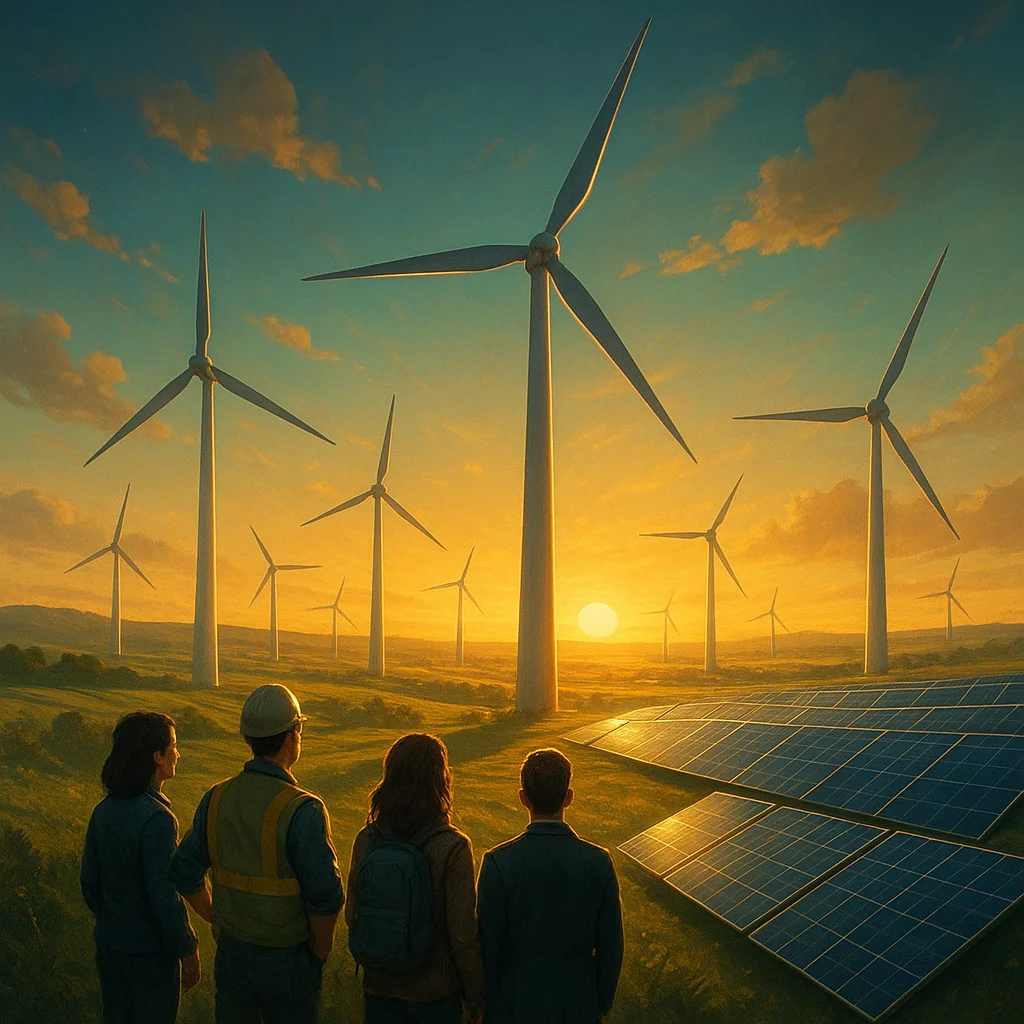
At sunrise in the Gulf, the contrast is becoming impossible to ignore. On one side, oil terminals still move millions of barrels, and giants like Aramco remain central to regional prosperity. On the other, solar parks spread across desert land, battery projects are moving from pilot stage to commercial scale, and electric mobility is changing how power systems are planned. For investors, this is not a symbolic shift. It is a capital reallocation story, and a very large one.
According to the International Energy Agency, global clean energy investment has been running far above fossil fuel supply investment in recent years, and the gap has widened as solar, grids, storage, and electrification attract more funding. BloombergNEF has also repeatedly shown that energy transition financing is no longer a niche category reserved for climate specialists. It is becoming core infrastructure, core industrial policy, and, in some markets, core national security strategy. That matters greatly for Middle East investors, because the region is not standing outside this transition. It is trying to shape it.
From Riyadh, the question is not whether renewable energy creates opportunities. The question is where the best risk-adjusted opportunities now sit, and which parts of the value chain can still deliver attractive returns after years of enthusiasm, policy shifts, and supply-chain volatility. Readers looking for a broader market map may also compare this analysis with Complete Guide to Renewable Energy Investment Opportunities and Unlocking Renewable Energy Investment Opportunities Across Global Markets, both useful for framing the global spread of sectors and geographies.
Renewable energy investing is no longer only about owning a wind farm or buying a solar stock. The real story now is integration: power generation, storage, grids, materials, software, and transport electrification moving together.
That integration is where many investors still make mistakes. They chase the most visible assets, often utility-scale solar, while missing the enabling systems that make renewable penetration bankable and profitable. The deeper opportunities sit inside the plumbing of transition, not only the headline projects. This article examines those layers, with a focus on what has changed by 2026, where capital is flowing, and how investors in clean energy and electric mobility can think more clearly, inshallah, about the next phase.
Why the opportunity set is broader than many investors assume
For years, renewable energy investing was discussed in a narrow way. People thought first about solar farms, wind turbines, and perhaps a few listed developers. That frame is now outdated. A functioning low-carbon power system needs generation, yes, but it also needs transmission expansion, balancing capacity, battery storage, demand-response systems, charging networks, critical minerals, power electronics, and industrial customers willing to sign long-term contracts. Each layer creates a separate investment thesis, with different cash-flow profiles and different policy exposure.
Consider solar alone. Module prices have moved sharply over the past decade, making generation more affordable, but lower equipment costs do not automatically mean easier returns for investors. In many markets, the margin has shifted downstream, toward developers with strong land positions, utilities with grid access, and service providers that manage interconnection and optimization. In other words, cheap panels are only one piece. The project economics depend on contract structures, curtailment risk, local content rules, financing costs, and transmission timing.
The electric vehicle sector expands this opportunity set further. EV adoption increases electricity demand, but more importantly it changes load patterns. That creates value for smart charging, fleet depots, software orchestration, and eventually vehicle-to-grid services where regulations permit. Investors who understand EV infrastructure are often better positioned to understand renewable power monetization, because both sectors depend on the same question: when is electricity available, where, and at what price?
MoneyWeek made a useful point in its feature on the investment opportunities at the heart of the energy transition. The article emphasized that materials and commodities are central to transition economics, not peripheral. That is correct. Copper, lithium, nickel, rare earth elements, and high-grade aluminum all matter because they sit upstream of deployment. When investors focus only on project developers, they may miss the industrial bottlenecks that decide who can build on time and at acceptable cost.
- Generation assets: solar, wind, hydro, geothermal, waste-to-energy
- Enabling infrastructure: grids, transformers, substations, inverters, interconnectors
- Flexibility tools: batteries, pumped hydro, thermal storage, demand response
- Electrification demand: EV charging, heat pumps, green industrial loads
- Upstream inputs: metals, chemicals, wafers, cables, power semiconductors
This broader lens matters especially in the Middle East, where governments are trying to localize manufacturing and capture more value beyond exporting raw energy. Saudi Vision 2030 has pushed this thinking across multiple sectors. Renewable investment is therefore not only a decarbonization story. It is an industrial diversification story, a jobs story, and for some states, a water and resilience story as well.
The economics that now separate strong projects from weak ones
Capital has become more selective. That is one of the clearest changes visible by 2026. During the low-rate years, many renewable projects looked attractive simply because financing was cheap and growth expectations were high. After a period of inflation pressure, supply-chain disruption, and higher financing costs, investors are asking harder questions about contract quality, merchant exposure, and execution capability. This is healthy. It means weak projects are less likely to hide behind fashionable language.
The first filter is cost of capital. Renewable projects are infrastructure-like, so valuation is highly sensitive to interest rates and debt pricing. A utility-scale solar project with a long-term power purchase agreement can still be attractive, but only if the tariff reflects current financing conditions and local risk. Markets that still assume old pricing benchmarks may see delayed tenders, renegotiated contracts, or lower bid appetite. This has happened in several countries as developers became more disciplined.
The second filter is grid reality. Many markets have approved renewable capacity much faster than they expanded transmission. The result is curtailment, delayed connections, and congestion pricing. Investors who ignore this can overestimate revenue. Grid bottlenecks are not a side issue anymore. They are central to asset performance. In some cases, the better opportunity is not another generation project, but the company supplying transformers, high-voltage equipment, or digital grid management.
Third comes offtake quality. Corporate PPAs have become more common, especially from data centers, industrial users, and large commercial buyers seeking predictable electricity costs. Yet not all counterparties are equal. A long contract with a weak buyer may be less valuable than a shorter contract with a stronger balance sheet and flexible pricing escalators. The sophistication of the contract matters as much as the headline tariff.
The renewable asset that wins in 2026 is not always the one with the lowest levelized cost. It is often the one with the best grid access, the best contract structure, and the best ability to deliver power when the market needs it.
Battery storage has become the best example of this shift. A few years ago, many investors treated batteries as an add-on to solar. Now storage is increasingly a standalone investment category. Revenue can come from capacity markets, ancillary services, arbitrage, and grid support, depending on the country. But the complexity is higher. Investors need to understand degradation assumptions, augmentation costs, software controls, and local market rules. This is why some of the strongest returns may go not to the battery manufacturer, but to the platform operator or project owner who knows how to stack revenues intelligently.
- Check interconnection status before headline return targets.
- Stress-test debt assumptions under higher-rate scenarios.
- Review curtailment exposure and local congestion history.
- Assess offtaker credit quality, not just contract length.
- Model storage and flexibility value where renewable penetration is rising fast.
Investors who want a comparative 2026 snapshot can also review Renewable Energy Investment Opportunities in 2026: A Comprehensive Analysis, which complements this article with a wider survey of categories.
What changed recently: 2026 trends shaping capital flows
Three developments stand out in 2026. First, grids have moved to the center of the discussion. For years, generation dominated headlines because it was visible and politically attractive. Now policymakers and investors increasingly recognize that transmission, distribution modernization, and system flexibility are the true rate limiters. Reuters and the IEA have both highlighted the scale of global grid investment needed to support electrification and renewable integration. This is not glamorous, but it is investable, and in many cases it offers steadier returns than merchant generation.
Second, industrial policy is reshaping supply chains. The United States, Europe, China, India, and Gulf countries are all trying, in different ways, to secure domestic or allied manufacturing capacity for strategic clean-energy components. This creates opportunity, but also fragmentation. A solar or battery manufacturer may benefit from incentives in one market and face margin pressure in another. Investors need to distinguish between policy-supported volume growth and sustainable profitability. They are not same thing.
Third, emerging markets are becoming more important, but only for investors who can manage execution risk. Southeast Asia is a notable example. The China Briefing guide on investing in Indonesia's renewable energy sector explains the mix of policy ambition, resource potential, and practical market-entry considerations. Indonesia is interesting not only because of renewable demand, but because it also sits within broader mineral and industrial supply chains linked to battery manufacturing. For strategic investors, this kind of market offers layered exposure: power, processing, logistics, and downstream industry.
Meanwhile, the Gulf is becoming more assertive. Saudi Arabia, the UAE, and others are pushing major renewable tenders, green hydrogen plans, and manufacturing ambitions. The region has natural advantages in solar irradiation, available capital, and increasingly sophisticated project execution. Yet the strongest immediate opportunities may not be in hydrogen exports alone, where economics remain challenging, but in domestic power system build-out, desalination-linked clean power, industrial electrification, and EV infrastructure in urban corridors.
Another 2026 change is that corporate buyers are more mature. Large companies are no longer entering PPAs only for branding. They are using renewable procurement to lock in costs, satisfy export-market requirements, and support data-heavy operations. This strengthens long-duration demand for renewable projects with credible delivery schedules. It also creates more room for hybrid plants that combine solar, wind, and batteries into one contractable output profile.
- Grid equipment demand remains elevated as connection queues grow.
- Battery storage is gaining institutional capital as market rules improve.
- Emerging markets attract strategic investors where policy frameworks are maturing.
- Corporate PPAs are becoming more sophisticated and bankable.
- Localized manufacturing is rising, but margins vary sharply by segment.
For readers who prefer a ranked approach, Top 10 Renewable Energy Investment Opportunities in 2026 offers a useful companion read, especially when comparing technologies with different maturity levels.
Where the smartest investors are looking inside the value chain
If we move beyond the obvious, several categories deserve close attention. One is power electronics. Inverters, converters, and control systems are essential for solar plants, batteries, charging stations, and modern grids. These components may not receive public excitement, but they are indispensable and often benefit from recurring service revenue. Firms with strong software integration can defend margins better than pure hardware sellers.
A second category is transmission and grid services. Across many countries, transformer shortages and long lead times for grid equipment have become serious constraints. This creates opportunity for manufacturers, engineering firms, and specialized service providers. It also favors investors willing to back regulated utilities or infrastructure vehicles that earn returns from expanding and modernizing networks. The market is slowly admitting a simple truth: no energy transition happens without wires.
Third is storage, but with discipline. Battery projects in the right market can produce compelling returns, especially where renewable penetration is high and balancing services are well paid. Still, not every market offers transparent revenue stacking. Investors should prefer jurisdictions with clearer ancillary service design, stronger data transparency, and realistic assumptions about battery cycling and replacement schedules.
Fourth is EV charging infrastructure, especially fleet and commercial charging. Public charging gets attention because consumers see it, but depot charging for delivery fleets, buses, port vehicles, and corporate transport can offer better utilization and more predictable contracts. In Saudi Arabia and neighboring markets, fleet electrification is still early, but that is exactly why long-term infrastructure investors should watch it. As logistics, tourism, and urban development expand under Vision 2030, charging networks tied to commercial activity may become more attractive than scattered retail charging alone.
Fifth is industrial decarbonization infrastructure. This includes on-site solar, private wire arrangements, heat electrification, and energy management systems for factories and large facilities. Many industrial users care less about climate language and more about reliability, export competitiveness, and cost stability. Investors who can package these needs into bankable energy service models may find resilient demand.
Finally, there is selective exposure to materials. MoneyWeek was right to frame transition materials as central. But investors must be careful. Commodity exposure can be lucrative, yet it is cyclical, politically sensitive, and vulnerable to oversupply. The better strategy may be diversified exposure through producers with strong balance sheets, low-cost assets, or downstream integration, rather than chasing every exploration narrative attached to a battery metal.
Case studies: how opportunity looks in the Gulf and Asia
Saudi Arabia offers a useful case because it combines scale, capital, and policy direction. The kingdom has ambitious renewable targets, and utility-scale solar continues to attract attention because of world-class irradiation and large land availability. Yet the more interesting story for investors may be the ecosystem forming around those projects. Grid reinforcement, local manufacturing, industrial demand centers, and transport electrification all increase the value of each renewable megawatt installed. This is where traditional energy expertise can become an advantage. Companies that learned to finance, build, and operate large energy assets in hydrocarbons can adapt those capabilities to clean power and associated infrastructure.
The UAE presents a slightly different model, with strong international project development capabilities and a track record of investing abroad. Investors studying Gulf opportunities should note that regional champions are not only building domestic assets. They are also exporting capital and expertise into Africa, Central Asia, and Southeast Asia. That creates opportunities through co-investment, supply agreements, and engineering partnerships.
Indonesia, as discussed by China Briefing, is compelling for different reasons. It has large renewable potential, rising electricity demand, and strategic relevance to battery supply chains. But the market also requires patience. Regulatory complexity, local partnership needs, and infrastructure gaps can slow execution. This is why broad enthusiasm is not enough. Investors must match project type to local realities. Utility-scale renewables may work in one province, while industrial captive power or processing-linked energy solutions may work better in another.
India also deserves mention, even without linking, because it remains one of the most important renewable growth markets globally. Its scale in solar deployment, transmission investment, and clean manufacturing policy makes it difficult to ignore. Yet margins can be tight, and competition is intense. For foreign investors, the edge often comes from specialization, such as storage, grid tech, or niche industrial applications, rather than generic solar exposure.
Geography still matters. Renewable energy is a global theme, but returns are local, shaped by permits, land, currency, grids, and political consistency.
Across these case studies, one lesson repeats. The best opportunities usually appear where policy ambition meets practical execution capacity. Markets with only ambition may disappoint. Markets with only execution but weak demand may stagnate. Investors should seek both.
Risks that deserve more respect than they usually get
Renewable investing is often marketed as morally clear and structurally inevitable. That can make risk analysis too soft. In reality, this sector has many sharp edges. Policy risk remains high, especially where subsidy regimes are unstable or elections can reverse procurement rules. A project that looks excellent under one tariff framework may become mediocre under another. This is why diversified exposure across technologies and jurisdictions is wiser than overconcentration in a single incentive program.
Commodity volatility is another underappreciated threat. Falling module or battery prices can help developers, but they can also crush manufacturers. Rising metal prices can support miners while hurting equipment buyers. Investors need to know where in the chain they are taking risk. Saying one is bullish on the energy transition is not enough. One must specify whether the exposure is to commodity extraction, component manufacturing, project ownership, software, or regulated infrastructure.
Then there is execution risk. Delays in permits, land acquisition, transmission access, and equipment delivery can destroy internal rates of return even when long-term demand is strong. In emerging markets, currency risk adds another layer. Revenues may be local, while debt service or equipment costs are linked to dollars or euros. Hedging can help, but it is not free.
Technology risk should also be handled soberly. Not every new chemistry, hydrogen pathway, or carbon-related add-on will become commercial at scale. Investors should separate proven deployment technologies from aspirational ones. Solar, onshore wind, grid batteries, and charging infrastructure are already real asset classes. Some advanced fuels and long-duration storage concepts may become important, but they still require careful milestone-based investing rather than blind enthusiasm.
- Policy and tariff changes can reset project economics quickly.
- Grid delays can leave completed assets waiting for revenue.
- Currency mismatches can erode returns in emerging markets.
- Upstream commodity swings can distort margins across the chain.
- Technology hype can outrun commercial readiness.
A disciplined investor therefore asks a simple set of questions. Who pays? For how long? Under what regulation? Through which grid? With what replacement and maintenance assumptions? These questions sound basic, but they separate infrastructure thinking from trend chasing.
What to watch next and how to position capital
Looking ahead, I expect five themes to shape the next phase of renewable energy investment. First, the premium will rise for assets and companies that solve intermittency rather than merely adding generation. Storage, flexible demand, and grid optimization should continue gaining importance. Second, local manufacturing strategies in the Gulf and other growth regions will become more serious, especially where governments want industrial capability, not only imported equipment.
Third, EVs will matter more to renewable investors than many still assume. As electric fleets grow, charging demand becomes a new form of dispatchable load. That can improve economics for solar-plus-storage and for smart energy management systems. The connection between transport electrification and renewable monetization will become tighter, especially in cities building logistics, tourism, and public transit capacity.
Fourth, blended finance and public-private capital structures will remain important in emerging markets. Many excellent renewable opportunities exist outside OECD markets, but they need de-risking tools, patient capital, and strong local execution. Investors who understand this can enter before markets become crowded. Fifth, green hydrogen will continue attracting headlines, but near-term winners may be those who build the enabling power assets, water systems, and transmission lines, rather than those assuming immediate export-scale profitability.
For practical positioning, investors can think in layers rather than single bets:
- Core stability: regulated grids, contracted renewables, utility-scale storage in transparent markets
- Growth exposure: EV charging, industrial energy services, selected emerging-market developers
- Strategic optionality: transition materials, localized manufacturing, hydrogen-adjacent infrastructure
The most durable insight is this: renewable energy investment opportunities are now inside systems, not only inside assets. The investor who understands connections between power generation, mobility, grids, and industry will likely outperform the investor who buys only the most visible theme. For the Middle East, this is especially relevant. Our region already knows how to build energy at scale. The next challenge is to build integrated clean-energy value chains that support jobs, resilience, and competitive industry under Vision 2030. If that happens with discipline, not only with slogans, the opportunity is very large indeed.
And that is the hopeful part. The transition does not ask the region to abandon energy leadership. It asks the region to redefine it. For investors willing to study the details, that redefinition is where the best opportunities are hiding.






























Sign in to leave a comment.