

Pre-delivery inspection is the last quality checkpoint before a vehicle or piece of equipment reaches the customer. Done well, it catches defects that would otherwise generate early warranty claims, customer complaints, and the reputational damage that comes with a customer who received a machine that was not ready for delivery. Done poorly or done on paper, it generates a record that no one else in the dealer network can access when it would actually be useful.
The problem most OEMs face with PDI is not that their dealers skip the inspection. The problem is that even when the inspection is performed thoroughly, the data from it stays trapped in the inspection itself. It does not flow into inventory management. It does not attach to the unit record in the DMS. It does not inform the warranty team when a claim arrives six months later for a condition that was present at delivery. The inspection happened, but the information it produced disappeared.
PDI software integration with a dealer management system is the solution to this problem. When PDI data is connected to the DMS in real time, the inspection record becomes part of the unit's permanent history, accessible to service, parts, warranty, and the OEM in the same way that any other transaction is accessible. This changes what PDI actually does for the dealer network.
| PDI software integration connects pre-delivery inspection data inspection checklists, defect records, photos, technician sign-offs, and customer handover confirmations to the dealer management system in real time, so that inspection results are immediately linked to the unit record and available across service, warranty, and inventory functions. |
Why Disconnected PDI Creates Downstream Problems
When PDI records exist only in paper or in a standalone inspection tool that does not connect to the DMS, several predictable problems follow.
Inventory Records That Do Not Reflect PDI Status
A vehicle that is currently in PDI, which means it is not ready for sale or handover, should be clearly flagged in the inventory management system as unavailable. If PDI and inventory are not connected, the unit may appear as available in the DMS when it is actually still in inspection, leading to sales staff promising delivery dates that cannot be met or allocating vehicles that still have open defects.
Conversely, when a PDI is completed and the unit is cleared for handover, that status change should automatically update inventory availability. Waiting for a manual update from the inspection team to the inventory system, typically through a notification, a phone call, or an end-of-day report, introduces delays that affect both sales throughput and customer handover scheduling.
Warranty Claims Without PDI Context
When a vehicle arrives for a warranty repair six or twelve months after delivery, the technician creating the work order should be able to see the PDI record for that unit. Was this condition noted at delivery and resolved? Was there a related condition documented at PDI that was not flagged as a defect but is now showing as a failure? Was the configuration as delivered different from what the customer believes they received?
Without PDI-to-DMS integration, none of this context is available at the service desk. The warranty claim is processed based on the current presentation of the problem, with no ability to reference the unit's condition at delivery. For OEMs, this creates legitimate disputes about whether a claimed failure was pre-existing at delivery, disputes that are difficult to resolve without a contemporaneous inspection record.
Defect Patterns That Never Get Analyzed
Individual PDI defects recorded on paper or in a standalone system are invisible to OEM quality management. If a particular connector is consistently flagged at PDI across a production batch, that pattern is a quality signal worth investigating. If a specific model consistently generates paint defects at delivery, that is a shipping or handling problem with a measurable scope.
When PDI data flows into the DMS and from there into OEM reporting, these patterns become visible. The data that was previously locked inside individual inspection reports becomes aggregated quality intelligence that can inform engineering, manufacturing, and logistics decisions before the defects generate warranty claims at scale.
What PDI-DMS Integration Actually Looks Like
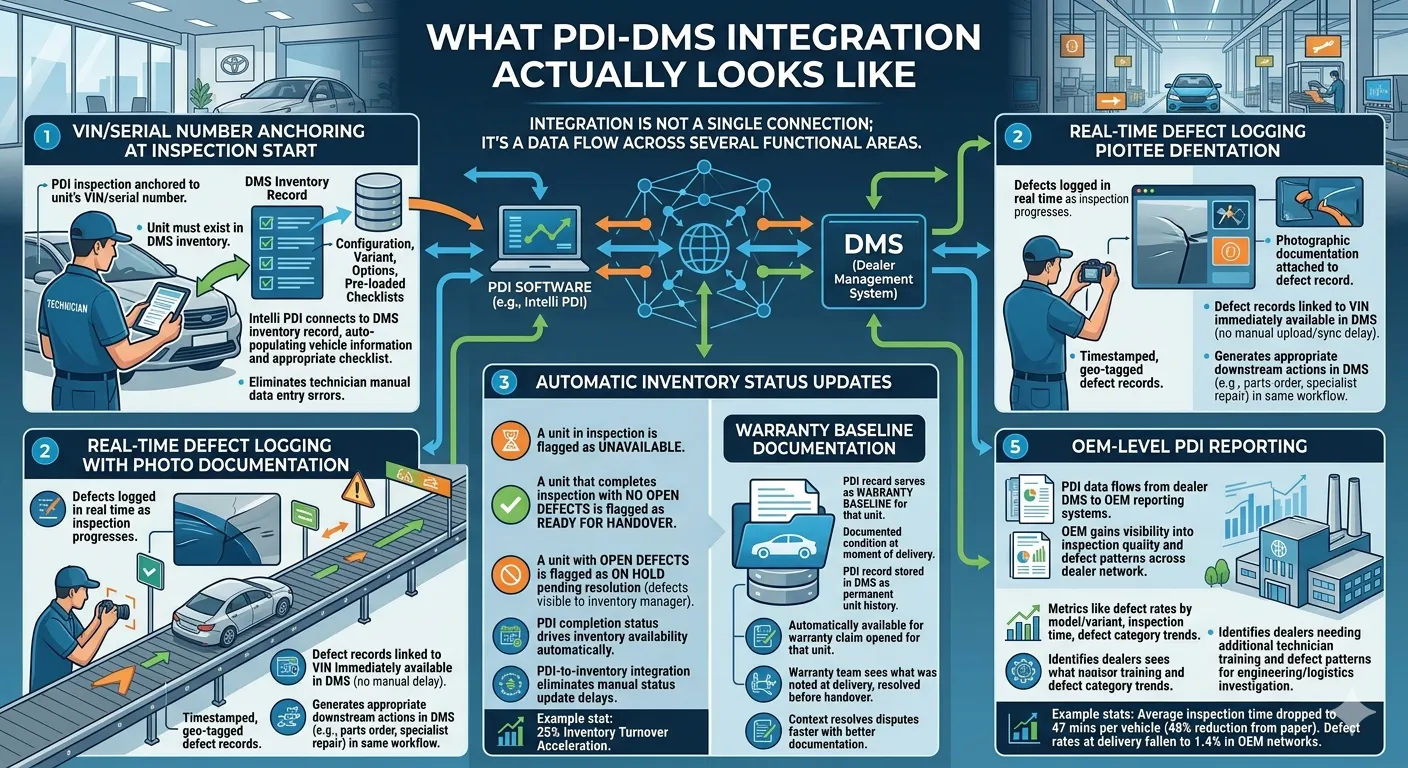
Integration between PDI software and a DMS is not a single connection it is a data flow that runs in multiple directions across several functional areas.
VIN/Serial Number Anchoring at Inspection Start
When a technician begins a PDI, the inspection should be anchored to the unit's VIN or serial number from the start. This means the unit must already exist in the DMS inventory record before the inspection begins, and the PDI tool must pull the unit's configuration data model, variant, options, and pre-loaded checklists from the DMS rather than requiring manual entry.
Intelli PDI connects to the DMS inventory record at the start of every inspection, auto-populating vehicle information and presenting the appropriate inspection checklist for that specific unit configuration. This eliminates the data entry errors that occur when technicians manually enter unit details into standalone inspection tools.
Real-Time Defect Logging with Photo Documentation
PDI defects should be logged in real time as the inspection progresses, with photographic documentation attached to each defect record. This creates a timestamped, geo-tagged defect record that is much more defensible as documentation than a paper checklist completed at the end of the inspection.
When defect records are captured digitally and linked to the VIN in real time, they are available in the DMS immediately, not after a manual upload or end-of-day sync. This means that a defect requiring a parts order or a specialist repair generates the appropriate downstream action in the DMS in the same workflow as the inspection itself.
Automatic Inventory Status Updates
PDI completion status should drive inventory availability automatically. A unit in inspection is flagged as unavailable. A unit that completes inspection with no open defects is flagged as ready for handover. A unit with open defects is flagged as on hold pending resolution, with the specific defects and their resolution status visible to the inventory manager without a separate conversation with the inspection team.
Intelli PDI implementations have shown inventory turnover acceleration of 25% when PDI-to-inventory integration eliminates the manual status update delays that typically sit between inspection completion and inventory availability confirmation.
Warranty Baseline Documentation
Every PDI record serves as the warranty baseline for that unit, the documented condition at the moment of delivery, before the customer takes possession. This baseline is the reference point for any future warranty dispute about whether a condition was pre-existing at delivery.
When the PDI record is stored in the DMS as part of the unit's permanent history, this baseline is automatically available when a warranty claim is opened for that unit. The warranty team can see what was noted at delivery, what was resolved before handover, and what condition the vehicle was in when it left the dealership. This context does not eliminate disputes, but it resolves them much faster and with much better documentation.
OEM-Level PDI Reporting
When PDI data flows from the dealer DMS to OEM reporting systems, the OEM gains visibility into inspection quality and defect patterns across the entire dealer network. This includes defect rates by model and variant, inspection completion time by dealer and technician, defect category trends by production batch or delivery period, and compliance with PDI checklist requirements.
Inspection times have dropped to an average of 47 minutes per vehicle, a 48% reduction from paper-based processes, and defect rates at delivery have fallen to 1.4% in OEM dealer networks using integrated digital PDI. The OEM visibility this creates is a significant tool for identifying which dealers need additional technician training and which defect patterns require engineering or logistics investigation.
Integration Requirements: What to Verify Before Implementation
Not all PDI-DMS integrations are equivalent. Before implementing, verify the following.
Bidirectional Data Flow
True integration means data flows in both directions: from the DMS to the PDI tool (unit configuration, checklist templates, technician assignments) and from the PDI tool to the DMS (inspection results, defect records, photos, completion status, inventory updates). Integrations that only push PDI results to the DMS without pulling configuration data from it require manual setup for each unit, which introduces errors and delays.
Offline Functionality
Dealerships and inspection areas do not always have reliable internet connectivity, particularly in developing markets or for PDI conducted at a port or at a transport yard rather than at the dealership facility. PDI software must be capable of capturing the full inspection offline and syncing to the DMS when connectivity is restored without data loss or the need to restart the inspection.
Intelli PDI includes offline functionality as a core capability, not an optional add-on, because connectivity limitations in real dealer environments would otherwise make mobile-based PDI unreliable precisely where digital capture is most valuable.
Configurable Checklists by Model and Market
The inspection requirements for a commercial truck delivered in Germany differ from those for an agricultural machine delivered in India, with different regulatory requirements, different market-specific quality standards, and different checklist items. The PDI system must support configurable checklists by model, variant, and market, with OEM-defined mandatory items and dealer-defined supplementary checks.
ERP Integration for Parts and Repair Orders
When a PDI defect requires a parts order or a repair work order before the unit can be cleared for delivery, that action should flow directly from the inspection tool into the ERP or DMS, not through a manual handoff. This requires integration between the PDI system and the parts ordering and work order management functions of the DMS, not just with the unit inventory record.
| Digital PDI integration with the DMS reduces inspection time by 48%, lowers delivery defect rates to 1.4%, and accelerates inventory turnover by 25%. These outcomes come from eliminating manual data entry, removing the delay between inspection completion and inventory status updates, and making PDI records immediately available across service and warranty functions. |
See how Intelli PDI integrates with dealer management systems to improve inspection visibility, inventory accuracy, and warranty tracking. Book a free demo today.
FAQ: PDI Software and DMS Integration
What is PDI in the automotive industry?
PDI stands for pre-delivery inspection. It is the quality check performed on a vehicle or piece of equipment before it is handed over to the customer, typically covering mechanical condition, electrical systems, cosmetic condition, fluid levels, software version, and configuration verification against the customer's order. A properly documented PDI creates the baseline record of the unit's condition at delivery.
Why should PDI software integrate with the DMS?
PDI software should integrate with the DMS because the inspection data it produces is useful across multiple dealer functions: inventory management (the unit's availability status), service (the unit's delivery condition as context for future repairs), and warranty (the baseline documentation for claims disputes). Without integration, PDI data is isolated in the inspection tool and cannot inform these downstream functions.
How does PDI integration reduce warranty claims?
PDI integration reduces warranty claims in two ways. First, it improves defect detection at delivery defects caught at PDI are resolved before the customer takes possession, rather than becoming warranty claims after delivery. Second, it provides a documented baseline that allows OEMs and dealers to distinguish pre-existing conditions from new failures, reducing fraudulent or disputed claims.
What is Intelli PDI?
Intelli PDI is Intellinet's pre-delivery inspection software for OEMs and dealer networks. It provides mobile-based digital inspection with offline functionality, configurable checklists by model and market, real-time DMS integration for inventory status and unit history, photographic defect documentation, and OEM-level reporting across the dealer network. Implementations have shown 48% reduction in inspection time and delivery defect rates falling to 1.4%.
Can PDI software work offline in dealer environments?
A well-designed PDI system should support full offline functionality, capturing the complete inspection, photos, and defect records locally on the device and syncing to the DMS when connectivity is restored. Environments where internet connectivity is intermittent, such as port facilities, rural dealerships, or large outdoor inspection yards, require offline capability for the PDI tool to be practically deployable.
How long does a PDI typically take with digital tools?
PDI inspection time varies by vehicle complexity, but digital PDI tools have reduced average inspection time to approximately 47 minutes per vehicle, a 48% reduction compared to paper-based processes. The time saving comes primarily from eliminating manual data entry, having the correct checklist automatically presented for each unit configuration, and not needing to transcribe paper inspection results into a separate system after completion.



























Sign in to leave a comment.