

Most OEMs manage their dealer networks with a persistent information lag. They know what happened last month because the monthly report came in. They know what happened last quarter because the audit is complete. What they do not know, until something goes wrong, is what is happening right now across 50, 100, or 200 dealer locations.
This lag is not acceptable when a service quality problem is developing at a dealer in a key market, when warranty costs from a specific location are trending significantly above the network average, or when parts inventory at multiple dealers is critically low on a high-velocity component. By the time the data arrives through the traditional reporting cycle, the problem has already compounded.
Real-time visibility across a dealer network is what a modern dealer management system (DMS) is supposed to provide. Many OEM networks are still operating on dealer DMS platforms that were designed for single-location management, not OEM-level aggregation. The gap between what these systems provide and what OEM aftermarket operations actually need is significant.
This blog is about what real-time dealer network visibility looks like in practice, what data it requires, and how a modern cloud DMS creates the operational picture that OEM service and aftermarket heads need to manage their networks proactively rather than reactively.
| What is dealer network visibility? Dealer network visibility is the OEM's ability to access real-time operational data across all dealers simultaneously, including service job status, parts inventory levels, warranty claim volumes, technician productivity, and customer satisfaction signals. Modern cloud DMS platforms provide this visibility through centralised dashboards that aggregate dealer data without requiring manual reporting cycles. |
The Cost of Operating Without Real-Time Visibility
Before getting into what real-time visibility provides, it is worth understanding concretely what the absence of it costs.
Delayed quality intervention: A dealer whose service quality is deteriorating, with rising repeat visit rates, increasing warranty claim rejection rates, and declining CSI scores, will not appear in an OEM monthly report until those problems have been developing for weeks. By the time the OEM identifies the issue and intervenes, the dealer may have delivered poor service to hundreds of customers. Real-time visibility would have surfaced the trend within days, when intervention is faster and cheaper.
Parts availability failures: When multiple dealers in the same region draw down stock on a high-velocity part simultaneously, a reactive restocking approach means some dealers run out before new stock arrives. For critical components, this means customer vehicles waiting for parts that should have been proactively replenished. Real-time inventory visibility across the network allows demand signals to reach the supply team before stock reaches zero.
Warranty cost escalation: A warranty cost problem that is visible in real time can be investigated immediately: is it one dealer overclaiming, a specific component failing at higher-than-expected rates, or a regional policy being misapplied? Without real-time visibility, these questions are answered retrospectively after high cost has accumulated.
Missed revenue opportunities: Dealers with high service bay utilisation who are turning customers away represent a constraint on aftermarket revenue. Dealers with low utilisation and idle technicians represent an underused resource. Neither is visible without operational data that is current enough to act on.
| A practical example: An OEM managing a 150-dealer network in three countries. One dealer begins systematically under documenting warranty claims to speed up submission. Without real-time visibility, this pattern goes undetected until the quarterly audit. With a DMS that tracks claim documentation completeness in real time, the pattern surfaces within a week, and the OEM can address it before it becomes a systemic problem. |
What Real-Time Visibility Actually Requires
Real-time dealer network visibility is not achieved by giving the OEM access to each dealer's DMS separately. That would mean an OEM managing 100 dealers having to log into 100 different systems, which is not visibility; it is manual data collection at scale.
True real-time visibility requires a single platform through which all dealer operational data is captured and aggregated. This is the architectural shift from on-premises DMS, where each dealer manages a local installation, to cloud DMS, where all dealers operate on a shared platform, and the OEM sees all dealer data in one place.
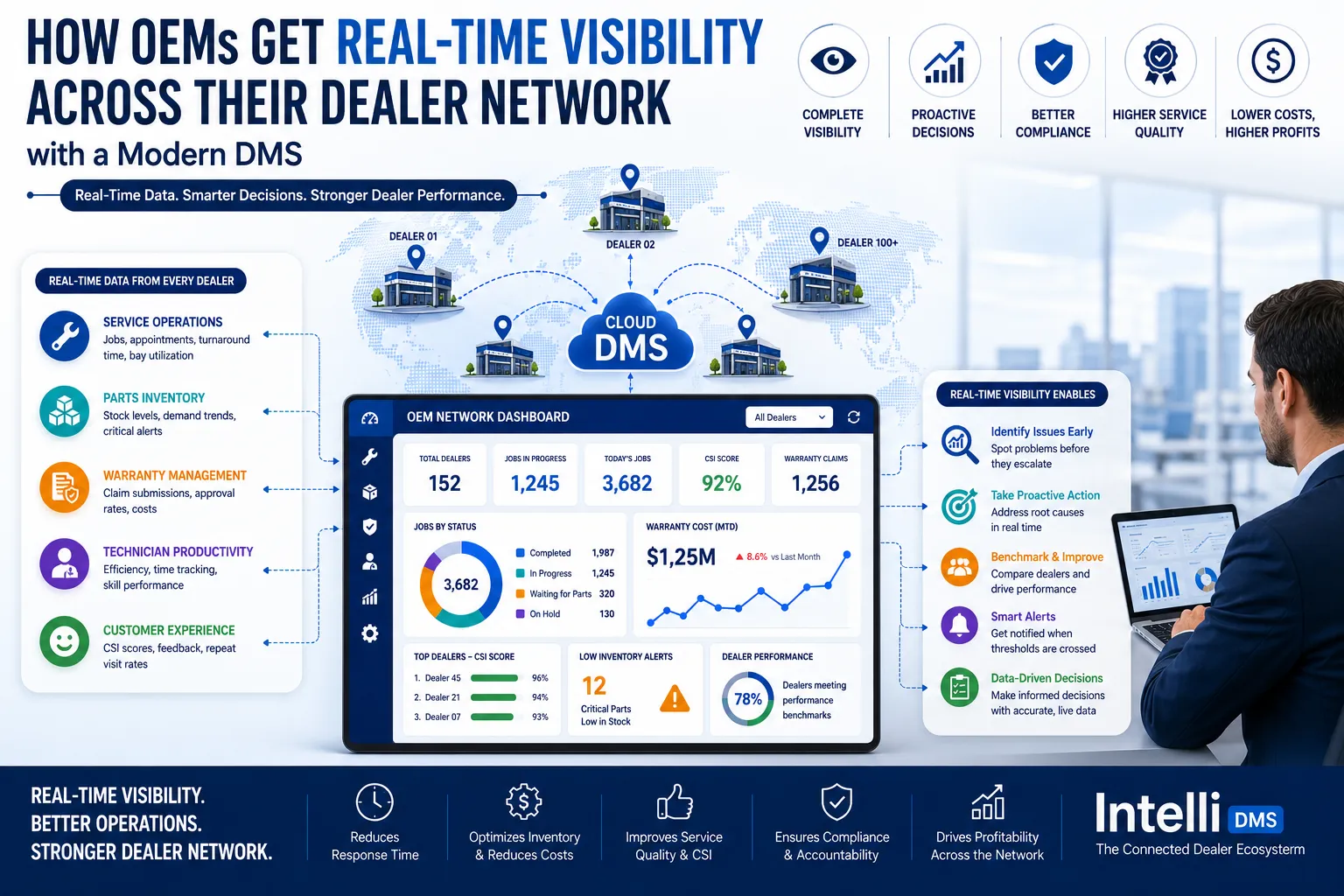
The data that needs to flow in real time from dealer operations to the OEM includes: active service job status (how many jobs are open, in progress, or waiting for parts), parts inventory levels by dealer and by part category, warranty claim submission rates and documentation quality, technician assignment and productivity data, and customer satisfaction signals where the DMS connects to post-service feedback systems.
What the OEM does with this data is equally important. Raw data across 100 dealers is overwhelming without the analytical layer that surfaces what matters. A modern DMS should provide configurable dashboards that let the OEM define which metrics they want to monitor at what thresholds, and alert them when those thresholds are crossed rather than requiring constant dashboard watching.
Six Operational Areas Where Real-Time DMS Visibility Changes How OEMs Work
1. Service Throughput and Capacity Management
A real-time view of service jobs across all dealers shows the OEM which dealers are at capacity, which have available throughput, and where customers are waiting longest. This data is actionable in several ways: redirecting overflow from high-utilisation dealers, identifying dealers that consistently underperform on job turnaround time, and informing decisions about expanding service capacity in specific markets.
Without this visibility, capacity management is driven by anecdote and periodic surveys. It is driven by current operational data.
2. Parts Inventory and Demand Planning
Real-time inventory visibility across all dealer locations gives the OEM's supply chain team the data to proactively manage stock. Dealers approaching zero stock on high-velocity parts trigger restocking. Dealers carrying excess stock on slow-moving parts flag for return or redistribution. Parts that are being ordered across multiple dealers simultaneously signal an emerging demand spike that may indicate a component issue or an upcoming maintenance cycle.
This level of proactive inventory management is only possible when inventory data from all dealers is current and aggregated. Dealers reporting inventory weekly or monthly create a lag that makes proactive management impossible.
3. Warranty Cost Monitoring
Warranty cost by dealer, by claim type, and by component can be tracked in real time as claims are submitted. Dealers whose average claim value exceeds the network average by more than a defined threshold surface automatically. Claim types with above-average approval rates indicate either a quality issue in the product or a process gap in the review workflow.
Real-time warranty monitoring moves the OEM from end-of-quarter surprise to week-by-week awareness. The financial impact is significant: catching a systemic overclaiming pattern in week two of a quarter costs a fraction of what it costs if discovered in the quarterly audit.
4. Technician Productivity and Training Needs
When all dealer job cards are on a common platform, technician productivity data is comparable across the network. Which technicians consistently take longer than the approved labour time on specific repair types? Which dealers have high rates of jobs requiring a return visit within 30 days? These patterns identify training needs with precision that a general training calendar cannot.
The OEM that can say 'technicians at dealers in Region X are consistently underperforming on transmission diagnostics based on DMS job card data' is targeting training investment far more effectively than one relying on manager feedback or periodic assessments.
5. Dealer Performance Benchmarking
Real-time data makes benchmarking meaningful because it is current. Dealers can be ranked by first-visit resolution rate, by average job turnaround time, by warranty documentation quality score, and by parts ordering accuracy. These rankings can be shared with dealers as part of a performance program, creating competitive pressure from within the network rather than relying solely on OEM-directed improvement initiatives.
Dealers who see their benchmarked position relative to the network average are more motivated to address performance gaps than those who receive a periodic summary report with no context.
6. Compliance and Audit Readiness
For OEMs in regulated industries or markets with specific dealer compliance requirements, real-time DMS data provides an ongoing compliance picture rather than a point-in-time audit snapshot. Which dealers are current on mandatory training certifications? Which have completed the required safety inspections? Which are operating within approved process parameters as defined by job card data?
An OEM that monitors compliance continuously is in a fundamentally different position from one that discovers compliance gaps during an annual audit.
| What is Intelli DMS? Intelli DMS is a cloud-based dealer management system built for OEM dealer networks that provides real-time visibility into service operations, parts inventory, warranty activity, and technician productivity across all connected dealers. OEM-level dashboards aggregate dealer data into network-wide views with configurable alerts, benchmarking tools, and drill-down capability to individual dealer and technician level. |
The Transition from Local to Cloud DMS: What the OEM Needs to Drive
The reality in most dealer networks is that dealers are not on a single DMS. Some are on the OEM-mandated system. Some are on a legacy local system they have used for years. Some are managing with spreadsheets. Getting to true real-time visibility requires getting all dealers onto a common platform, and that is an OEM-driven initiative, not something that happens organically.
OEMs that have successfully achieved full network DMS standardisation share a common approach: they treat the cloud DMS as an OEM program, not a dealer IT decision. The OEM defines the platform, funds or subsidises the implementation support, provides training, and sets a clear timeline for compliance. Dealers who adopt early are supported generously. Adoption is not optional.
This approach works because it is clear. Dealers know what is being asked, they know the timeline, and they know the OEM is invested in making the transition successful. Programs that leave the decision to individual dealers end up with mixed adoption that delivers incomplete visibility and no comparability across the network.
The business case for dealers is also straightforward when presented correctly. A modern cloud DMS is not worse than their current system. It is typically faster for job card management, better for parts ordering, and provides dealer-level analytics they do not currently have. The OEM visibility is a condition of the program, not a surveillance mechanism.
Get complete real-time visibility across your dealer network with Intelli DMS. Book a free demo to see how OEMs monitor service operations, inventory, warranty activity, and dealer performance from one cloud-based platform.
Frequently Asked Questions
What is real-time dealer network visibility and why do OEMs need it?
Real-time dealer network visibility is the OEM's ability to see current operational data across all dealers simultaneously, including service job status, parts inventory, warranty activity, and technician productivity. OEMs need it because the traditional approach of monthly and quarterly reporting creates information lags of weeks or months, during which service quality problems compound, parts run out, and warranty costs escalate before anyone at the OEM level knows there is an issue.
How does a cloud DMS provide real-time visibility to OEMs?
A cloud DMS hosts all dealer operational data on a shared platform, which means the OEM has access to all dealer data in real time without requiring dealers to generate reports or submit data manually. OEM-level dashboards aggregate this data into network-wide views, with the ability to filter by region, dealer, job type, or time period and drill down to individual dealer or technician data.
What data should an OEM be able to see in real time from their dealer network?
The most operationally critical data for real-time visibility includes: active service job volumes and status by dealer, parts inventory levels by dealer and component, warranty claim submission rates and documentation quality, technician productivity relative to labour time standards, and first-visit resolution rates by dealer. Secondary data that adds value includes dealer capacity utilisation, parts ordering patterns, and customer satisfaction signals where the DMS connects to feedback systems.
Can real-time DMS data be used for proactive parts supply chain management?
Yes. Real-time inventory data from all dealers in the network gives the OEM's supply chain team early signals of stock depletion before dealers run out. Parts being ordered at higher-than-normal rates across multiple dealers signal emerging demand that can be addressed proactively. This is significantly more effective than reactive restocking triggered by a dealer reporting zero stock.
How do you get dealers to adopt a new DMS when they are comfortable with existing systems?
The most effective approach is to treat the DMS as an OEM program rather than a dealer IT decision. The OEM selects the platform, provides implementation support, and sets a clear adoption timeline. Dealers who adopt early receive generous support. The business case is presented honestly: modern cloud DMS improves dealer operations as well as giving the OEM visibility. Framing it purely as OEM surveillance produces resistance; framing it as a shared operational improvement program produces cooperation.
What is the difference between a modern cloud DMS and an on-premise DMS?
An on-premise DMS is installed and managed at each dealer location, with data stored locally. The OEM cannot access dealer data directly and must rely on dealer-generated reports. A cloud DMS is hosted centrally, accessed via browser or app, and gives the OEM real-time access to all dealer data on a single platform. Process updates and configuration changes can be pushed to all dealers simultaneously rather than requiring individual dealer system updates.




























Sign in to leave a comment.