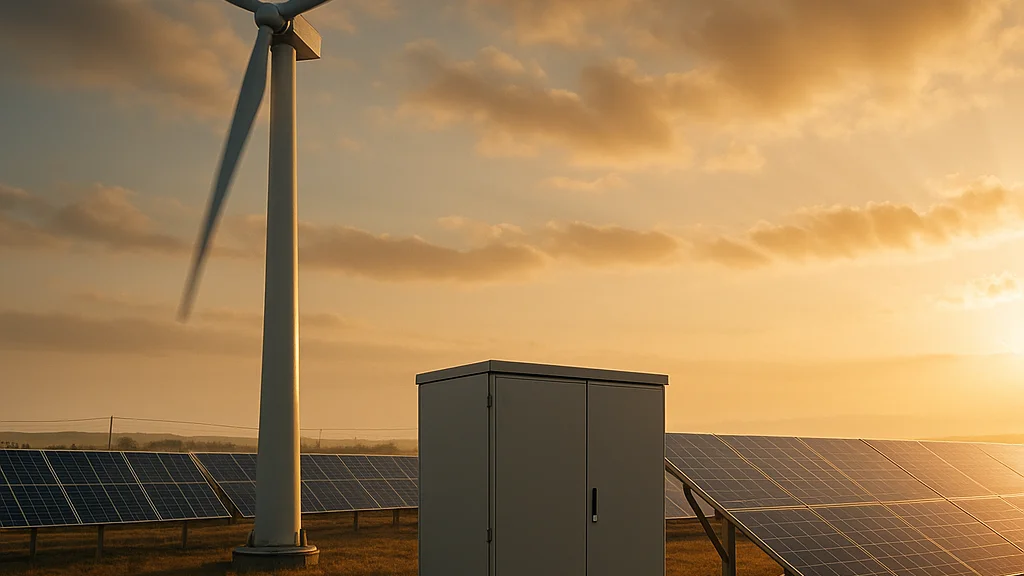

Just after sunrise, a utility dispatcher somewhere in South Asia is watching two curves move in opposite directions: solar output climbing fast, fossil generation easing back. A few hours later, a wind fleet on another continent will pick up as evening demand rises. That rhythm now defines the global power story more than many people realize. The debate is no longer whether wind and solar can scale. It is how quickly countries can remove the frictions that keep new capacity from connecting, producing, and earning stable returns.
The numbers behind that shift are becoming harder to ignore. According to pv magazine International, wind and solar dominated global power growth in 2025, a sign that clean generation is no longer a side story in electricity planning. Recharge also reported that solar beat wind for the first time ever after unprecedented growth, underscoring how rapidly solar manufacturing, deployment speed, and project economics have changed. For readers tracking the broader trend, WriteUpCafe has also followed the momentum in Wind and Solar Energy Capacity Growth Worldwide in 2026 and Global Surge in Wind and Solar Energy Capacity Fuels Clean Power Transition.
Still, capacity growth is not a simple race to install more panels and turbines. It is a systems challenge. Transmission queues, permitting delays, weak auction design, local opposition, supply-chain concentration, financing costs, and curtailment can all slow progress even when headline demand is strong. The countries moving fastest tend to be the ones treating wind and solar as infrastructure ecosystems, not isolated projects.
Capacity targets make headlines. Grid access, policy stability, and bankable revenue models decide whether those targets become steel in the ground.
For governments, utilities, developers, and investors, the practical question is what actually works. The best expert tips are not glamorous. They are disciplined, technical, and often administrative. Yet they are precisely what turns ambition into gigawatts. Here is where the global market stands in 2026, and what the most effective playbook for wind and solar expansion looks like now.
Start with the real bottleneck: grids, not generation
In many regions, wind and solar are no longer the slowest part of the build-out. Interconnection is. A solar farm can be developed in a fraction of the time it takes to secure a transmission upgrade, and an onshore wind project can spend years in a queue before a shovel touches the ground. That mismatch is one of the clearest lessons from the past five years. Expert tip number one is simple: if policymakers want faster capacity growth, they must treat grid planning as the lead project, not the follow-up.
This means building transmission proactively in high-resource zones rather than waiting for each project to justify each upgrade on its own. It also means modernizing grid operations with dynamic line ratings, advanced forecasting, and better regional coordination. In practice, countries that expand transfer capacity and shorten interconnection studies tend to unlock multiple projects at once. That is far more efficient than negotiating piecemeal fixes after queues become unmanageable.
Canada offers a useful cautionary example. CBC reported in its coverage of a major renewables report that the future of electricity is increasingly wind and solar, while Canada has been slower than some peers in translating that reality into faster deployment. The issue is not resource quality; Canada has plenty of wind corridors and strong solar potential in several provinces. The challenge is coordination across provinces, planning timelines, and grid expansion that matches the pace of project proposals.
Developers and regulators should focus on a short list of grid actions that repeatedly show results:
- Designate renewable energy zones where transmission is planned in advance.
- Standardize interconnection studies to reduce queue uncertainty and duplicative reviews.
- Invest in digital grid tools for forecasting wind and solar variability more accurately.
- Expand cross-border and interregional links so diverse weather patterns can balance each other.
- Pair new generation with storage where congestion and curtailment are already visible.
There is a gentle truth here that energy planners sometimes resist: generation alone does not create a power transition. Delivery does. If the wires are late, the clean electrons are stranded.
Policy quality matters more than policy volume
It is tempting for governments to announce a stack of incentives and assume the market will sort itself out. The evidence suggests otherwise. The most effective policy environments are not necessarily the most generous on paper; they are the most predictable. Investors can price risk. What they struggle with is policy whiplash, unclear permitting authority, retroactive contract changes, and auction rules that shift after bids are submitted.
One of the strongest expert tips for worldwide capacity growth is to simplify the investment case. That starts with long-term visibility. Multi-year procurement schedules help manufacturers, contractors, and lenders plan capacity. Stable offtake structures, whether through contracts for difference, feed-in frameworks, or well-designed auctions, reduce financing costs. Clear land-use rules and community benefit expectations lower conflict later in the process.
PolitiFact, in a fact-check about wind and solar’s role in the broader energy mix, noted that these sources still account for a relatively modest share of total global energy, even as they are growing quickly in power systems. You can read that context in its April 2026 review. That distinction matters. Electricity is only one part of total energy demand, which includes transport, heat, and industry. So if governments want wind and solar capacity growth to keep compounding, they need policy frameworks that support electrification as well as generation.
Strong policy design usually includes the following ingredients:
- Bankable procurement with transparent auction criteria and realistic delivery timelines.
- Permitting deadlines that force agencies to decide within set windows.
- Local benefit mechanisms such as tax sharing, lease payments, or community funds.
- Industrial strategy where appropriate, especially for grid equipment, towers, inverters, and storage.
- Demand-side electrification to absorb growing clean power output through EVs, heat pumps, and flexible industry loads.
Some of the world’s strongest markets learned this the hard way. A cheap bid is not the same as a viable project. Auction systems that push prices too low can create a pipeline of delayed or canceled capacity. Better to procure slightly higher-priced projects that actually connect than celebrate record-low bids that never survive inflation, supply-chain shifts, or financing stress.
The fastest-growing clean power markets are not always the ones with the loudest announcements. They are the ones where developers can model revenue, obtain permits, and trust the rules will still apply in three years.
Solar is moving faster, but wind still solves different problems
One of the more important recent developments is the widening difference in deployment speed between solar and wind. According to Recharge, solar overtook wind in global additions after exceptional expansion. That should not be read as a verdict against wind. It is a signal that the two technologies now play distinct strategic roles. Solar is often quicker to permit, modular to build, and easier to finance in many markets. Wind, especially onshore, can deliver stronger output profiles in colder months, overnight periods, and regions where solar production is less aligned with demand.
Expert tip number three is to stop treating wind and solar as interchangeable. Countries need a portfolio view. If planners optimize only for the fastest near-term additions, they can create systems with heavy midday solar surpluses and insufficient evening or winter coverage. Conversely, leaning too heavily on wind can expose systems to longer weather-driven lulls without enough complementary generation or storage.
The practical answer is co-optimization. Developers increasingly pair solar with batteries, and some utilities are designing portfolios where solar, wind, hydro, storage, and flexible gas or demand response each serve a defined reliability function. The best capacity growth strategies look beyond nameplate megawatts and focus on system value: when power is produced, where it is delivered, and how often it is curtailed.
There are several reasons solar has accelerated so sharply:
- Shorter construction timelines than many wind projects.
- Massive manufacturing scale, especially across Asia, which has pushed module availability higher.
- Modular project design that allows rapid expansion from rooftop to utility scale.
- Falling balance-of-system learning curves in mature markets.
- Growing compatibility with batteries for peak-shifting and grid services.
Wind retains major advantages of its own. Onshore wind often has higher capacity factors than solar in many markets, and offshore wind, while more capital intensive, can provide large volumes near coastal demand centers. The challenge in 2026 is not choosing a winner. It is building the market rules, transmission links, and storage stack that allow both to contribute at their best.
That distinction matters for electric vehicles and clean energy planning too. EV charging can become a flexible demand sink for midday solar, while stronger overnight wind can support lower-emission charging patterns after sunset. The smartest capacity growth plans increasingly connect renewable build-out to transport electrification rather than planning each sector in isolation.
Fix permitting with community trust, not just deadlines
Permitting is often described as a bureaucratic issue. In reality, it is just as much a social one. Projects slow down when communities feel surprised, dismissed, or asked to absorb visual, land-use, or wildlife impacts without meaningful benefit. Expert tip number four is to treat local acceptance as core infrastructure. A faster process that ignores trust can backfire into litigation, political backlash, and project redesign.
Developers with the best records tend to start earlier and listen more carefully. They map sensitive habitats before formal filings, adjust layouts around community concerns, and establish clear benefit-sharing mechanisms before opposition hardens. Governments can help by setting standardized consultation expectations and publishing transparent environmental review criteria. That reduces the sense that decisions are arbitrary or negotiated behind closed doors.
Wind often faces the sharper local challenge because turbines are taller, more visible, and sometimes linked to concerns around noise, birds, or landscape change. Solar can trigger land-use conflict as well, especially on agricultural land or near fast-growing suburbs. The lesson from successful markets is not that opposition disappears. It is that conflict becomes more manageable when benefits are tangible and the process is legible.
Useful approaches include:
- Offer community ownership stakes or revenue participation where law and financing structures allow.
- Prioritize brownfields, industrial land, and dual-use models such as agrivoltaics where feasible.
- Publish biodiversity and decommissioning plans early rather than as technical afterthoughts.
- Create local workforce pipelines through colleges, unions, and contractor training programs.
- Report expected tax and lease benefits clearly so residents understand the local upside.
There is also a communication lesson here. People do not respond warmly to being told their concerns are irrational. They respond better when developers explain trade-offs plainly, acknowledge uncertainties, and show how project design changed because of local input. Clean energy growth is faster when it feels participatory rather than imposed.
That may sound soft beside discussions of gigawatts and grid code. It is not. Social legitimacy is an operational asset. In a sector where delay can destroy project economics, trust has measurable value.
Capital costs, supply chains, and storage now define the winners
The renewable boom of the early 2020s taught investors one sobering lesson: headline demand does not protect projects from cost inflation. Turbine makers struggled with margins. Offshore wind developers in several markets sought contract revisions or delayed projects. Interest rates rose globally, changing the economics of capital-intensive infrastructure. By 2026, expert advice has become more financially disciplined. The winners are not simply those adding the most pipeline, but those structuring projects to survive volatility.
That starts with procurement realism. Developers should lock in critical equipment earlier where possible, diversify supplier exposure, and avoid bidding assumptions that leave no room for currency swings or logistics shocks. Policymakers can support this by indexing contracts appropriately, allowing limited rebidding under exceptional conditions, and building domestic or regional manufacturing where it makes economic sense. Not every country needs a full supply chain, but overconcentration carries obvious risk.
Storage has also moved from optional enhancement to strategic necessity in many markets. Batteries do not replace the need for transmission or dispatchable capacity, yet they increasingly improve the economics of solar-heavy systems by reducing curtailment and shifting output into higher-value hours. For wind, storage can help smooth ramps and provide ancillary services. The key point is that capacity growth should be measured in deliverable clean power, not just installed megawatts.
Investors and utilities should pressure-test projects against several variables:
- Interest-rate sensitivity over the construction and refinancing period.
- Curtailment risk based on local congestion and expected future build-out.
- Merchant price exposure if contracted revenues cover only part of output.
- Supply-chain concentration for modules, inverters, transformers, and turbine components.
- Storage economics including duration, cycling assumptions, and degradation.
According to Reuters reporting across recent years, one of the recurring themes in clean energy markets has been the tension between ambitious deployment targets and the practical cost of capital. That is not a reason for pessimism. It is a reminder that the next phase of wind and solar growth will be won through better structuring as much as better technology.
When I think about this from Calgary, where winter makes energy reliability feel deeply personal, the lesson lands quietly: affordable capital is climate infrastructure too. If financing is brittle, the transition slows even when the technology is ready.
What changed recently and what experts should watch next
The 2026 picture is sharper than it was even a year ago. Solar’s manufacturing scale and deployment speed have widened its lead in annual additions, while wind remains crucial for system balance, seasonal diversity, and large-scale generation in strong-resource regions. Reports cited by pv magazine International and Recharge suggest the center of gravity in new power additions has moved decisively toward wind and solar, even though total global energy use still includes much larger fossil components. That gap between electricity progress and broader energy transition remains one of the defining tensions of the moment.
Several changes stand out. First, grid congestion has become impossible to ignore. Second, storage is being planned earlier in project design, not bolted on later. Third, industrial policy is shaping supply chains more visibly, from local content debates to transformer and cable shortages. Fourth, the clean power conversation is increasingly linked to EV charging, data centers, hydrogen ambitions, and industrial electrification. Demand growth is coming from new places, and that can either strengthen the case for more renewables or expose planning failures if grids lag behind.
For the next few years, the most important indicators to watch are not only annual installation totals. They include:
- Interconnection queue reform and average time to connect new projects.
- Transmission build rates in major renewable corridors.
- Battery deployment growth relative to solar additions.
- Offtake quality as corporate PPAs, utility contracts, and state procurement evolve.
- Policy durability after elections, fiscal tightening, or trade disputes.
My broadest expert tip is this: plan for integration, not just installation. Countries that connect renewable growth to grids, storage, transport electrification, local trust, and industrial demand will keep pulling ahead. Those that chase megawatt headlines without fixing bottlenecks will find themselves with crowded queues, curtailment, and disappointed investors.
Wind and solar capacity growth worldwide is no longer a niche subject for engineers and climate specialists. It is becoming the operating logic of modern power systems. The work ahead is technical, political, and very human. It asks for patience in one place, urgency in another, and a willingness to build institutions as carefully as hardware.
If you are a policymaker, make the rules stable. If you are a developer, earn trust early. If you are an investor, reward projects designed for real system value, not vanity metrics. And if you are simply trying to understand where the energy world is heading, keep your eye on the wires, the batteries, and the communities near the projects. That is where the future tends to reveal itself first.
I hope this leaves you a little clearer and a little steadier. Pour a tea, call someone you love, and keep going.































Sign in to leave a comment.