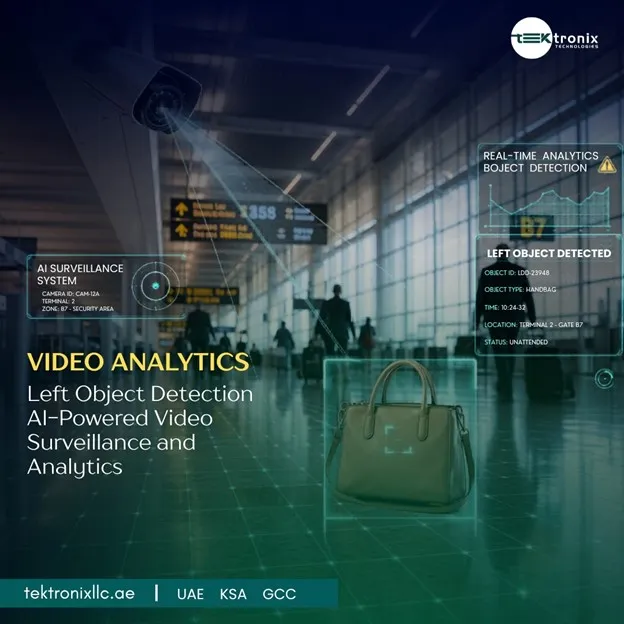

Video Analytics purpose-built for left object detection gives UAE security operators a continuously vigilant layer of protection that human CCTV monitoring simply cannot sustain — scanning every camera feed across a facility, around the clock, for items abandoned in places they should not be. From the platforms of RTA Dubai Metro to the concourses of UAE international airports, the exhibition halls of Dubai World Trade Centre, and the public lobbies of government buildings, an unattended bag or package left beyond a defined time threshold is treated as a potential threat that demands immediate, evidence-backed investigation.
Tektronix LLC, a SIRA-licensed security integrator with more than 500 surveillance and analytics deployments across the UAE and GCC, builds intelligent video analytics solutions for left object detection engineered specifically for the operational tempo and risk tolerance of UAE public and commercial environments.
Why UAE Security Teams Need an Intelligent Layer Beyond Human Monitoring
Security operations centres across the UAE typically allocate a small number of operators to monitor banks of CCTV feeds spanning dozens or even hundreds of cameras simultaneously. Academic studies on vigilance decrement consistently find that human attention to monitor screens degrades sharply after roughly 20 minutes of continuous observation — a limitation that no amount of operator training or shift discipline can fully overcome. In a UAE metro station, mall atrium, or airport concourse where camera counts routinely exceed 100 per facility, the mathematics of human-only monitoring make it statistically certain that some unattended objects will go unnoticed until a member of the public reports them — by which point the response window has already narrowed considerably.
AI-Powered Video Analytics closes this gap by giving every camera feed the equivalent of a dedicated, fatigue-free analyst whose sole task is watching for abandoned items. The system does not replace human security judgement — it ensures that human attention is directed precisely where and when it is needed, rather than spread thinly across feeds that, statistically, are quiet for the overwhelming majority of any shift.
The Detection Pipeline: From Pixel Change to Confirmed Threat
Real-Time Object Detection
Real-Time Object Detection forms the first stage of the pipeline, continuously comparing each incoming video frame against a dynamically maintained model of the expected scene background. As soon as a new physical object appears in the foreground and remains in a fixed position, the system flags it as a candidate for further analysis. This frame-level comparison runs at 25–30 frames per second, meaning a bag set down on a metro platform or mall corridor is registered by the system within a fraction of a second of being placed — well ahead of the 60–120 second window that most UAE security operating procedures define as the threshold for investigating an unattended item in high-consequence locations such as transport hubs and airport terminals.
Advanced AI Recognition
Advanced AI Recognition then classifies the candidate object using deep learning models trained to distinguish genuine items of concern — bags, suitcases, backpacks, boxes — from the everyday scene clutter and transient changes that simpler motion-detection systems routinely misclassify. A coat draped over a chair, a delivery trolley parked briefly by a loading bay, or a shadow cast as clouds pass over a sun-flooded atrium must all be correctly excluded, while a backpack quietly set against a pillar and left behind must be correctly flagged. This classification layer, trained on datasets reflecting the specific retail, transport, and public-building environments common across the UAE, is what separates a genuinely deployable system from one that floods operators with noise.
Prolonged Detection
Prolonged Detection introduces the temporal dimension that turns object presence into a meaningful security signal. Rather than alarming on any stationary item, the system times each newly detected object from the moment it first appears and only escalates to an alert if it remains in place — without its owner returning to retrieve it — beyond a configurable dwell period. Dwell thresholds are set per camera zone according to local risk and normal behaviour patterns: a tighter 30–60 second threshold at an airport departure lounge seating area, a more relaxed 120–180 second threshold in a shopping mall corridor where shoppers commonly set bags down briefly, and longer thresholds again for loading bays and back-of-house areas where equipment is routinely left in place as part of normal operations.
False Alarm Reduction
False Alarm Reduction is ultimately the metric that determines whether a left object detection system earns its place in a UAE security operation centre or is quietly switched off after a few weeks of nuisance alerts. Tektronix LLC achieves consistently low false alarm rates through a combination of AI-based object classification, configurable per-zone dwell thresholds, owner-return logic that automatically cancels a pending alert if the depositing individual returns within the dwell window, and a structured scene-learning period during commissioning that allows the system to adapt to each camera’s specific background — fixed furniture, signage, planters, and other permanent fixtures — before it goes live. Performance against a target false positive rate, typically fewer than two nuisance alerts per camera per 24-hour period in busy UAE public venues, is formally measured during site acceptance testing before handover.
Instant Alerts and Notifications
Instant Alerts and Notifications complete the pipeline by ensuring that a confirmed detection translates into an immediate, actionable response rather than a logged event that nobody reviews until the next shift. Tektronix LLC configures multi-channel alerting tailored to each client’s operational model: an automatic pop-up on the security operations centre video wall with the alarming camera brought to the foreground; simultaneous SMS or mobile push notification to the nearest patrolling officer with a snapshot of the object and its precise location; and, where the venue operates a digital radio network, an automated channel announcement. Alert routing rules differ by zone classification — a detection in an airside or government-restricted area can be configured to notify law enforcement liaison and venue management simultaneously, while a detection in a standard retail corridor routes only to the local security team.
Where Left Object Detection Delivers the Greatest Value in the UAE
• Transport and Transit Hubs: RTA Dubai Metro and bus interchange platforms, Abu Dhabi Integrated Transport Centre facilities, and airport landside and airside concourses, where high passenger volumes and tight dwell-time tolerances make automated detection operationally essential.
• Retail and Mixed-Use Developments: Major UAE shopping malls and mixed-use lobbies, where dwell thresholds and AI classification are calibrated through an extended scene-learning period covering normal trading-hour shopper behaviour to avoid disrupting the customer experience with unnecessary alerts.
• Government and Institutional Facilities: Federal and local government service halls, regulated financial free zone reception areas, and critical infrastructure visitor zones, where tighter dwell thresholds and dual-channel alert routing reflect the elevated security classification of the environment.
• Healthcare Facilities: Hospital emergency department waiting areas and outpatient registration halls regulated by Dubai Health Authority and Abu Dhabi Health Services, where unattended items in confined public spaces require prompt, discreet investigation that does not disturb the clinical environment.
National Coverage: Video Analytics UAE
Video Analytics UAE deployments for left object detection by Tektronix LLC cover all seven emirates — from large-scale transport hub and shopping mall installations in Dubai and Abu Dhabi to government facility and healthcare venue systems in Sharjah, Ras Al Khaimah, Fujairah, Ajman, and Umm Al Quwain. Our national field service infrastructure, in-country analytics server hardware, and 24/7 technical helpdesk ensure that every installation, regardless of emirate, receives the same implementation rigour and post-commissioning support standard. Modular system architecture means additional camera nodes can be added to an existing platform as a venue’s footprint grows, without requiring a redesign of the underlying analytics infrastructure.
Tektronix LLC: UAE Expertise in Intelligent Video Analytics
Tektronix LLC holds active SIRA licensure and maintains certified integration partnerships with Axis Communications, Hikvision, Genetec Security Center, Milestone XProtect, and Dahua — the platforms whose AI analytics engines power our left object detection deployments. Our engineering team has formal training in video analytics platform configuration, background-model calibration, and multi-channel alert system integration, backed by a UAE and GCC project portfolio exceeding 500 surveillance and analytics installations across transport, retail, government, and healthcare environments.
Our engineers bring direct, field-tested experience of the specific challenges that left object detection deployments face in the UAE: tuning background models for the extreme contrast between sun-flooded atria and shaded interior corridors common in Gulf architecture; calibrating owner-return logic for UAE shopping and transit behaviour patterns that differ meaningfully from the international datasets many off-the-shelf systems are trained on; and coordinating alert integration with RTA, Dubai Police, and Abu Dhabi Police command systems where formal interface agreements are required before go-live.
Security operations managers evaluating left object detection are invited to review our complete video analytics solutions for UAE facility and public space security and arrange a site assessment with our SIRA-licensed engineering team.
Conclusion
Left object detection at the speed and reliability that UAE public and commercial venues require is only achievable through Video Analytics engineered specifically for this purpose. AI-Powered Video Analytics gives every camera continuous vigilance; Real-Time Object Detection registers a newly placed item within a fraction of a second; Advanced AI Recognition filters out the scene clutter and transient changes that would otherwise overwhelm operators; Prolonged Detection confirms genuine abandonment against a configurable dwell threshold; False Alarm Reduction ensures every alert is one worth acting on; and Instant Alerts and Notifications put that intelligence directly in front of the right responder within seconds. Tektronix LLC delivers this complete pipeline across our Video Analytics UAE programme, serving transport authorities, retail operators, government bodies, and healthcare providers across all seven emirates.
Strengthen your venue’s security posture with intelligent, continuous monitoring — explore our video analytics solutions for left object detection in the UAE and request a no-obligation site assessment from our SIRA-licensed engineering team today.
FAQs
Q1. How does AI-Powered Video Analytics avoid raising an alert every time someone sets a bag down briefly?
AI-Powered Video Analytics resolves this through two combined mechanisms working together: deep learning classification that analyses whether the person who placed the object remains nearby or has left the scene, and a temporal dwell timer that only escalates to an alert once the object has been stationary beyond a configured threshold without its owner returning. A bag set down for a few seconds while someone checks their phone or ties a shoelace never approaches the dwell threshold and is never escalated, while an item left behind by someone who has clearly moved on triggers a confirmed alert once the threshold is breached.
Q2. What dwell thresholds does Tektronix LLC typically configure for Prolonged Detection in UAE venues?
Prolonged Detection thresholds are set per camera zone based on the specific risk profile of the location. Tektronix LLC’s standard UAE configurations include 30–60 seconds for airport airside zones and high-security government areas, 90–120 seconds for metro platforms and busy transit interchanges, 120–180 seconds for shopping mall corridors and food court areas, and 300 seconds or more for loading bays and back-of-house service corridors where equipment placement is a routine part of daily operations. Thresholds are validated during a structured observation period before go-live and can be adjusted remotely afterward without requiring an on-site visit.
Q3. How is Real-Time Object Detection calibrated to ignore permanent fixtures like bins and seating?
Real-Time Object Detection includes a scene-learning period, typically 24–72 hours of calibration footage, during which the system identifies and registers every permanently installed object already present in each camera’s field of view — waste bins, seating, signage stands, planters, and similar fixtures. These registered items are excluded from the detection workflow entirely, so the system only evaluates genuinely new objects that appear after calibration is complete. If a permanent fixture is legitimately moved or replaced, a brief re-learning cycle updates the background model automatically without generating false alarms.
Q4. Can Instant Alerts and Notifications be routed differently depending on the zone where an object is detected?
Instant Alerts and Notifications are configured with zone-specific routing rules rather than a single uniform alert path. A detection in an airside or government-restricted zone can be configured to notify law enforcement liaison contacts and venue security management simultaneously, while a detection in a standard retail or office corridor routes only to the nearest on-site security officer. Alert formats are similarly configurable, ranging from SOC video-wall pop-ups and mobile push notifications to automated digital radio channel announcements, depending on the communication infrastructure already in place at the venue.
Q5. How does Tektronix LLC measure False Alarm Reduction performance before handing a system over to a UAE client?
False Alarm Reduction performance is formally validated during site acceptance testing using a structured protocol that evaluates false positive rates across the actual conditions of the client’s venue — peak-hour pedestrian density, quiet off-peak periods, and the range of normal object-placement behaviours observed during the pre-deployment scene study. A target false positive rate, typically fewer than two nuisance alerts per camera per 24-hour period for busy UAE retail and transit environments, is documented in the project specification and measured against the actual test results. Where the target is not met, Tektronix LLC adjusts detection sensitivity and classification thresholds until the agreed performance level is achieved before the system is handed over for live operational use.
For more information contact us on:
Tektronix Technology Systems Dubai-Head Office
- 971 50 814 4086
Real-Time Object Detection
Video Analytics UAE
Advanced AI Recognition




























Sign in to leave a comment.