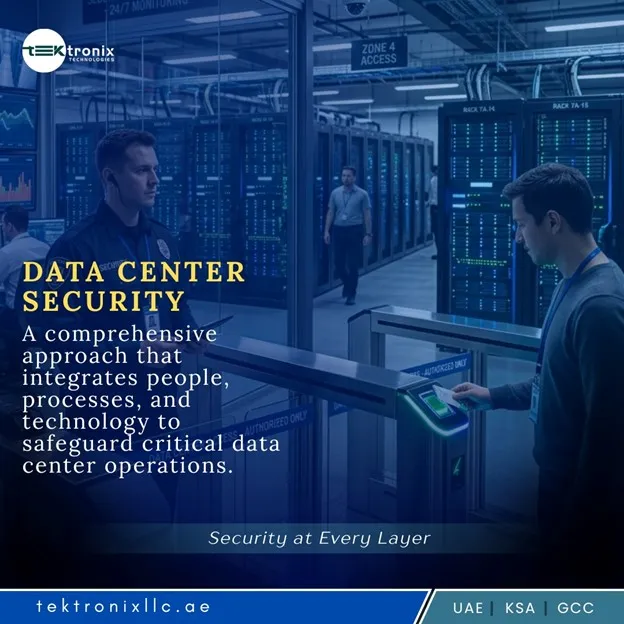

The UAE's data centre footprint is expanding at a pace that has no historical precedent — driven simultaneously by the AI compute boom, a wave of hyperscale cloud provider investment, edge computing deployment to support smart city initiatives, and the digital transformation of every sector from banking to healthcare. This unprecedented growth has fundamentally changed the risk calculus around Data Center Security: facilities that once stored routine business records now host AI training workloads worth hundreds of millions of dirhams, sovereign data with national security implications, and the real-time transaction infrastructure that the UAE's economy increasingly cannot function without for even a few hours.
Tektronix LLC, a SIRA-licensed, ISO 9001:2015 and ISO/IEC 27001:2022 certified integrator with over 500 UAE deployments since 2009, explains why Data Center Security UAE has moved from a routine IT budget line item to a board-level strategic priority — and what UAE organisations must do differently to keep pace with this transformed threat and value landscape.
The AI Compute Boom Has Changed What's Inside UAE Data Centers
The UAE's positioning as a regional AI hub — exemplified by G42's data centre investments, Microsoft's expanded UAE cloud region, and the National AI Strategy's compute infrastructure targets — means that UAE data centres increasingly house GPU clusters running AI training and inference workloads whose underlying models and training data represent some of the most commercially and strategically valuable digital assets in the region's history. A single GPU cluster theft, a successful exfiltration of proprietary training data, or a sabotage event disrupting a multi-week training run causes losses that dwarf the financial impact of a traditional enterprise data breach.
This shift in asset value fundamentally changes the calculation of what level of Cybersecurity for Data Center investment is justified. A facility protecting routine transactional data might reasonably accept a moderate residual risk to control costs; a facility housing proprietary AI infrastructure worth a material fraction of its parent organisation's market capitalisation cannot accept the same risk tolerance. Tektronix LLC's security architecture recommendations for AI infrastructure clients reflect this elevated asset value — applying the same rigour historically reserved for financial sector vaults and government classified facilities to commercial AI compute environments.
Data Center Encryption: Why 'Good Enough' Encryption No Longer Is
The cryptographic threat landscape has shifted meaningfully in the past several years. The advancing maturity of quantum computing research has prompted security architects globally to begin planning for post-quantum cryptographic migration, even though practical quantum decryption capability remains years away — because data encrypted today with current standards may still require confidentiality protection when quantum capability matures. Data Center Encryption architecture designed in 2025 must therefore account for cryptographic agility — the ability to migrate to post-quantum algorithms without a complete infrastructure replacement — alongside the current-generation AES-256 and HSM-based key management that remains the immediate practical standard.
Tektronix LLC designs encryption architectures with this forward path in mind: HSM platforms selected for current deployments are evaluated against their vendor's published post-quantum cryptography roadmap, ensuring that clients are not locked into hardware that cannot accommodate the algorithm transition that NIST's post-quantum cryptography standardisation process is actively driving across the global security industry. For UAE organisations protecting data with multi-decade confidentiality requirements — government records, long-term financial contracts, and intellectual property with extended commercial value — this forward-looking encryption strategy is no longer optional.
Data Center Firewalls: The Edge Computing Expansion Problem
The UAE's smart city and IoT initiatives are driving a proliferation of edge computing facilities — smaller, distributed data processing nodes positioned close to the data sources they serve, from smart traffic management systems to industrial IoT sensor networks. Each edge node represents a network perimeter requiring Data Center Firewalls protection, but at a scale and distribution that traditional centralised security operations models struggle to manage consistently. A UAE smart city deployment with 200 edge computing nodes across a metropolitan area creates 200 network perimeters, each a potential entry point if firewall policy consistency is not centrally enforced and continuously monitored.
Tektronix LLC addresses this through centrally managed, cloud-orchestrated firewall policy deployment — where security policy is defined once at a central management console and pushed consistently to every edge location, with configuration drift detection alerting when any individual node's firewall ruleset diverges from the approved baseline. This approach extends enterprise-grade firewall governance to distributed edge environments without requiring a dedicated security team at every physical location — a critical capability as UAE edge computing deployment accelerates beyond what manual, location-by-location security management can sustain.
Data Center Access Control: Protecting Assets Worth More Than the Building
When the GPU hardware inside a single data hall can be worth more than the building that contains it, Data Center Access Control must be evaluated against an asset value calculation that has shifted dramatically from historical norms. High-density AI compute racks concentrate enormous value in a small physical footprint — a single rack of current-generation AI accelerators can represent capital investment in the tens of millions of dirhams, creating a theft incentive structure that traditional data centre physical security, designed around the much lower per-rack asset density of conventional compute infrastructure, did not anticipate.
Tektronix LLC's access control recommendations for high-density AI compute environments include individual cabinet-level locking with independent audit logging — not merely data hall perimeter access control — biometric multi-factor authentication at every zone boundary, and two-person integrity rules for any physical hardware removal or maintenance access to GPU clusters. The cost of this elevated access control rigour is a small fraction of the asset value it protects, a calculation that justifies security investment levels that would have seemed disproportionate for traditional enterprise data centre deployments just a few years ago.
Data Center Surveillance and Intrusion Detection: Continuous Vigilance for Continuous Operations
UAE organisations increasingly operate data centre infrastructure that cannot tolerate any downtime — real-time payment processing, AI inference services supporting customer-facing applications, and government digital services that residents now expect to be available continuously. This operational reality elevates the importance of Data Center Surveillance and Data Center Intrusion Detection beyond their traditional security function into a business continuity assurance role — every camera and sensor not only documents security events but provides the early warning that prevents a developing physical issue from escalating into an unplanned outage.
Tektronix LLC designs surveillance and intrusion detection architectures with this dual security-and-continuity purpose explicit in the system design: thermal imaging cameras supplement standard CCTV to detect equipment overheating before it triggers a thermal shutdown, vibration sensors on cooling infrastructure detect the early signature of mechanical failure before it causes a cooling system outage, and door sensor analytics flag unusual access patterns that might indicate either a security event or an operational process deviation requiring investigation. This integrated approach reflects the reality that in 2025, physical security infrastructure and operational continuity infrastructure are converging into a single monitoring discipline.
Data Center Threat Detection: Why Yesterday's Threat Models Are Already Obsolete
The threat actor landscape targeting UAE data centre infrastructure has evolved as rapidly as the infrastructure itself. AI-assisted attack tooling now enables threat actors to develop and test novel attack techniques at a pace that signature-based Data Center Threat Detection cannot keep up with — by the time a new attack signature is catalogued and distributed, AI-assisted adversaries have often already moved on to a variant that evades the new signature. The defensive response must be equally AI-driven: behavioural analytics platforms that detect anomalous patterns regardless of whether they match any known signature are no longer a premium add-on but the baseline requirement for credible threat detection in 2025's threat landscape.
Tektronix LLC deploys threat detection architectures built around continuous behavioural baselining — UEBA platforms that learn the normal operational pattern of every administrator account, service account, and network segment, and that flag deviations immediately regardless of whether the deviation matches a previously documented attack pattern. This approach is the only credible defence against the AI-accelerated attack development cycle that UAE organisations now face, and represents a fundamental shift from the signature-matching threat detection model that was adequate even five years ago.
Data Center Security Dubai and Abu Dhabi: Where the Growth Is Concentrated
Data Center Security Dubai: Cloud Hyperscale and AI Compute Concentration
Dubai's data centre growth is concentrated in hyperscale cloud provider expansion and AI compute infrastructure, with Dubai Internet City, Dubai South, and emerging data centre clusters near DEWA's renewable energy infrastructure hosting the highest-density, highest-value compute deployments in the region. Data Center Security Dubai deployments by Tektronix LLC for this growth segment are designed from inception around the elevated asset value and continuous-operation requirements that hyperscale and AI infrastructure demand, with SIRA compliance integrated into the design process rather than retrofitted after construction.
Data Center Security Abu Dhabi: Sovereign AI and Government Digital Infrastructure
Abu Dhabi's data centre growth reflects the emirate's sovereign AI ambitions — G42's infrastructure investments and the broader push toward AI self-sufficiency — alongside continued expansion of government digital services hosting. Data Center Security Abu Dhabi deployments by Tektronix LLC for this growth segment incorporate the elevated physical security and threat detection rigour appropriate to sovereign AI infrastructure, designed in coordination with ADGICT requirements and NESA IA Standards applicable to nationally strategic digital infrastructure.
Conclusion
The UAE's data centre infrastructure in 2025 protects fundamentally different — and fundamentally more valuable — assets than it did even five years ago. Data Center Encryption must now plan for the post-quantum transition, Data Center Firewalls must secure distributed edge environments at a scale traditional models cannot manage, Data Center Access Control must reflect the concentrated asset value of high-density AI compute, and Data Center Threat Detection must counter AI-accelerated adversaries with AI-driven behavioural defence. Tektronix LLC designs every security architecture with this transformed landscape as the starting assumption, not an afterthought.
Contact Tektronix LLC today for a forward-looking security assessment of your Cybersecurity for Data Center infrastructure — and ensure your protection architecture matches the value of what it defends, today and as the UAE's digital infrastructure continues its unprecedented growth.
FAQs
Q1. Why does AI compute infrastructure require different security than traditional enterprise data centers?
AI compute infrastructure concentrates extraordinary capital value and intellectual property worth in a small physical footprint — a single rack of current-generation GPU accelerators can represent tens of millions of dirhams in hardware investment, alongside training data and model weights that may represent years of proprietary research and development investment. Traditional enterprise data centre security was designed around a lower asset-density assumption where the cost of breaching physical security typically exceeded the value an attacker could extract. AI infrastructure inverts this calculation in many scenarios, justifying security investment levels — individual cabinet locking, two-person integrity rules, enhanced surveillance, and elevated access control tiers — that would have been considered disproportionate for conventional enterprise compute environments just a few years ago. Tektronix LLC's security architecture recommendations are calibrated to this elevated asset value whenever AI compute infrastructure is part of the protected environment.
Q2. What is post-quantum cryptography, and should our organisation be planning for it now?
Post-quantum cryptography refers to encryption algorithms designed to remain secure against attacks from sufficiently advanced quantum computers, which could theoretically break current widely used algorithms such as RSA and elliptic curve cryptography. While practical quantum decryption capability is not yet available, the planning horizon matters because data encrypted today with current standards may need to remain confidential for years or decades — meaning data captured by an adversary today, even if not immediately decryptable, could become vulnerable once quantum capability matures, a risk often described as 'harvest now, decrypt later.' Organisations protecting data with long-term confidentiality requirements should begin evaluating cryptographic agility in their infrastructure now, ensuring that HSM and encryption platform investments can support algorithm migration without complete replacement when post-quantum standards mature. Tektronix LLC incorporates this forward-looking evaluation into encryption architecture recommendations for clients with extended data confidentiality requirements.
Q3. How can a centrally managed firewall policy actually improve security across dozens of distributed edge computing locations?
Centrally managed firewall policy addresses the configuration drift problem that inevitably emerges when dozens or hundreds of distributed locations are each managed independently — over time, individual locations accumulate undocumented exceptions, delayed updates, and inconsistent rule sets that collectively create a fragmented security posture with unpredictable gaps. Tektronix LLC's centrally orchestrated approach defines security policy once, pushes it consistently to every edge location through a cloud management platform, and continuously monitors every node for configuration drift from the approved baseline — generating an alert the moment any location's actual configuration diverges from policy, whether due to an unauthorised change, a failed update, or a local administrator's manual intervention. This transforms edge security management from a location-by-location manual process, which inevitably degrades in consistency at scale, into a centrally governed, continuously verified security posture across the entire distributed estate.
Q4. How does UEBA-based threat detection differ from traditional signature-based security monitoring?
Signature-based threat detection identifies attacks by matching observed activity against a database of known attack patterns — effective against previously documented threats but structurally incapable of detecting genuinely novel attack techniques until a signature has been developed and distributed, a process that may take days or weeks after a new technique first appears in the wild. User and Entity Behaviour Analytics (UEBA) takes a fundamentally different approach: it establishes a behavioural baseline for every user account, service account, and network segment, then flags any activity that deviates significantly from that baseline, regardless of whether the activity matches any known attack signature. An administrator account that suddenly accesses systems it has never touched before, at an unusual hour, from an unusual location, triggers a UEBA alert even if the specific actions taken match no documented attack pattern — providing detection capability against the novel, AI-assisted attack techniques that signature-based systems cannot recognise until they have already been used successfully elsewhere.
Q5. How does Tektronix LLC help organisations future-proof their data center security investment given how quickly the threat landscape changes?
Tektronix LLC addresses the future-proofing challenge through architectural choices that prioritise extensibility over point-in-time optimisation: selecting HSM and encryption platforms with published vendor roadmaps for emerging cryptographic standards, designing network segmentation architectures that can accommodate new firewall and threat detection technologies without complete redesign, and specifying physical security platforms — access control, surveillance, and intrusion detection — with open API architectures that allow new analytics and AI capabilities to be layered onto existing hardware investments as they mature. The Annual Maintenance Contract includes an annual security architecture review specifically assessing whether the deployed configuration remains appropriate given threat landscape evolution and any changes in the protected asset value, ensuring that security investment decisions made today remain defensible as the environment continues to change at the rapid pace the UAE's digital infrastructure growth demands.
For more information contact us on:
Tektronix Technology Systems Dubai-Head Office
+971 50 814 4086
Data Center Encryption
Data Center Firewalls






























Sign in to leave a comment.