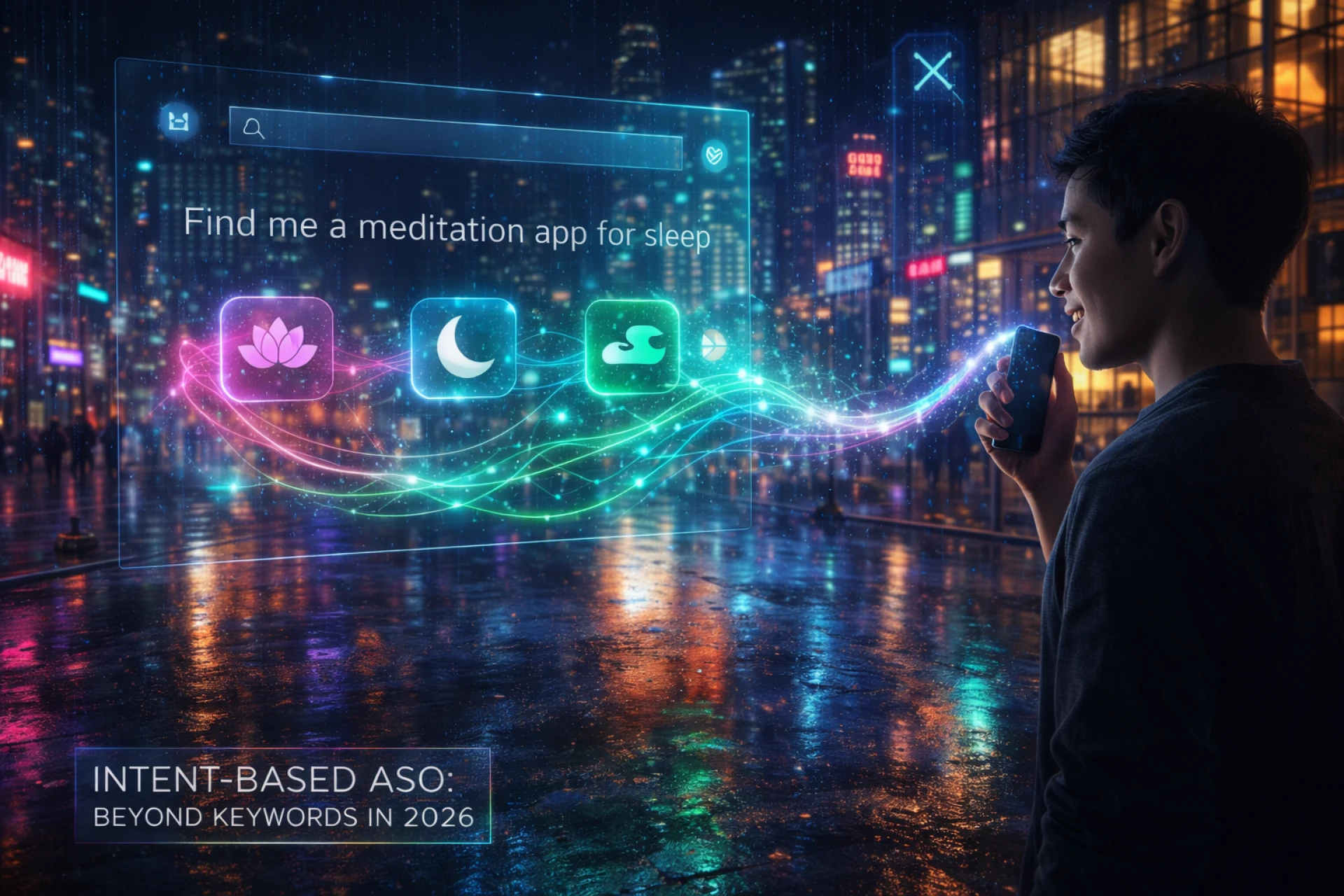

The era of "keyword stuffing" as a viable App Store Optimization (ASO) strategy officially ended with the summer algorithm updates of 2025. For a decade, developers treated the App Store and Google Play like basic databases, assuming that repeating a term enough times would guarantee a top spot. In 2026, the logic has shifted. Search engines inside the stores now operate as recommendation engines. They no longer just match strings of characters; they interpret why a user is searching and what they expect to accomplish.
If you are still managing your metadata by looking at individual keyword volume and difficulty alone, you are likely seeing your organic reach compress. The current store environments prioritize semantic relevance and intent-based clusters. This shift requires a fundamental change in how we approach visibility, moving away from "ranking for words" toward "answering for intent."
The 2026 Reality: AI-Mediated Discovery and Semantic Search
In 2026, app discovery is no longer a linear process of typing a word and scrolling a list. Apple Intelligence and Google’s Gemini-powered Play Store have introduced a layer of "discovery mediation."
On iOS 26, Siri with App Intents allows users to perform actions—like "find me a budget tracker that handles crypto"—without ever opening the App Store search bar. When they do use search, the algorithm now handles ambiguous queries by surfacing "intent diversity." An analysis of search behavior in early 2026 shows that for broad terms, the stores now split the top 10 results between 3 to 4 distinct user intents rather than giving all spots to the highest-authority apps for that exact word.
Google Play has followed a similar path with its "Organized with AI" sections. Instead of a flat list, users see categories like "Boost My Productivity" or "Secure My Data." This means your app is no longer just competing against other apps with the same name; it is competing for a slot within a machine-generated category that matches a specific human goal.
The Strategic Transition: From Word Matching to Intent Clustering
The transition to intent-based ASO requires moving away from the "long-tail keyword" obsession of 2023. Instead, successful developers in 2026 build semantic keyword clusters.
A semantic cluster is a group of terms that collectively define a specific use case. For example, instead of targeting "photo editor" as a primary term, a high-performing app in 2026 targets the "AI-driven professional retouching" intent. This cluster includes terms like "remove background," "skin smoothing," "lighting fix," and "object removal." The store algorithm sees these related terms in your metadata, reviews, and App Intents and classifies your app as the definitive answer for that specific intent.
Recent data from a study of 7,500 top-performing apps shows that the most successful listings stay lean. Filler words—like "the," "and," or "best"—appear in less than 3.2% of all top-ranking titles. These apps focus 100% of their character count on intent-signaling verbs: Track, Learn, Scan, Chat, or Edit.
The Failure of "Pure ASO" and the Rise of Synergy
One of the most observed patterns in 2026 is that "pure ASO"—optimizing metadata in a vacuum—is failing. Organic-only strategies have lost ground because the stores now use conversion data from all sources to validate your app's "meaning."
If you run an ad for "budgeting" but your app has low retention for that segment, the algorithm will eventually stop showing you organically for that term, regardless of how many times it is in your subtitle. The store assumes your app is a "poor answer" for that intent. For teams looking at mobile app development in Michigan, this means the development phase must involve mapping features directly to the search intents the marketing team plans to target. If the product does not solve the problem the keyword promises, the 2026 algorithm will identify the discrepancy through user behavior signals within weeks.
Authenticity Marker: The "Bacon" Algorithm Shift
A clear example of this shift occurred in a mid-2025 algorithm update. Previously, a search for an ambiguous term like "Bacon" in the US App Store might return a single popular game. Following the update, the results now consistently show a mix of intents: a game about bacon, a grocery delivery app (shopping intent), and a breakfast recipe app (cooking intent). This "Intent Diversity" means you can no longer monopolize a broad term just through high install volume; you must prove your app is the best representative for a specific type of user interest.
AI Tools and Resources
In the 2026 environment, traditional keyword tools are secondary to platforms that can map semantic relationships and monitor AI-driven discovery paths.
- AppTweak (Semantic Analysis Module): This tool identifies the "intent clusters" the store algorithm has associated with your app. It is useful for identifying where your metadata and user reviews are sending conflicting signals.
- MobileAction (Intent Discovery): Helps track how your app appears in "AI Mode" on Google Play. It shows which machine-generated categories (e.g., "Personal Intelligence") your app is currently qualifying for.
- Gemini 3 and Apple Intelligence Testing: Developers should use these AI assistants directly to see which apps they recommend for conversational queries. If an AI assistant does not "know" your app handles a specific task, your ASO is incomplete.
- Data.ai (Market Intelligence): Essential for monitoring the "remarketing" trends that now drive 29% of total app budgets. Use this to see if your competitors are using paid intent-targeting to steal your organic positions.
Practical Application: Building Your 2026 ASO Workflow
To move from keyword stuffing to intent-based answers, follow this four-week implementation cycle:
Week 1: Intent Audit
Analyze your current installs. Are users coming for your "brand" or a "problem"? Identify the top 3 intents your app solves. Do not look at words yet; look at the job your app does for the user.
Week 2: Cluster Construction
For each intent, gather 10-15 related terms. Use conversational queries found in "AI Mode" or Siri search logs. Avoid generic descriptors. Focus on verbs and outcomes.
Week 3: Metadata Refinement
Rewrite your App Title and Subtitle. Remove every filler word. Ensure the Title (Brand + Core Intent) is under 60 characters. If your app helps with "tax filing for freelancers," those four words must be the highest signal in your metadata.
Week 4: Review Mining and Validation
The 2026 algorithms read your reviews to confirm your intent. If you want to rank for "secure messaging," but your reviews only talk about "funny stickers," the algorithm will prioritize the "funny stickers" intent. Use your "What's New" section to encourage users to review specific features that align with your target intent.
Risks, Trade-offs, and Limitations
While intent-based ASO is the standard, it is not a silver bullet. The primary risk in 2026 is "Ranking Fragmentation." Because the stores surface diverse intents, you may find that your "Rank #1" spot for a high-volume term only results in 25% of the total clicks for that term, as the other 75% are diverted to different intent categories.
Furthermore, this system fails for apps that try to be "everything to everyone." A utility app that tries to rank for "gaming," "productivity," and "social" will likely be penalized for "Vague Positioning." The algorithm will struggle to categorize the app, leading to lower visibility in both organic search and AI-mediated recommendations.
Failure Scenario: The Generic Multi-Tool
We observed a 2025 case where a "Universal Business Tool" attempted to rank for 15 different intents (invoicing, scheduling, CRM, etc.). Despite a $50k monthly ASA budget, its organic visibility dropped by 40% after the "Semantic Clarity" update. The store algorithm could not confidently place it in any "Organized with AI" category. The app only recovered after the developers split the listing into three niche-specific apps with clear, singular intents.
Key Takeaways
- Verbs Rule 2026: Replace descriptive adjectives with intent-signaling verbs (Scan, Learn, Track).
- Stop Word Purge: Eliminate filler words from your title. Every character must signal a specific user goal.
- Intent Diversity: Understand that broad terms now share space between multiple user needs; aim for the #1 spot in a specific intent category rather than the #1 spot for a word.
- Review Alignment: Your user reviews are a ranking factor for semantic search. If reviews don't match your metadata, your rankings will remain fluid and unpredictable.
- Siri and Gemini Matter: Optimization now includes ensuring AI assistants can "read" your app's capabilities through App Intents and structured data.
Next Steps
Start by searching for your app's primary function in a conversational format (e.g., "Help me find an app for...") on both an iPhone (Siri) and an Android device (AI Mode). If your app does not appear in the top 3 recommendations, your current keyword-centric ASO is outdated. Focus your next update on feature-based metadata and semantic clustering to reclaim your authority in the 2026 app ecosystem.
FAQ
Q: Does keyword volume still matter in 2026?
A: Yes, but only as a validation of interest. A high-volume keyword with low intent alignment for your app will lead to a "relevance penalty" that eventually hides your listing.
Q: How often should I update my intent clusters?
A: Monthly. AI-mediated discovery patterns change faster than traditional SEO. Watch for new categories emerging in the "Organized with AI" sections of the store.
Q: Can I still use "2026" in my title to show freshness?
A: Data shows that "2026" is a high-performing intent signal for utility and finance apps, as it communicates that the app is compliant with the latest regulations and standards.
Q: Is "intent" different for games and apps?
A: Highly. For apps, intent is "utility-driven" (solve a problem). For games, intent is "vibe-driven" (space games, robot games, quick puzzles). Apple’s new Games app in iOS 26 specifically categorizes by these "vibes."
Q: Will Apple Search Ads (ASA) help my organic intent ranking?
A: Only if the ads convert well. In 2026, the stores use ASA as a "testing ground" to see if your app actually satisfies the intent of the searcher. Successful ads lead to better organic semantic positioning.



























Sign in to leave a comment.