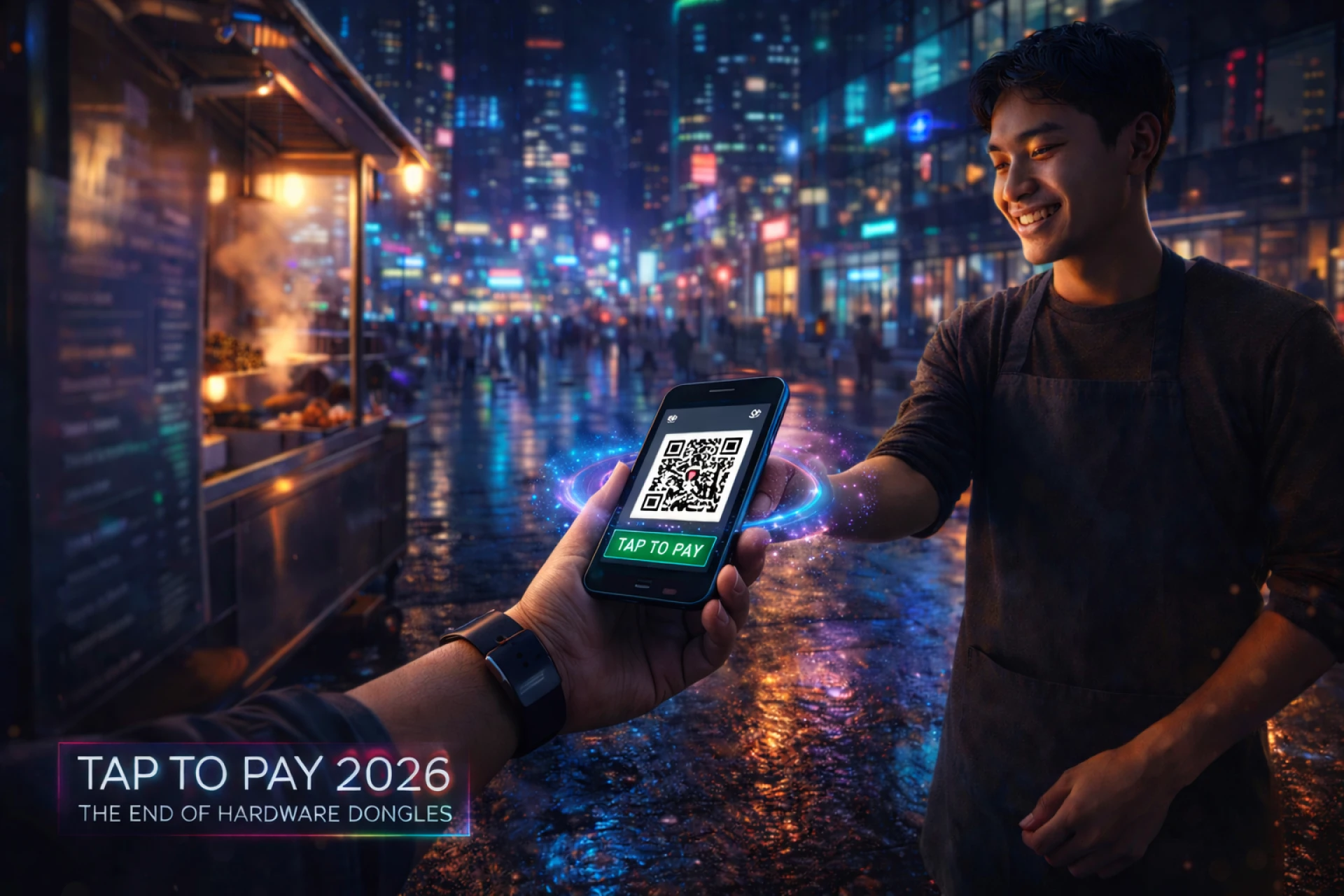

This guide explores the technical transition from external hardware to native "Tap to Pay" integration, detailing the implementation logic, security requirements, and operational hurdles for businesses adopting software-based payment acceptance in 2026.
The payment landscape in 2026 has moved decisively beyond the era of the "dongle." For over a decade, small businesses and mobile service providers relied on external card readers plugged into headphone jacks or connected via Bluetooth to bridge the gap between physical cards and digital processing.
Today, the standard has shifted to Tap to Pay (SoftPOS) technology. This allows standard consumer smartphones and tablets to function as fully compliant payment terminals using their native Near Field Communication (NFC) chips. For developers and business owners, this transition isn't just about convenience—it’s about reducing hardware failure points, lowering entry costs, and meeting the consumer expectation for "frictionless" checkout.
Current State of Contactless Acceptance (2026)
In 2026, the global adoption of digital wallets (Apple Pay, Google Wallet) and contactless EMV cards has reached a saturation point. Most consumers no longer carry physical "swipe" cards, making the magnetic stripe reader obsolete.
The primary shift has been the democratization of the NFC controller. Previously locked behind proprietary manufacturer walls, native APIs now allow third-party applications to securely access the NFC antenna to read encrypted payment data. This has birthed the "Phone-as-a-POS" movement, where the hardware cost of starting a retail business has dropped essentially to the price of a mid-range smartphone.
Core Implementation Framework
Implementing Tap to Pay directly on a device requires a sophisticated handshake between hardware, local software, and cloud-based payment gateways.
- NFC Initialization: The application invokes the device’s NFC controller to enter "reader mode." In 2026, this requires specific entitlements from OS providers (Apple or Google) to ensure the app is authorized to handle financial data.
- The APDU Exchange: The device and the card/phone perform an exchange of Application Protocol Data Units (APDUs). This is the "handshake" where the card proves its authenticity without revealing sensitive primary account numbers (PAN).
- Kernel Processing: The heavy lifting occurs in the "Contactless Kernel." This is software—either on-device or in the cloud—that manages the complex EMV specifications required to process the transaction.
- Tokenization & Authorization: The captured data is encrypted via a Secure Element (SE) or Trusted Execution Environment (TEE) on the device before being sent to the processor. The actual card data is never stored in the app’s local memory.
Real-World Application: The Service Industry
Imagine a mobile pet grooming service operating in a high-density urban area. Historically, they struggled with Bluetooth card readers losing connection in "dead zones" or batteries dying mid-shift.
By switching to native Tap to Pay, the groomer simply opens their booking app on an iPhone or Android device. The customer taps their smartwatch against the groomer's phone. Because the NFC chip is integrated into the device's main power supply and logic board, the failure rate of the "read" drops by approximately 15% compared to external hardware. Furthermore, businesses looking to scale their digital presence often integrate these payment capabilities during the initial stages of mobile app development in Michigan or other tech hubs, ensuring the payment flow is a core feature rather than a third-party afterthought.
AI Tools and Resources
Apple Tap to Pay / Android Google Pay API
- What it does: These are the foundational SDKs provided by the OS manufacturers.
- Why it’s useful: They provide the most direct, secure access to the NFC hardware and handle the low-level encryption required by PCI standards.
- Who should use it: Any developer building a native POS application.
Stripe Terminal (Server-Driven Integration)
- What it does: A cloud-based platform that manages the complexity of the EMV kernels.
- Why it’s useful: It allows you to implement Tap to Pay without writing your own payment kernel from scratch, which is a massive regulatory undertaking.
- Who should use it: Mid-to-large scale businesses that want a unified dashboard for online and in-person sales.
PCI MPoC Compliance Scanners
- What it does: Automated tools that check your app’s code against the Mobile Policy on COTS (Commercial Off-the-Shelf) requirements.
- Why it’s useful: Essential for ensuring your app won't be flagged or banned by payment networks for security vulnerabilities.
- Who should use it: Security officers and lead developers during the QA phase.
Risks, Trade-offs, and Limitations
While SoftPOS is revolutionary, it is not without constraints.
- Distance and Sensitivity: NFC has a maximum effective range of about 4cm. Unlike older Bluetooth readers that could be passed around, the consumer must bring their card/phone in very close proximity to the business's device, which can occasionally feel intrusive in personal service settings.
- Battery Drain: Constant NFC polling can drain a device's battery significantly faster than standard app usage.
- Hardware Limitations: Older devices (pre-2022) often have NFC chips that are not powerful enough or lack the necessary security certifications to handle modern EMV kernels.
Failure Scenario: A high-volume coffee shop attempts to use a single mid-range smartphone for "line-busting" during morning rushes. After 90 minutes of constant NFC activity, the device overheats and throttles the processor, causing the payment app to crash. The "warning sign" here is a noticeable lag in the UI or the device feeling hot to the touch. The alternative is using a dedicated "Ruggedized" smartphone designed for high-cycle thermal management.
Key Takeaways for 2026
- Hardware Independence: Transitioning to Tap to Pay removes the $50–$300 overhead of purchasing and maintaining external card readers.
- Security First: Software-based acceptance relies on "Attestation"—the device must prove to the payment network that its OS hasn't been tampered with (rooted or jailbroken) before it can accept a payment.
- Consumer Preference: By 2026, the "tap" is the default. Systems that require "insert" or "swipe" are increasingly viewed as high-friction and less secure by the general public.
- Unified Development: Modern payment integration happens at the API level, allowing businesses to sync their physical and digital inventories in real-time without manual reconciliation.
Would you like me to develop a specific technical integration guide for a particular OS, or perhaps create a comparison of the top SoftPOS providers available in 2026?


























Sign in to leave a comment.