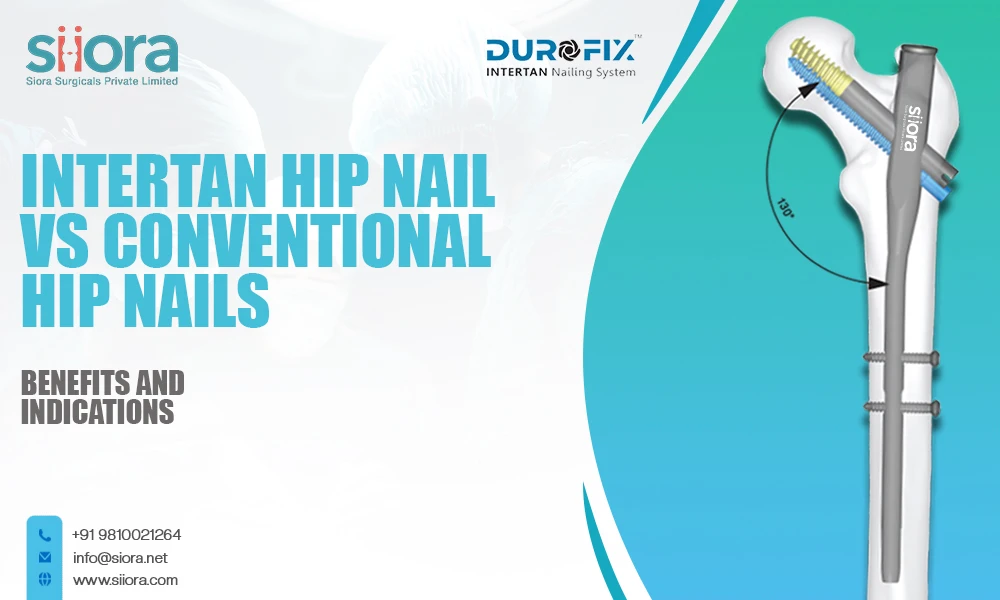

Hip fractures are some of the most frequent injuries treated in orthopedic practice, especially among older adults. As people live longer and osteoporosis becomes more common, the number of patients requiring surgical fixation for hip fractures has been rising sharply. The standard of care is surgical stabilization, and the choice of implant can make a major difference in healing and mobility. Two well-known options are conventional hip nails and the more recent Intertan hip nail. Each has its role, but their designs and benefits are not identical.
Conventional Hip Nails in Practice
For many years, intramedullary or cephalomedullary nails have been the go-to choice in hip fracture surgery. These nails usually have a single large screw or blade directed into the femoral head, connected to the main shaft of the nail. The system provides stability and helps patients regain mobility. In routine clinical practice, conventional nails are still widely used because they are versatile, cost-effective, and suitable for a broad range of fracture types.
However, they are not perfect. In unstable fractures, conventional nails may allow the screw to rotate or slide too much. This can result in the femoral head collapsing, the leg shortening, or the screw cutting out of the bone entirely. Surgeons often face these challenges when treating frail patients with soft, osteoporotic bone.
The Concept Behind Intertan Hip Nail
The Intertan nail was created to improve on some of these weaknesses. Instead of relying on one large screw, the Intertan design places two integrated screws into the femoral head, linked together in a way that locks rotationally. This dual-screw concept spreads out the mechanical forces more evenly and keeps the head of the femur from twisting.
Another feature is the way both screws can be compressed at the same time, allowing the fracture to close neatly while avoiding excessive collapse. This controlled stability encourages fracture healing and lowers the risk of limb shortening. In practice, the Intertan nail often performs better for unstable or complex fracture patterns, where old designs sometimes fall short.
Why Surgeons Prefer Intertan in Complex Fractures?
When looking at clinical outcomes, several real advantages set the Intertan nail apart:
- It offers much stronger rotational control of the femoral head compared with a single-screw nail.
- Rates of screw cut-out are noticeably lower, a complication that can be devastating for the patient.
- Because collapse is minimized, patients avoid significant leg shortening, which helps them regain a more natural walking pattern.
- In cases of osteoporotic bone, the extra fixation strength makes it more reliable.
- Patients can usually start bearing weight earlier, which is critical to prevent complications like chest infections, pressure sores, or muscle loss.
Indications for Using Intertan Hip Nail
Surgeons will usually choose the Intertan nail for:
- Unstable intertrochanteric fractures, where pieces of bone are comminuted.
- Reverse obliquity fractures, which tend to collapse if not controlled properly.
- Subtrochanteric extensions, where the fracture line extends lower than the classic intertrochanteric region.
- Osteoporotic or fragile bone, especially in elderly patients.
That being said, not all fractures require such an advanced implant. Standard nails still have a place. In stable fracture patterns with minimal fragmentation, a conventional nail often works well and avoids the added cost of newer systems.
Final Thoughts
When treating hip fractures, the surgeon’s choice of trauma implant is guided by the fracture type, the patient’s age, and bone quality. Conventional hip nails remain reliable for simpler, stable patterns, but when stability becomes questionable, the Intertan nail offers a safer mechanical design. Its twin-screw system reduces rotation, shortens healing time, and protects against complications seen with older nails. For patients, this often translates to standing and walking sooner and returning to independence faster.



























Sign in to leave a comment.